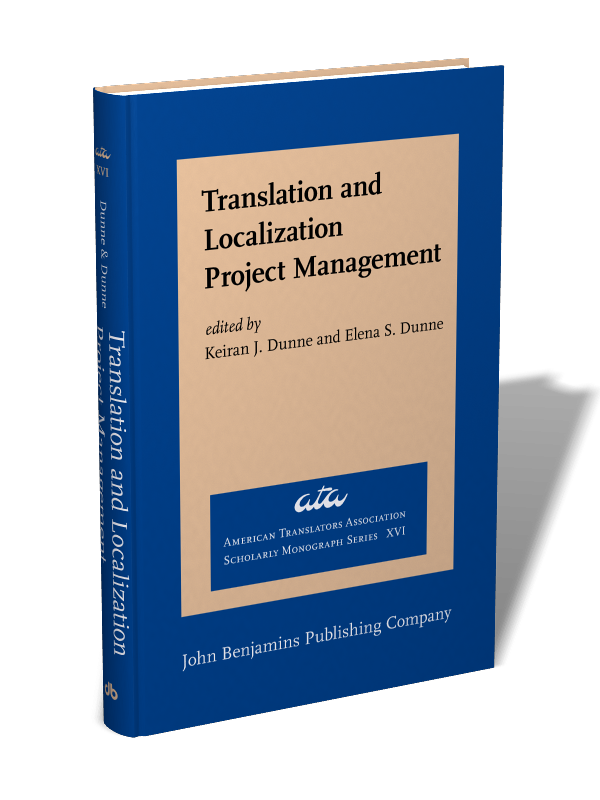
Translation and Localization Project Management
The art of the possible
Editors


Over the past three decades, translation has evolved from a profession practiced largely by individuals to a cottage industry model and finally to a formally recognized industrial sector that is project-based, heavily outsourced and that encompasses a wide range of services in addition to translation. As projects have grown in size, scope and complexity, and as project teams have become increasingly distributed across geographies, time zones, languages and cultures, formalized project management has emerged as both a business requirement and a critical success factor for language service providers. In recognition of these developments, this volume examines the application of project management concepts, tools and techniques to translation and localization projects. The contributors are seasoned practitioners and scholars who offer insights into the central role of project management in the language industry today and discuss best-practice approaches to the adaptation of generic project management knowledge, skills, tools and techniques for translation and localization projects.
[American Translators Association Scholarly Monograph Series, XVI] 2011. vi, 424 pp.
Publishing status: Available
© John Benjamins Publishing Company




Table of Contents
-
Mapping terra incognita: Project management in the discipline of translation studiesKeiran J. Dunne and Elena S. Dunne | pp. 1–14
-
I. Project management in the context of translation and localization business
-
Strategic views on localization project management: The importance of global product management and portfolio managementSalvatore Giammarresi | pp. 17–50
-
Selecting enterprise project management software: More than just a build-or-buy decision?Alain Chamsi | pp. 51–68
-
II. Project management knowledge areas
-
Applying PMI methodology to translation and localization projects: Project Integration ManagementAlexandra Zouncourides-Lull | pp. 71–94
-
Requirements collection: The foundation of scope definition and scope management in localization projectsNatalia Levitina | pp. 95–118
-
Managing the fourth dimension: Time and schedule in translation and localization projectsKeiran J. Dunne | pp. 119–152
-
From vicious to virtuous cycle: Customer-focused translation quality management using ISO 9001 principles and Agile methodologiesKeiran J. Dunne | pp. 153–188
-
Effective communication in translation and localization project managementNatalia Tsvetkov and Veronica Tsvetkov | pp. 189–210
-
Risk management in localizationMark Lammers | pp. 211–232
-
III. Managing human and organizational factors
-
Rethinking the role of the localization project managerRichard Sikes | pp. 235–264
-
Project as a learning environment: Scaffolding team learning in translation projectsElena S. Dunne | pp. 265–288
-
Global virtual teamsWillem Stoeller | pp. 289–318
-
Relationship management: A strategy for fostering localization successKaren Combe | pp. 319–346
-
IV. Translation and localization project management in action
-
Managing the challenges of game localizationPing Zhou | pp. 349–378
-
Project management for crowdsourced translation: How user-translated content projects work in real lifeDonald A. DePalma and Nataly Kelly | pp. 379–408
-
Additional resources | pp. 409–412
-
Contributors | pp. 413–416
-
Author index | pp. 417–420
-
Subject index | pp. 421–424
“
Translation and Localization Project Management: The art of the possible, edited by Keiran Dunne and Elena Dunne, is a comprehensive and long overdue collection of essays that cover the complex set of different skills required to succeed as a translation and localization project manager. [...] It constitutes the most comprehensive and most updated overview of PM available, and it will be essential reading for students, trainers and scholars working in this under-researched field.”
Miguel A. Jiménez-Crespo, Rutgers University, in Target Vol. 27:1 (2015)
“[...] the overarching thrust of this volume is not so much about discussing competing frameworks for project management in the language industry, but about how generic project management frameworks, as represented by the PMBOK, can be used and adapted in the context of translation and localization. [...] I definitely recommend this volume for scholars, practitioners, and students. It is accessible, well-written, and well-edited throughout. I see it as a solid contribution to the literature on applied translation studies. The volume has a solid introduction, a clear organization, and the topics and authors chosen represent some of the more important scholars and practitioners in the industry.”
Gregory M. Shreve, Kent State University, Multilingua, Vol. 32:3 (2014)
“The articles, written by respected industry experts, provide valuable information both of the general project management techniques documented in the PMBOK and of localization-specific issues related to project management. This information would be extremely useful to any novel localization project manager.”
Aram Morera Mesa, University of Limerick, in Machine Translation, Vol. 27 (2013)
Cited by
Cited by 18 other publications
Ciobanu, Dragoș
2016. Automatic Speech Recognition in the professional translation process. Translation Spaces 5:1 ► pp. 124 ff. 

Ciobanu, Dragoș
2018. Collaborative Student Translation Projects. In Multilingual Writing and Pedagogical Cooperation in Virtual Learning Environments [Advances in Linguistics and Communication Studies, ], ► pp. 222 ff.
del Mar Sánchez Ramos, María
2019. Mapping new translation practices into translation training. Babel. Revue internationale de la traduction / International Journal of Translation 65:5 ► pp. 615 ff.
Heinisch, Barbara
2021. The Role of Translation in Citizen Science to Foster Social Innovation. Frontiers in Sociology 6
Iacono, Katia & Barbara Heinisch
2022. Übersetzer*innenplattformen als Auftragsmanagementtools – Implikationen für die Translationsdidaktik. In Translation im Wandel: Gesellschaftliche, konzeptuelle und didaktische Perspektiven [TRANSÜD. Arbeiten zur Theorie und Praxis des Übersetzens und Dolmetschens, ], ► pp. 159 ff.
Konttinen, Kalle, Outi Veivo & Pia Salo
2020. Translation students’ conceptions of translation workflow in a simulated translation company environment. The Interpreter and Translator Trainer 14:1 ► pp. 79 ff.
Maumevičienė, Dainora
2018. Communication of Cultures by Means of Localisation. In Readings in Numanities [Numanities - Arts and Humanities in Progress, 3], ► pp. 209 ff.
Mitchell-Schuitevoerder, Rosemary
2020. Computer-aided translation tools and translation project management. In A Project-Based Approach to Translation Technology, ► pp. 1 ff.
Olohan, Maeve & Elena Davitti
2017. Dynamics of Trusting in Translation Project Management: Leaps of Faith and Balancing Acts. Journal of Contemporary Ethnography 46:4 ► pp. 391 ff.
Plaza-Lara, Cristina
2018. Las competencias del gestor de proyectos de traducción: análisis de un corpus de anuncios de trabajo. Meta 63:2 ► pp. 510 ff.
Plaza-Lara, Cristina
2022. Competences of translation project managers from the academic perspective: analysis of EMT programmes. The Interpreter and Translator Trainer 16:2 ► pp. 203 ff.
Sakamoto, Akiko & Melanie Foedisch
Santaemilia-Ruiz, José & Sergio Maruenda-Bataller
2017. On the institutional dimensions of specialised translation in Spain. Revista Española de Lingüística Aplicada/Spanish Journal of Applied Linguistics 30:2 ► pp. 429 ff.
Sawyer, David B., Frank Austermühl & Vanessa Enríquez Raído
2019. The evolving curriculum in interpreter and translator education. In The Evolving Curriculum in Interpreter and Translator Education [American Translators Association Scholarly Monograph Series, XIX], ► pp. 1 ff.
Sayaheen, Bilal & Ibrahim Darwish
2023. Localising INGOs websites into Arabic: A case study of IFRC. Lebende Sprachen 68:1 ► pp. 96 ff.
Schäler, Reinhard
2012. Internationalization and Localization. In The Encyclopedia of Applied Linguistics,
Torres del Rey, Jesús
2019. The proper place of localization in translation curricula. In The Evolving Curriculum in Interpreter and Translator Education [American Translators Association Scholarly Monograph Series, XIX], ► pp. 229 ff.
Zanoletti, Margherita
2023. Review of Walker (2023): Translation Project Management. Babel. Revue internationale de la traduction / International Journal of Translation / Revista Internacional de Traducción
This list is based on CrossRef data as of 12 april 2024. Please note that it may not be complete. Sources presented here have been supplied by the respective publishers. Any errors therein should be reported to them.
Subjects
Translation & Interpreting Studies
Main BIC Subject
CFP: Translation & interpretation
Main BISAC Subject
LAN023000: LANGUAGE ARTS & DISCIPLINES / Translating & Interpreting