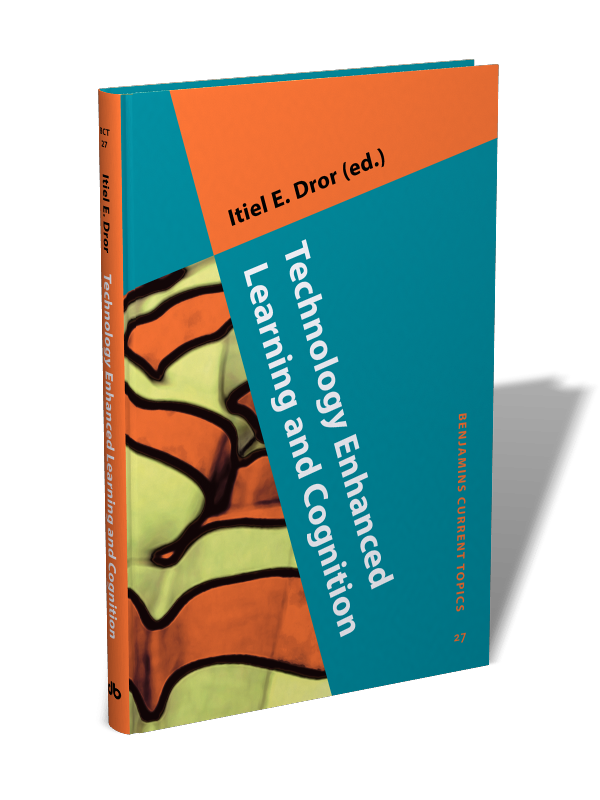
Technology Enhanced Learning and Cognition


E-learning must be 'brain friendly', so it optimizes learning to the cognitive architecture of the learners. If technology enhanced learning promotes the formation of effective mental representations and works with the human cognitive system, then the learners will not only be able to acquire information more efficiently, but they will also remember it better and use it. Technology should not be the driving force in shaping e-learning, but rather how that technology can better serve the cognitive system.
This volume, originally published as a special issue of Pragmatics & Cognition 16:2 (2008) and partly in Pragmatics & Cognition 17:1 (2009), explores the research frontiers in cognition and learning technology. It provides important theoretical insights into these issues, as well as very practical implications of how to make e-learning more brain friendly and effective.




Table of Contents
-
About the authors | pp. vii–ix
-
Brain friendly technology: What is it? And why do we need it?Itiel E. Dror | pp. 1–7
-
Fostering general transfer with specific simulationsJi Y. Son and Robert L. Goldstone | pp. 8–50
-
Attention management for dynamic and adaptive scaffoldingInge Molenaar and Claudia Roda | pp. 51–96
-
Social, usability, and pedagogical factors influencing students' learning experiences with wikis and blogsShailey Minocha and Dave Roberts | pp. 97–131
-
Software-realized inquiry support for cultivating a disciplinary stanceIris Tabak and Brian J. Reiser | pp. 133–181
-
Perceptual learning and the technology of expertise: Studies in fraction learning and algebraPhilip J. Kellman, Christine Massey, Zipora Roth, Timothy Burke, Joel Zucker, Amanda Saw, Katherine E. Aguero and Joseph A. Wise | pp. 183–231
-
On foundations of technological support for addressing challenges facing design-based science learningSwaroop S. Vattam and Janet L. Kolodner | pp. 233–263
-
Index | p. 264
Cited by
Cited by 5 other publications

This list is based on CrossRef data as of 12 april 2024. Please note that it may not be complete. Sources presented here have been supplied by the respective publishers. Any errors therein should be reported to them.