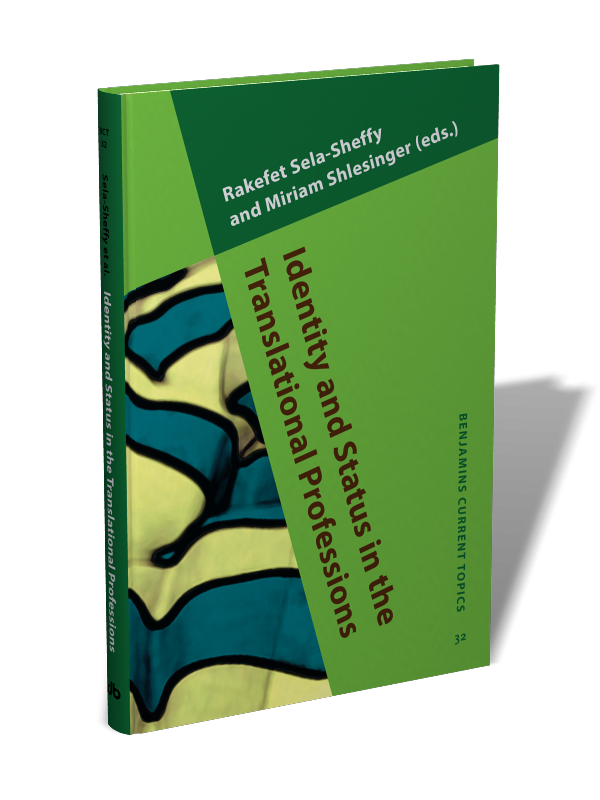
Identity and Status in the Translational Professions
Editors

This volume contributes to the emerging research on the social formation of translators and interpreters as specific occupational groups. Despite the rising academic interest in sociological perspectives in Translation Studies, relatively little research has so far been devoted to translators’ social background, status struggles and sense of self. The articles assembled here zoom in on the “groups of individuals” who perform the complex translating and/or interpreting tasks, thereby creating their own space of cultural production. Cutting across varied translatorial and geographical arenas, they reflect a view of the interrelatedness between the macro-level question of professional status and micro-level aspects of practitioners’ identity. Addressing central theoretical issues relating to translators’ habitus and role perception, as well as methodological challenges of using qualitative and quantitative measures, this endeavor also contributes to the critical discourse on translators’ agency and ethics and to questions of reformulating their social role.The contributions to this volume were originally published in Translation and Interpreting Studies 4:2 (2009) and 5:1 (2010).
[Benjamins Current Topics, 32] 2011. xiii, 282 pp.
Publishing status: Available
© John Benjamins Publishing Company




Table of Contents
-
Preface | pp. vii–xiv
-
Introduction | pp. 1–10
-
Legal and translational occupations in Spain: Regulation and specialization in jurisdictional strugglesEsther Monzó-Nebot | pp. 11–30
-
Effectiveness of translator certification as a signaling device: Views from the translator recruitersAndy Lung Jan Chan | pp. 31–48
-
Conference interpreting: Surveying the professionFranz Pöchhacker | pp. 49–64
-
Occupation or profession: A survey of the translators' worldDavid Katan | pp. 65–88
-
Attitudes to role, status and professional identity in interpreters and translators with Chinese in Shanghai and TaipeiRobin Setton and Alice Guo Liangliang | pp. 89–118
-
Conference interpreters and their self-representation: A worldwide webbased surveyCornelia Zwischenberger | pp. 119–134
-
Habitus and self-image of native literary author-translators in diglossic societiesReine Meylaerts | pp. 135–154
-
The people behind the words: Professional profiles and activity patterns of translators of Arabic literature into Hebrew (1896–2009)Hannah Amit-Kochavi | pp. 155–172
-
Revised translations, revised identities: (Auto)biographical contextualization of translationElena Baibikov | pp. 173–188
-
Conference interpreters and their perception of culture: From the narratives of Japanese pioneersKumiko Torikai | pp. 189–208
-
Images of the court interpreter: Professional identity, role definition and self-imageRuth Morris | pp. 209–230
-
A professional ideology in the making: Bilingual youngsters interpreting for their communities and the notion of (no) choiceClaudia V. Angelelli | pp. 231–246
-
"Boundary work" as a concept for studying professionalization processes in the interpreting fieldNadja Grbić | pp. 247–262
-
The task of the interpreter in the struggle of the other for empowerment: Mythical utopia or sine qua non of professionalism?Şebnem Bahadır | pp. 263–278
-
Index | pp. 279–282
“The contributions in this carefully edited and eminently readable volume
(with an excellent and useful index) present a wealth of empirical
material as well as a great deal of stimulating conceptual work. The
volume is indispensable
reading for Translation Studies scholars interested in the sociology of
professions and it offers a number of insights with respect to the
sociology of translation in general. It is, moreover, highly recommended
to anyone trying to keep up with
the not-so-mechanic mechanisms and driving forces underlying
differentiation processes within our field of study and the “effets de
théorie” (Bourdieu 1981) informing them.”
(with an excellent and useful index) present a wealth of empirical
material as well as a great deal of stimulating conceptual work. The
volume is indispensable
reading for Translation Studies scholars interested in the sociology of
professions and it offers a number of insights with respect to the
sociology of translation in general. It is, moreover, highly recommended
to anyone trying to keep up with
the not-so-mechanic mechanisms and driving forces underlying
differentiation processes within our field of study and the “effets de
théorie” (Bourdieu 1981) informing them.”
Gisella M. Vorderobermeier, University of Graz, Target 26:2 (2014)
Cited by
Cited by 29 other publications
Angelelli, Claudia V.
2018. Translation and Interpreting. In The Palgrave Handbook of Applied Linguistics Research Methodology, ► pp. 761 ff. 

Bednárová-Gibová, Klaudia & Branislav Madoš
2019. Investigating Translators’ Work-related Happiness: Slovak Sworn and Institutional Translators as a Case in Point. Meta 64:1 ► pp. 215 ff.
Bednárová-Gibová, Klaudia & Mária Majherová
2021. Academic literary translators: a happy ‘elite’ or not?. The Translator 27:2 ► pp. 167 ff.
Davier, Lucile
Haualand, Hilde
2023. Licence to inform: Norwegian sign language interpreters in a bureaucratic organisation. Interpreting and Society 3:1 ► pp. 6 ff.
Heiss, Sarah N., Kristin K. Smith & Heather J. Carmack
2018. Waging a professional turf war: an examination of professionalization as a strategic communication practice used by registered dietitians. Qualitative Research in Medicine and Healthcare 2:3
Hlavac, Jim
2017. Brokers, dual-role mediators and professional interpreters: a discourse-based examination of mediated speech and the roles that linguistic mediators enact. The Translator 23:2 ► pp. 197 ff.
Hong, Sulyoung & Eunah Choi
2020. Struggling for professional identity. Babel. Revue internationale de la traduction / International Journal of Translation 66:4-5 ► pp. 674 ff.
Hoyte-West, Antony
2020. The professional status of conference interpreters in the Republic of Ireland: An exploratory study. Translation Studies 13:2 ► pp. 183 ff.
Im, Sei-inn & Hyang-Ok Lim
2019. Where do we stand?. FORUM. Revue internationale d’interprétation et de traduction / International Journal of Interpretation and Translation 17:2 ► pp. 192 ff.
Kafi, Mohsen, Masood Khoshsaligheh & Mohammad Reza Hashemi
2018. Translation profession in Iran: current challenges and future prospects. The Translator 24:1 ► pp. 89 ff.
Kaindl, Klaus
2021. (Literary) Translator Studies. In Literary Translator Studies [Benjamins Translation Library, 156], ► pp. 1 ff.
Kara, Hanna & Camilla Nordberg
2023. Configuring public service interpreting in Finland as a sentient professional practice and affirmative social service work: emotion in the work of public service interpreters. Nordic Social Work Research 13:4 ► pp. 563 ff.
Lee, Juyeon
2020. Professional identity development among student interpreters. FORUM. Revue internationale d’interprétation et de traduction / International Journal of Interpretation and Translation 18:2 ► pp. 179 ff.
Martín Ruano, M. Rosario
2015. (Trans)formative theorising in legal translation and/or interpreting: a critical approach to deontological principles. The Interpreter and Translator Trainer 9:2 ► pp. 141 ff.
Ní Fhrighil, Rióna, Anne O’Connor & Michelle Milan
2020. Translation in Ireland: Historical and contemporary perspectives. Translation Studies 13:2 ► pp. 129 ff.
Orlando, Daniele & Mitja Gialuz
2017. From academia to courtroom: Perception of and expectations from the legal translator’s role
. International Journal of Legal Discourse 2:2 ► pp. 195 ff.
Risku, Hanna, Regina Rogl & Jelena Milosevic
Risku, Hanna, Regina Rogl & Jelena Milosevic
2019. Translation practice in the field: Current research on socio-cognitive processes. In Translation Practice in the Field [Benjamins Current Topics, 105], ► pp. 1 ff.
Roig-Sanz, Diana & Reine Meylaerts
2018. General Introduction. Literary Translation and Cultural Mediators. Toward an Agent and Process-Oriented Approach. In Literary Translation and Cultural Mediators in 'Peripheral' Cultures, ► pp. 1 ff.
Sapiro, Gisèle
2014. The Sociology of Translation: A New Research Domain. In A Companion to Translation Studies, ► pp. 82 ff.
Sapiro, Gisèle
2016. Translation and Identity: Social Trajectories of the Translators of Hebrew Literature in French1. TTR 26:2 ► pp. 59 ff.
SEÇKİN, Sevcan
2021. Serbest çevirmenlerin Türkiye çeviri sektöründe yaşadığı zorluklar. RumeliDE Dil ve Edebiyat Araştırmaları Dergisi :23 ► pp. 1128 ff.
Tryuk, Małgorzata
2017. Le traducteur et l’interprète dans la littérature et le film. Między Oryginałem a Przekładem 23:2 (36) ► pp. 97 ff.
Tyulenev, Sergey
2015. Towards theorising translation as an occupation. Asia Pacific Translation and Intercultural Studies 2:1 ► pp. 15 ff.
Tyulenev, Sergey, Binghan Zheng & Penelope Johnson
2017. A comparative study of translation or interpreting as a profession in Russia, China and Spain. Translation and Interpreting Studies 12:2 ► pp. 332 ff.
Villanueva Jordán, Iván, Fiorella Hermoza Vega & Monica Bravo Diaz
2017. Experiencias profesionales y percepciones sobre la subtitulación interlingüística en Lima, Perú. Mutatis Mutandis. Revista Latinoamericana de Traducción 10:2 ► pp. 123 ff.
Zaradez, Noam, Rakefet Sela-Sheffy & Tali Tal
2020. The identity work of environmental education teachers in Israel. Environmental Education Research 26:6 ► pp. 812 ff.
Zwischenberger, Cornelia, Karin Reithofer & Sylvi Rennert
2023. Introducing new hypertexts on Interpreting (Studies). In Introducing New Hypertexts on Interpreting (Studies) [Benjamins Translation Library, 160], ► pp. 1 ff.
This list is based on CrossRef data as of 12 april 2024. Please note that it may not be complete. Sources presented here have been supplied by the respective publishers. Any errors therein should be reported to them.
Subjects
Translation & Interpreting Studies
Main BIC Subject
CFP: Translation & interpretation
Main BISAC Subject
LAN023000: LANGUAGE ARTS & DISCIPLINES / Translating & Interpreting