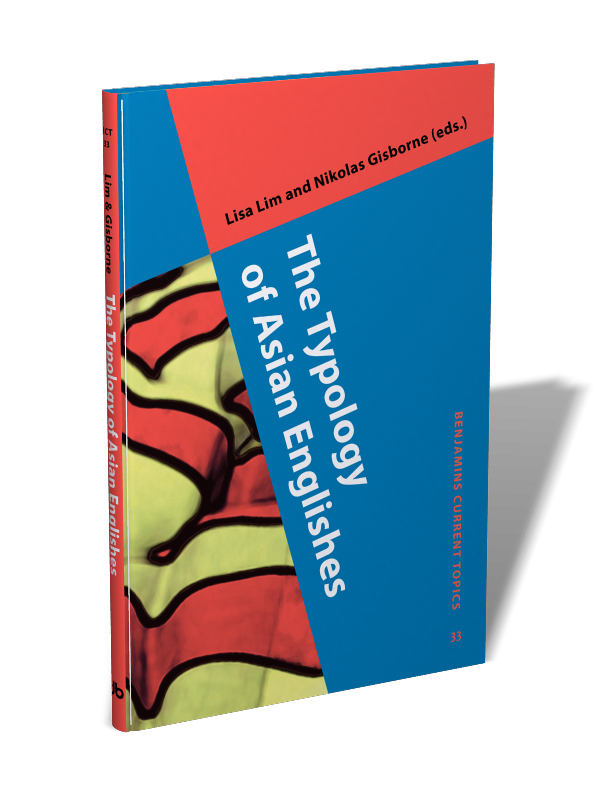
The Typology of Asian Englishes
Editors

When considering the structure of New Englishes which have evolved in – multilingual, mostly post-colonial – contexts of Asia (thus, Asian Englishes), the significant factors to be considered are: 1) the variety/ies of the English lexifier that entered the local context; 2) the nature of transmission of English to the local population; and 3) the local, i.e. substrate, languages of the community in which the New English emerges. This third factor is the focus of the five papers in this volume: they investigate the structure of Asian varieties of English by exploring the relationship between the typological profile of substrate languages in the specific linguistic ecology and the grammatical features of the emerging contact variety of English.The contributions to this volume were originally published in English World-Wide 30:2 (2009).
[Benjamins Current Topics, 33] 2011. vii, 120 pp.
Publishing status: Available
© John Benjamins Publishing Company




Table of Contents
-
Acknowledgments | pp. vii–viii
-
The typology of Asian Englishes: Setting the agendaLisa Lim and Nikolas Gisborne | pp. 1–10
-
The Asian typology of English: Theoretical and methodological considerationsUmberto Ansaldo | pp. 11–26
-
Aspects of the morphosyntactic typology of Hong Kong EnglishNikolas Gisborne | pp. 27–48
-
Typological diversity in New EnglishesDevyani Sharma | pp. 49–74
-
Thai English: Rhythm and vowelsPriyankoo Sarmah, Divya Verma Gogoi and Caroline R. Wiltshire | pp. 75–96
-
Revisiting English prosody: (Some) New Englishes as tone languages?Lisa Lim | pp. 97–118
-
Index | p. 119
Cited by
Cited by 4 other publications
Calle-Martín, Javier & Jesús Romero-Barranco
2017. Third person present tense markers in some varieties of English. English World-Wide. A Journal of Varieties of English 38:1 ► pp. 77 ff. 

Lim, Lisa
2014. Yesterday’s founder population, today’s Englishes. In The Evolution of Englishes [Varieties of English Around the World, G49], ► pp. 401 ff.
SCHNEIDER, EDGAR W.
2016. Hybrid Englishes: An exploratory survey. World Englishes 35:3 ► pp. 339 ff.
[no author supplied]
2012. PUBLICATIONS RECEIVED. English Language and Linguistics 16:2 ► pp. 339 ff.
This list is based on CrossRef data as of 12 april 2024. Please note that it may not be complete. Sources presented here have been supplied by the respective publishers. Any errors therein should be reported to them.
Subjects
Main BIC Subject
CFK: Grammar, syntax
Main BISAC Subject
LAN009000: LANGUAGE ARTS & DISCIPLINES / Linguistics / General