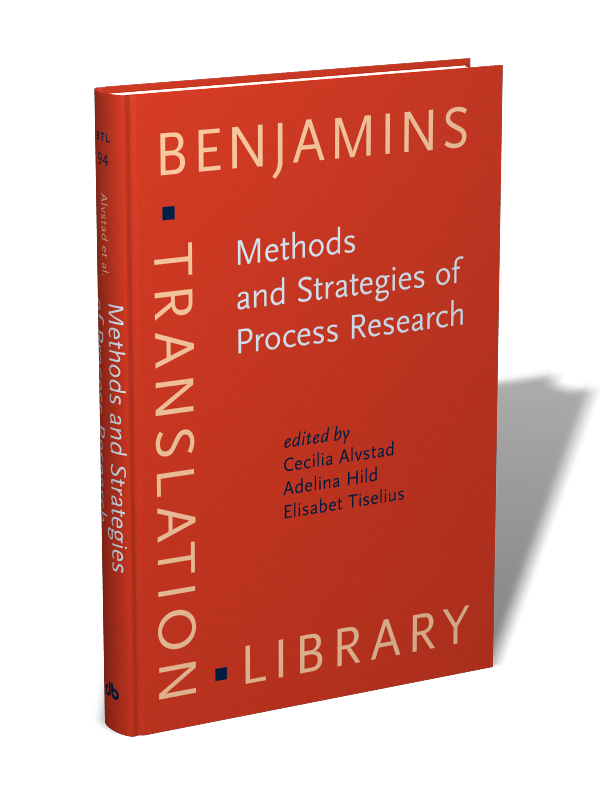
Methods and Strategies of Process Research
Integrative approaches in Translation Studies
Editors


The volume includes contributions on the cognitive processes underlying translation and interpreting, which represent innovative research with a methodological and empirical orientation. The methodological section offers an assessment/validation of different time lag measures; discusses the challenges of interpreting keystroke and eye-tracking data in translation, and triangulating disfluency analysis and eye-tracking data in sight translation research. The remainder of the volume features empirical studies on such topics as: metaphor comprehension; audience perception in subtitling research; translation and meta-linguistic awareness; effect of language-pair specific factors on interpreting quality. A special section is dedicated to expertise studies which look at the link between problem analysis and meta-knowledge in experienced translators; the effects of linguistic complexity on expert interpreting; strategic processing and tacit knowledge in professional interpreting.
The volume celebrates the work of Birgitta Englund Dimitrova and her contribution to the development of process-oriented research.
The volume celebrates the work of Birgitta Englund Dimitrova and her contribution to the development of process-oriented research.
[Benjamins Translation Library, 94] 2011. xii, 377 pp.
Publishing status: Available
© John Benjamins Publishing Company




Table of Contents
-
Foreword | pp. xi–xii
-
Methods and strategies of process research: Integrative approaches in Translation StudiesCecilia Alvstad, Adelina Hild and Elisabet Tiselius | pp. 1–9
-
Part I. Conceptual and methodological discussions
-
Interpreting in theory and practice: Reflections about an alleged gapCecilia Wadensjö | pp. 13–21
-
Reflections on the literal translation hypothesisAndrew Chesterman | pp. 23–35
-
Tracking translators’ keystrokes and eye movements with TranslogArnt Lykke Jakobsen | pp. 37–55
-
Seeing translation from inside the translator’s mindBrian Mossop | pp. 57–66
-
Metonymic language use as a student translation problem: Towards a controlled psycholinguistic investigationSonia Vandepitte and Robert J. Hartsuiker | pp. 67–92
-
Sight translation and speech disfluency: Performance analysis as a window to cognitive translation processesGregory M. Shreve, Isabel Lacruz and Erik Angelone | pp. 93–120
-
Time lag in translation and interpreting: A methodological explorationŠárka Timarová, Barbara Dragsted and Inge Gorm Hansen | pp. 121–146
-
Part II. Process research in interpreting and translation
-
A new pair of glasses: Translation skills in secondary schoolMiriam Shlesinger and Ruth Almog | pp. 149–168
-
Are primary conceptual metaphors easier to understand than complex conceptual metaphors? An investigation of the cognitive processes in metaphor comprehensionAntin Fougner Rydning and Christian Lachaud | pp. 169–186
-
Innovative subtitling: A reception studyAlexander Künzli and Maureen Ehrensberger-Dow | pp. 187–200
-
Errors, omissions and infelicities in broadcast interpreting: Preliminary findings from a case studyDaniel Gile | pp. 201–218
-
On cognitive processes during wordplay translation: Students translating adversarial humorUlf Norberg | pp. 219–229
-
“Can you ask her about chronic illnesses, diabetes and all that?”Claudia V. Angelelli | pp. 231–246
-
Part III. Studies of interpreting and translation expertise
-
Effects of linguistic complexity on expert processing during simultaneous interpretingAdelina Hild | pp. 249–267
-
Process and product in simultaneous interpreting: What they tell us about experience and expertiseElisabet Tiselius and Gard B. Jenset | pp. 269–300
-
Developing professional thinking and acting within the field of interpretingGun-Viol Vik-Tuovinen | pp. 301–315
-
Results of the validation of the PACTE translation competence model: Translation problems and translation competenceAllison Beeby, Mònica Fernández, Olivia Fox, Amparo Hurtado Albir, Anna Kuznik, Wilhelm Neunzig, Patricia Rodríguez Inés, Lupe Romero and Stefanie Wimmer | pp. 317–343
-
“This led me to start thinking about how this happened, and what the process behind it would be”: An interview with Professor Birgitta Englund DimitrovaElisabet Tiselius | pp. 345–359
-
Publications by Birgitta Englund Dimitrova | pp. 361–366
-
Notes on contributors | pp. 367–371
-
Index | pp. 373–377
“The volume comprises an impressive overview of and well-founded insights into current translation and interpreting process research and methodologies, with a particular and welcome emphasis on empirical studies. It should prove very valuable indeed for all who wish to understand and research the cognitive processes of translating and interpreting.”
Anne Schjoldager, Aarhus University
“There’s no greater tribute to the importance of Birgitta Englund Dimitrova’s work than this long-overdue, state-of-the-art collection of papers from scholars around the world who have been seminal in the development of process studies and observational approaches to translation and interpretation. It’s a must read for anyone interested in understanding or doing descriptive research in our field.”
Candace Séguinot, York University
“This collection of papers is at the same time a testimony to the significance of Professor Englund Dimitrova’s work as a translation process researcher and teacher and a snapshot of state-of-the-art methodological development and critique within this area of translation and interpreting research. The success in combining these two objectives is a considerable achievement on the part of the editors.”
Sandra L. Halverson, University of Bergen
“[...] the editors should be applauded for their effort in publishing this rich collection of papers that are of interest to all those who want to investigate the cognitive processes that influence translation behaviour. It offers fine illustrations of the wealth of innovative techniques that have become available in recent years to study the nature of cognitive processes when translating. The editors have succeeded in safeguarding the link with process research throughout the book, and the diverse selection of topics and methods renders the book suitable for those entering the discipline as students as well as for established scholars. In a time when translation studies is not yet recognized as an autonomous discipline in most countries (as deplored by Professor Englund Dimitrova herself in the interview that constitutes the book’s closing chapter, p. 358), this volume is much needed and will surely add to the field’s significance with its thorough investigation of what can be considered the psycholinguistic division of the domain of translation studies.”
June Eyckmans, Universiteit Gent, in Applied Linguistics, 30/11/2012. Pages 624-626
“
Methods and Strategies of Process Research presents the latest empirical findings in process-oriented research by influential translation and interpreting scholars from twelve countries. Its innovative methodology and extensive research scope make the volume highly relevant to students and researchers and encourage them to build on them in their own further investigations. It should be acknowledged that process-oriented research has gained considerable momentum and can be expected to become a subdiscipline in its own right within the wider framework of translation studies. Generally speaking, the volume has fulfilled its purpose of elaborating on methods and strategies of process research through different approaches. It is a must-read for anyone interested in this field.”
Lisheng Liu, Xuchang University, in Target Vol. 28:3 (2016)
Cited by
Cited by 31 other publications
Alves, Fabio
2015. Translation process research at the interface. In Psycholinguistic and Cognitive Inquiries into Translation and Interpreting [Benjamins Translation Library, 115], ► pp. 17 ff. 

Alves, Fabio & Igor A. Lourenço da Silva
2021. Bridging Paradigms to Approach Expertise in Cognitive Translation Studies. In Advances in Cognitive Translation Studies [New Frontiers in Translation Studies, ], ► pp. 89 ff.
Angelone, Erik
2018. Chapter 2. Reconceptualizing problems in translation using triangulated process and product data. In Innovation and Expansion in Translation Process Research [American Translators Association Scholarly Monograph Series, XVIII], ► pp. 17 ff.
Angelone, Erik & Álvaro Marín García
2019. Expertise acquisition through deliberate practice. In Translation Practice in the Field [Benjamins Current Topics, 105], ► pp. 123 ff.
Angelone, Erik & Álvaro Marín García
Arumí Ribas, Marta
2018. La interpretación dialógica como práctica estratégica. Análisis de la toma de decisiones de cinco intérpretes en los Servicios Públicos. Meta 63:1 ► pp. 118 ff.
Beeby, Allison, L. Castillo, Olivia Fox, A. Galán Mañas, Amparo Hurtado Albir, Anna Kuznik, Gisela Massana, Wilhelm Neunzig, Ch. Olalla, Patricia Rodríguez Inés & Lupe Romero
2015. Results of PACTE’s Experimental Research on the Acquisition of Translation Competence. Translation Spaces 4:1 ► pp. 29 ff.
Borg, Claudine
2019. Written alternative translation solutions in the translation process. Translation, Cognition & Behavior 2:1 ► pp. 55 ff.
Chen, Sijia
2020. The process of note-taking in consecutive interpreting. Interpreting. International Journal of Research and Practice in Interpreting 22:1 ► pp. 117 ff.
Chesterman, Andrew
2012. Models in Translation Studies. In Handbook of Translation Studies [Handbook of Translation Studies, 3], ► pp. 108 ff.
da Silva, Igor A. L.
2020. Translation, expert performance and cognition. In The Routledge Handbook of Translation and Cognition, ► pp. 461 ff.
Deckert, Mikołaj
2017. Asymmetry and automaticity in translation. Translation and Interpreting Studies 12:3 ► pp. 469 ff.
Deckert, Mikołaj
2017. Translation and Cognition: Cases of Asymmetry. An Editorial. Research in Language 15:2 ► pp. 119 ff.
Ferreira, Aline, John W. Schwieter & Daniel Gile
2015. The position of psycholinguistic and cognitive science in translation and interpreting. In Psycholinguistic and Cognitive Inquiries into Translation and Interpreting [Benjamins Translation Library, 115], ► pp. 3 ff.
Hubscher-Davidson, Séverine
2014. Emotional Intelligence and Translation Studies: A New Bridge. Meta 58:2 ► pp. 324 ff.
Hurtado Albir, Amparo & Paul Taylor
2015. The Acquisition of Translation Competence. Competences, Tasks, and Assessment in Translator Training. Meta 60:2 ► pp. 256 ff.
Inoue, Izumi & Christopher N. Candlin
2015. Applying Task-Based Learning to translator education. Translation and Interpreting Studies 10:1 ► pp. 58 ff.
Inoue, Izumi & Christopher N. Candlin
2017. Applying Task-Based Learning to translator education. In Translation and Interpreting Pedagogy in Dialogue with Other Disciplines [Benjamins Current Topics, 90], ► pp. 55 ff.
Jakobsen, Arnt Lykke
2017. Translation Process Research. In The Handbook of Translation and Cognition, ► pp. 19 ff.
Jääskeläinen, Riitta
2012. Translation psychology. In Handbook of Translation Studies [Handbook of Translation Studies, 3], ► pp. 191 ff.
Kolb, Waltraud
2021. Chapter 5. “Hemingway’s priorities were just different”. In Literary Translator Studies [Benjamins Translation Library, 156], ► pp. 107 ff.
Kruger, Haidee
2013. Child and adult readers’ processing of foreign elements in translated South African picturebooks. Target. International Journal of Translation Studies 25:2 ► pp. 180 ff.
Li, Xiangdong
2015. Putting interpreting strategies in their place. Babel. Revue internationale de la traduction / International Journal of Translation 61:2 ► pp. 170 ff.
Schaeffer, Moritz, Kevin B. Paterson, Victoria A. McGowan, Sarah J. White & Kirsten Malmkjaer
2017. Chapter 1. Reading for translation. In Translation in Transition [Benjamins Translation Library, 133], ► pp. 18 ff.
Shorofi, Mahboubeh, Mohammad Saleh Sanatifar & Mansoor Tavakoli
2020. The impact of Group Dynamic Assessment on the development of translation bilingual sub-competence. FORUM. Revue internationale d’interprétation et de traduction / International Journal of Interpretation and Translation 18:2 ► pp. 197 ff.
Su, Wei
2017. Ehrensberger-Dow, Maureen, Susanne Göpferich & Sharon O’Brien, eds. 2015. Interdisciplinarity in Translation and Interpreting Process Research. Target. International Journal of Translation Studies 29:1 ► pp. 168 ff.
Su, Wenchao & Defeng Li
2019. Identifying translation problems in English-Chinese sight translation. Translation and Interpreting Studies 14:1 ► pp. 110 ff.
Sun, Sanjun, Ricardo Muñoz Martín & Defeng Li
2021. Introduction: One More Step Forward—Cognitive Translation Studies at the Start of a New Decade. In Advances in Cognitive Translation Studies [New Frontiers in Translation Studies, ], ► pp. 1 ff.
Whyatt, Bogusława, Marta Kajzer-Wietrzny & Katarzyna Stachowiak
2017. Chapter 5. Intralingual and interlingual translation. In Translation in Transition [Benjamins Translation Library, 133], ► pp. 136 ff.
[no author supplied]
[no author supplied]
This list is based on CrossRef data as of 15 april 2024. Please note that it may not be complete. Sources presented here have been supplied by the respective publishers. Any errors therein should be reported to them.
Subjects
Translation & Interpreting Studies
Main BIC Subject
CFP: Translation & interpretation
Main BISAC Subject
LAN023000: LANGUAGE ARTS & DISCIPLINES / Translating & Interpreting