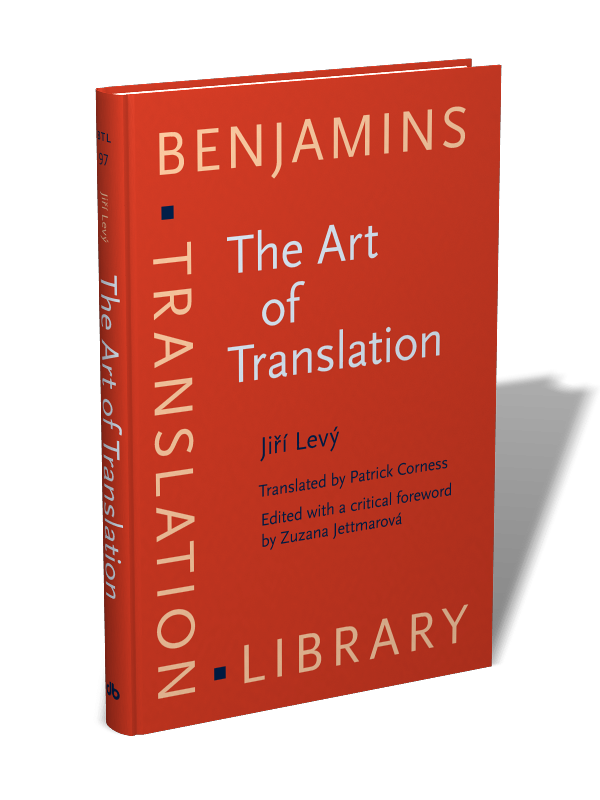
The Art of Translation
Author
Translator
Editor and foreword author

Jiří Levý’s seminal work, The Art of Translation, considered a timeless classic in Translation Studies, is now available in English. Having drawn on adjacent disciplines, the methodology of Czech functional sociosemiotic structuralism and the state-of-the art in the West, Levý synthesized his findings and experience in the field presenting them in a reader-friendly book, which combines the approaches of a theoretician, systemic analyst, historian, critic, teacher, practitioner and populariser. Although focused on literary translation from theoretical, descriptive and historical perspectives, it presents a conceptualization of a general theory, addressing a number of issues discussed today. The ‘practical’ mission of the book as a theory extending to practice is based on the same historical-dialectic affinity of methods, norms, functions and values, accounting for the translator’s agency and other contextual agents involved in the communication process. The book will be useful to translators, researchers, students and teachers in Translation and Literary Studies.
[Benjamins Translation Library, 97] 2011. xxviii, 322 pp.
Publishing status: Available
© John Benjamins (English only)




Table of Contents
-
Introduction to the second edition (1983) | pp. ix–xiv
-
Editor’s introduction to the English edition | pp. xv–xxvi
-
Translator’s introduction to the English edition | pp. xxvii–xxviii
-
Part I
-
Chapter 1. Translation theory: The state of the art | pp. 3–22
-
Chapter 2. Translation as a process | pp. 23–56
-
Chapter 3. Translation aesthetics | pp. 57–106
-
Chapter 4. On the poetics of translation | pp. 107–128
-
Chapter 5. Drama translation | pp. 129–166
-
Chapter 6. Translation in literary studies | pp. 167–186
-
Part II
-
Chapter 1. Original verse and translated verse | pp. 189–204
-
Chapter 2. Translating from non-cognate versification systems | pp. 205–216
-
Chapter 3. Translating from cognate versification systems | pp. 217–274
-
Chapter 4. Notes on the comparative morphology of verse | pp. 275–298
-
Chapter 5. Integrating style and thought | pp. 299–300
-
-
Index | pp. 311–322
“With remarkable acuity, he pinpointed the main problems of poetry translation and in many respects marked out the lines along which future research would proceed.”
Routledge Encyclopaedia of Translation Studies (1998: 380-381)
“His exuberant pioneering spirit is all the more remarkable, as is the fact that his innovative ideas have in essence neither been refuted nor become outdated over the last forty years, many have on the contrary been confirmed.”
Mary Snell-Hornby, University of Vienna (2006: 23), The Turns of Translation Studies
“The approach is both functional, in that it seeks to explain the occurrence and nature of translation in terms of its function in the receiving culture, and structuralist, in that Levý constantly looks for patterns behind phenomena, the grammar underlying events.”
Theo Hermans, University College of London (1994: 24), Translation in Systems
“Levý’s focus on decision-making also highlights the translator’s power and responsibility.”
Theo Hermans, University College of London (1999: 74), Translation in Systems
“Levý, the great Czech translation scholar, insisted that any contracting or omitting of difficult expressions in translating was immoral … and he declared that the functional view must be adopted with regard not only to meaning but also to style and form.”
Susan Bassnett, University of Warwick (2004: 30), Translation Studies
“In the West-European countries it is above all since the publication of (the German translation of) Levý’s Literarische Übersetzung (1969, orig. 1963) that the study of translated literature has really changed (although slowly and not everywhere …).”
José Lambert, KU Leuven (in Delabastita et al. 2006: 82), Functional Approaches to Culture and Translation
“To translation-as-communication he adds the translator as a decision-making agent. He points to the relevance of historically contingent concepts of translation for the practice of translating in a given period. He emphasizes the importance of prevailing attitudes towards translation as the backdrop to practical norms of translating.”
Theo Hermans, University College of London (1999: 24), Translation in Systems
“Jiří Levý´s Czech monograph was the most helpful Slavic book. Thoroughly grounded in Western European as well as Slavic translation theory and practice, it is far more erudite and sophisticated than any of the Soviet sources.”
Maurice Friedberg, University of Illinois at Urbana-Champaign (1997: 73), Literary Translation in Russia
“The Editor’s Introduction contains a maximum of potential relevant information on Levý´s significance, his theory and work. Also elaborated are items such as Czech structuralism, the original – translation relationship, the translation process, translativity as a category. Described is the complex genesis of the book as well as its prior reception in international TS. There are many books bearing the same title, in many languages (e.g. by Chukovsky, Dedecius, Savory), but Levý´s Art is a unique work. It has been made accessible to the world public by P. Corness, erudite translator and Slavist, under the editorship of Z. Jettmarová, prominent Czech translation scholar enjoying international repute in TS circles.
To me, this publication is the most cherished and significant event in Czech TS since the first publication of Umění překladu in Czech. Some things do take their due time and course. Z.Jettmarová´s long-standing research and scholarly work may have, besides her other relevant outputs, born an unprecedented fruit. Thanks to the initiated editorial foreword, The Art of Translation shall probably become a contribution not only for TS scholars in their search of a metatheory. Also Czech enthusiasts, knowing „their“ Czech version, may indulge in a comparison of interpretations or in detecting some planned deviations (e.g. differences in exemplifications). Most importantly, this edition is both a gift and a task (in the sense of the German Gabe und Aufgabe) for the discipline and profession alike. As Karel Hausenblas, the editor and translator of the 1983 Czech version, said, any following work in TS had to be measured up to Jiří Levý´s work. Now, it may be other works that will be compared to and seen through the universally accessible Levý.”
To me, this publication is the most cherished and significant event in Czech TS since the first publication of Umění překladu in Czech. Some things do take their due time and course. Z.Jettmarová´s long-standing research and scholarly work may have, besides her other relevant outputs, born an unprecedented fruit. Thanks to the initiated editorial foreword, The Art of Translation shall probably become a contribution not only for TS scholars in their search of a metatheory. Also Czech enthusiasts, knowing „their“ Czech version, may indulge in a comparison of interpretations or in detecting some planned deviations (e.g. differences in exemplifications). Most importantly, this edition is both a gift and a task (in the sense of the German Gabe und Aufgabe) for the discipline and profession alike. As Karel Hausenblas, the editor and translator of the 1983 Czech version, said, any following work in TS had to be measured up to Jiří Levý´s work. Now, it may be other works that will be compared to and seen through the universally accessible Levý.”
Tomáš Svoboda (translated by Zuzana Jetmarová), in ToP, 103/2012
“[...] the book proves to be valuable to translators, researchers, students and teachers in the field of Translation and Literary Studies who could not read the Czech or the German version of the book. The English version of Levý’s book will be a major contribution to our understanding of the extent to which translation studies emerged as a new academic field in the twentieth century.”
Adina Nicolae, UPG Ploieşti, in Word and Text. A Journal of Literary Studies and Linguistics Vol. II, Issue 2 December 2012
“Jiří Levý’s The Art of Translation is finally available in English. That, in itself, is good news for any translation scholar who reads neither in Czech nor in German. Although it appears in English almost 50 years after its first Czech edition was published, the book has lost surprisingly little of its relevance. [...] The Art of Translation ought not only to be on every translation scholar’s bookshelf. It should also be read.”
Jaroslav Špirk, Charles University, Prague, in Target Vol. 26:3 (2014)
“Patrick Corness and Zuzana Jettmarová should be commended not only for bringing Levý to an English readership, but also for enacting what Levý envisaged: an informed, erudite translation and introduction, that engages with and reveals theories important to the history of translation theory and contemporary Translation Studies.”
Michelle Woods, SUNY New Paltz, in TTR – Traduction, terminologie et rédaction, Vol. 25.2, 2012
Cited by
Cited by 56 other publications
Belousova, Anastasia, Juan Sebastián Páramo Rueda & Paula Ruiz Charris
2023. La disimilitud de lo similar: la rima de la octava real desde una perspectiva comparada, cuantitativa y funcional. Literatura: teoría, historia, crítica 25:2 

Boisseau, Maryvonne
2016. De la traductologie aux sciences de la traduction ?. Revue française de linguistique appliquée Vol. XXI:1 ► pp. 9 ff.
Bočková, Alena
2020. Balbín’s Diva Montis Sancti (1665) and Its Vernacular Versions as a Type of Early Modern Translations. AUC PHILOLOGICA 2020:2 ► pp. 157 ff.
Brzostowska-Tereszkiewicz, Tamara
2016. Multisensory Modalities and Modernist Translation. CounterText 2:3 ► pp. 283 ff.
Brzostowska-Tereszkiewicz, Tamara
2018. Jutro: posthumanistyczny przekład artystyczny. Między Oryginałem a Przekładem 24:1 (39) ► pp. 115 ff.
Brzostowska-Tereszkiewicz, Tamara
2021. Historia strukturalna, czyli długie trwanie przekładu artystycznego. Przekładaniec :42 ► pp. 183 ff.
Calvo del Olmo, Francisco Javier
2012. RUMANIA: ESBOZO DE UNA INTERSECCIÓN LINGÜÍSTICA. Mutatis Mutandis. Revista Latinoamericana de Traducción 5:2 ► pp. 391 ff.
Calvo del Olmo, Francisco Javier
2015. Traducir sotto voce: el caso de las lenguas minoritarias de la Europa Latina. Mutatis Mutandis. Revista Latinoamericana de Traducción 8:2 ► pp. 417 ff.
Corness, Patrick John
2020. Two English translations of Jaroslav Kvapil’s Rusalka libretto. In Opera in Translation [Benjamins Translation Library, 153], ► pp. 291 ff.
Costantino, Lorenzo
2015. Translation theories in “the other Europe”. Translation and Interpreting Studies 10:2 ► pp. 243 ff.
Cruz Romão, Tito Lívio
2016. Consideraciones sobre la traducción brasileña de Die Idee des Guten zwischen Plato und Aristoteles de Hans-Georg Gadamer a la luz de los principios teóricos de Jiří Levý. Mutatis Mutandis. Revista Latinoamericana de Traducción 9:2 ► pp. 328 ff.
Duběda, Tomáš
2023. From Jiří Levý’s model of translatorial decision-making to Optimality Theory: an application to legal translation. The Translator ► pp. 1 ff.
Duran, Angelica
2017. Milton: A Dramatic Scene in One Act and in Verse. Milton Quarterly 51:4 ► pp. 215 ff.
Escudero, Tanya
2022. Metatranslational discourse in poetry translators’ prefaces. The Translator 28:3 ► pp. 279 ff.
Faul, Scott M.
2016. City of the Queen, mis(apprehend)ing the mark: Levý's re-concretization of ideo-aesthetic reality as a translation boundary for literary re-creations. Asia Pacific Translation and Intercultural Studies 3:2 ► pp. 188 ff.
Fernández Escudero, Tanya
2017. Tratamiento de ritmo y rima en las traducciones al español de los Sonetos de Shakespeare. Meta 62:2 ► pp. 350 ff.
Flynn, Peter
2013. Author and translator. In Handbook of Translation Studies [Handbook of Translation Studies, 4], ► pp. 12 ff.
Getta, Elizaveta
2022. L'évolution des traductions de L'Art de la traduction et sa réception à l'étranger. Écho des études romanes 17:2 ► pp. 75 ff.
Hewson, Lance
2016. Les incertitudes du traduire. Meta 61:1 ► pp. 12 ff.
Jettmarová, Zuzana
2019. Chapter 14. The concept of translation in Slavic cultures. In A World Atlas of Translation [Benjamins Translation Library, 145], ► pp. 309 ff.
Kaźmierczak, Marta
1970. Na peryferiach teorii – trzeci język w przekładzie. Między Oryginałem a Przekładem 22:1(31) ► pp. 61 ff.
KESER, Burcu
2022. ORHAN PAMUK'UN “KAR” ADLI ROMANINDA GEÇEN DEYİMLERİN RUSÇA, GÜRCÜCE VE İNGİLİZCE ÇEVİRİSİNİN EREK-ODAKLI KURAM AÇISINDAN İNCELENMESİ. Çukurova Üniversitesi Türkoloji Araştırmaları Dergisi 7:2 ► pp. 661 ff.
Khan, Afrinul Haque
2018. Rewriting the “Vanishing Present”. In Redefining Translation and Interpretation in Cultural Evolution [Advances in Religious and Cultural Studies, ], ► pp. 1 ff.
Korzeniowska, Aniela
2020. On the Morally Dubious Custom of Rewriting Canonical Translations of Children’s Literature. In Negotiating Translation and Transcreation of Children's Literature [New Frontiers in Translation Studies, ], ► pp. 73 ff.
Kwok, Virginia
2016. Faithfulness in translation of children’s literature. Babel. Revue internationale de la traduction / International Journal of Translation 62:2 ► pp. 278 ff.
Kühnel, Patrick
2023. Paradigmatisches Übersetzen Chinesisch-Deutsch: Wann übersetzerisches Handeln selbst übersetzt werden muss
. Interkulturelles Forum der deutsch-chinesischen Kommunikation 3:1 ► pp. 1 ff.
Laiho, Leena
2013. Original and translation. In Handbook of Translation Studies [Handbook of Translation Studies, 4], ► pp. 123 ff.
Leenoi, Dhanon, Wasan Na Chai, Witchawoan Mankhong & Thepchai Supnithi
2019. Building a Multimodal Language Resource for Thai Cuisine. In Advances in Intelligent Informatics, Smart Technology and Natural Language Processing [Advances in Intelligent Systems and Computing, 807], ► pp. 3 ff.
Liseling-Nilsson, Sylvia
2017. Tłumaczenie niderlandzkiego czasownika zeggen na przykładzie polskiego i szwedzkiego przekładu "Minoes" Annie M.G. Schmidt. Między Oryginałem a Przekładem 23:3 (37) ► pp. 69 ff.
Lotze, Nathaniel
2019. Arabizing the faux-Arab: Literary intension and artistic liberty in The Horse and His Boy. Translation Review 104:1 ► pp. 63 ff.
Makarska, Renata
2018. Textual Multilingualism, or Inscribing a Place. Regionalism, Polyculturalism, and Multilingualism in New Central-European Literature. Wielogłos Special Issue:Special Issue ► pp. 93 ff.
Maslov, Boris & Tatiana Nikitina
2019. Rhyme in European Verse: A Case for Quantitative Historical Poetics. Comparative Literature 71:2 ► pp. 194 ff.
Mastropierro, Lorenzo
2020. The translation of reporting verbs in Italian. International Journal of Corpus Linguistics 25:3 ► pp. 241 ff.
Miharja, Deni, Aep Kusnawan & Salsabila Mustopa
2022. Rediscovering the way of Islamic propagation by continuing the tradition of religion-based agriculture. HTS Teologiese Studies / Theological Studies 78:4
Ondřej Molnár, Ondřej Klabal & Michal Kubánek
2022. Teaching Translation vs. Training Translators,
Mrugalski, Michał
2018. Natural History of the Translation Empire. Poetics Today 39:4 ► pp. 761 ff.
Munday, Jeremy
2022. Theories of Translation. In The Cambridge Handbook of Translation, ► pp. 13 ff.
Nanci, Giovanna
2016. La critica della traduzione di Jiří Levý in relazione al modello analitico di Lance Hewson. Mutatis Mutandis. Revista Latinoamericana de Traducción 9:2 ► pp. 286 ff.
Nádvorníková, Olga
2020. Differences in the lexical variation of reporting verbs in French, English and Czech fiction and their impact on
translation. Languages in Contrast 20:2 ► pp. 209 ff.
Odrekhivska, Iryna
2016. La tendencia anti-ilusionista en la traducción del texto dramático: reconfiguración del concepto de Jiří Levý. Mutatis Mutandis. Revista Latinoamericana de Traducción 9:2 ► pp. 247 ff.
Olivová, Lucie & Ondřej Vicher
2022. On Translating Jin Ping Mei into Czech. In Encountering China’s Past [New Frontiers in Translation Studies, ], ► pp. 207 ff.
Ožbot, Martina
2016. Foreignization and Domestication: A View from the Periphery. In Rereading Schleiermacher: Translation, Cognition and Culture [New Frontiers in Translation Studies, ], ► pp. 277 ff.
Rassokhina, Elena
2016. Shakespeare’s ‘Will sonnets’ in Russian. Translation and Interpreting Studies 11:1 ► pp. 44 ff.
Rojo López, Ana María, Purificación Meseguer Cutillas & Paula Arqués Abellán
2023. El uso de fuentes documentales y su impacto en la creatividad del estudiante de traducción e interpretación. Revista Española de Lingüística Aplicada/Spanish Journal of Applied Linguistics 36:2 ► pp. 386 ff.
Rusu, Iris
2021. Bridging the Gap between Cultures: The Translation of Cockney and Slang in G. B. Shaw’s “Pygmalion”. East-West Cultural Passage 21:2 ► pp. 105 ff.
Sammut, Ivan
2018. The translation of EU trademarks – a special type of Intellectual Property translation
. International Journal of Legal Discourse 3:1 ► pp. 133 ff.
Sousa Ribeiro, António
2020. The German Pessoa revisited: Georg Rudolf Lind as a translator. The Translator 26:4 ► pp. 357 ff.
Valdeón, Roberto A.
2019. Translation, a Tudor political instrument. Target. International Journal of Translation Studies 31:2 ► pp. 189 ff.
Washbourne, Kelly
2014. Nonlinear Narratives: Paths of Indirect and Relay Translation. Meta 58:3 ► pp. 607 ff.
Washbourne, Kelly
2023. Literary back-translation, mistranslation, and misattribution. Babel. Revue internationale de la traduction / International Journal of Translation / Revista Internacional de Traducción
YILMAZ GÜMÜŞ, Volga
2020. Translation of Idioms and Metaphors in Hasan Erkek’s Play Eşik: Difficulties and Solutions. Çeviribilim ve Uygulamaları Dergisi :29 ► pp. 227 ff.
YILMAZ GÜMÜŞ, Volga
2023. Oscar Wilde’ın Lady Windermere’s Fan Adlı Oyununun Hadiye Sayron İmzalı Türkçe Çevirisi Aracılığıyla Cumhuriyetin 100. Yılında Tercüme Bürosu’na Yeniden Bakmak. Anadolu Üniversitesi Sosyal Bilimler Dergisi 23:Özel Sayı ► pp. 279 ff.
Zehnalová, Jitka
2016. Estilo literario y su transferencia en traducción: Bohumil Hrabal en inglés. Mutatis Mutandis. Revista Latinoamericana de Traducción 9:2 ► pp. 418 ff.
Čermáková, Anna & Michaela Mahlberg
2018. Translating fictional characters – Alice and the Queen from the Wonderland in English and Czech. In The Corpus Linguistics Discourse [Studies in Corpus Linguistics, 87], ► pp. 223 ff.
Švelch, Jaroslav
2013. The delicate art of criticizing a saviour. Convergence: The International Journal of Research into New Media Technologies 19:3 ► pp. 303 ff.
[no author supplied]
This list is based on CrossRef data as of 16 april 2024. Please note that it may not be complete. Sources presented here have been supplied by the respective publishers. Any errors therein should be reported to them.
Subjects
Translation & Interpreting Studies
Main BIC Subject
CFP: Translation & interpretation
Main BISAC Subject
LAN023000: LANGUAGE ARTS & DISCIPLINES / Translating & Interpreting