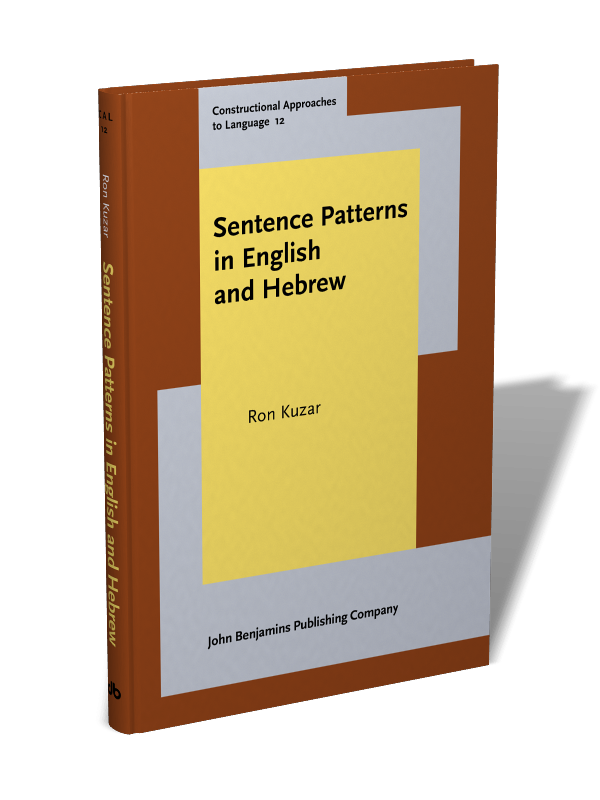
Sentence Patterns in English and Hebrew
Author

Sentence Patterns in English and Hebrew offers an innovative perspective on sentential syntax, in which sentence patterns are introduced as constructions within the general framework of Construction Grammar. Drawing on naturally occurring data collected from the Internet, the study challenges the prevailing view of predication as the sole mechanism of sentence formation, and introduces the idea of patterning as a complementary, sometimes even alternative mechanism. Major sentence patterns of English and Hebrew are systematically presented, targeting both their form and their function. A contrastive analysis of the sentence patterns in these two languages results in postulating a typological group, in which cognitive motivations are shown to account for both similarities and differences within the typology.
Sentence Patterns in English and Hebrew will appeal to scholars of constructional approaches, cognitive linguistics, typology, syntax, as well as anyone interested in English and Hebrew.
Sentence Patterns in English and Hebrew will appeal to scholars of constructional approaches, cognitive linguistics, typology, syntax, as well as anyone interested in English and Hebrew.
[Constructional Approaches to Language, 12] 2012. xvii, 254 pp.
Publishing status: Available
© John Benjamins Publishing Company




Table of Contents
-
Acknowledgements | pp. xi–xii
-
Preface | pp. xiii–xviii
-
Chapter 1. Introduction: Justifying sentence patterns | pp. 1–30
-
Chapter 2. Subject initial sentence patterns | pp. 31–62
-
Chapter 3. Predicate initial sentence patterns | pp. 63–132
-
Chapter 4. A field of sentence patterns | pp. 133–140
-
Chapter 5. The conceptual category of existence | pp. 141–168
-
Chapter 6. The conceptual category of evaluation | pp. 169–180
-
Chapter 7. The conceptual category of environmental conditions | pp. 181–186
-
Chapter 8. Situation types and information structure | pp. 187–202
-
Chapter 9. Non-canonical expletive behavior | pp. 203–210
-
Chapter 10. Patterning revisited | pp. 211–218
-
Chapter 11. Noun incorporation | pp. 219–230
-
Chapter 12. Conclusion | pp. 231–236
-
-
Index of constructions | pp. 247–248
-
Author index | pp. 249–250
-
Subject index | pp. 251–254
Cited by
Cited by 21 other publications
Becker, Israela
Dattner, Elitzur, Liron Kertes, Racehli Zwilling & Dorit Ravid
2019. Usage patterns in the development of Hebrew grammatical subjects. Glossa: a journal of general linguistics 4:1 

Halevy, Rivka
2016. Non-canonical ‘existential-like‘ constructions in colloquial Modern Hebrew. In Atypical predicate-argument relations [Lingvisticæ Investigationes Supplementa, 33], ► pp. 27 ff.
Halevy, Rivka
2020. Chapter 13. Transitivity and valence. In Usage-Based Studies in Modern Hebrew [Studies in Language Companion Series, 210], ► pp. 465 ff.
Halevy, Rivka
2020. The existential construction and its type‑shifting instances in colloquial Modern Hebrew. In La Prédication existentielle dans les langues naturelles : valeurs et repérages, structures et modalités, ► pp. 83 ff.
Halevy, Rivka
2020. Chapter 15. Impersonal and pseudo-impersonal constructions. In Usage-Based Studies in Modern Hebrew [Studies in Language Companion Series, 210], ► pp. 539 ff.
Halevy, Rivka
2022. What makes the dative-experiencer construction in Modern Hebrew different from its counterparts in European languages?. STUF - Language Typology and Universals 75:3 ► pp. 379 ff.
Halevy, Rivka
2023. Non-subject oriented existential, possessive and dative-experiencer constructions in Modern Hebrew – a cross-linguistic typological approach. STUF - Language Typology and Universals 76:4 ► pp. 545 ff.
Izre'el, Shlomo
2022. The syntax of existential constructions. Journal of Speech Sciences 11 ► pp. e022001 ff.
Izre’el, Shlomo
2021. Fautes de grammaire ou grammaire des fautes ? Or: Should Hebrew Speakers Be Afraid of Linguists?. Yod :23 ► pp. 23 ff.
Lyngfelt, Benjamin, Tiago Timponi Torrent, Adrieli Laviola, Linnéa Bäckström, Anna Helga Hannesdóttir & Ely Edison da Silva Matos
2018. Chapter 9. Aligning constructicons across languages. In Constructicography [Constructional Approaches to Language, 22], ► pp. 255 ff.
Maschler, Yael
2015. Word Order in Time. In Temporality in Interaction [Studies in Language and Social Interaction, 27], ► pp. 201 ff.
Melnik, Nurit
MINO, TAKASHI
2024. The usage of there sentences with become: the relationship between change of state and appearance/occurrence. English Language and Linguistics 28:1 ► pp. 1 ff.
Mor, Uri
2015. One More Look at the Negation of the Infinitive Construct in Second Temple Hebrew. Vetus Testamentum 65:3 ► pp. 437 ff.
Ozerov, Pavel
2018. Tracing the sources of Information Structure: Towards the study of interactional management of information. Journal of Pragmatics 138 ► pp. 77 ff.
Pat-El, Na'ama
2018. Chapter 7. The diachrony of non-canonical subjects in Northwest Semitic. In Non-Canonically Case-Marked Subjects [Studies in Language Companion Series, 200], ► pp. 155 ff.
Rubinstein, Aynat
2019. Existential possessive modality in the emergence of Modern Hebrew. In Language Contact, Continuity and Change in the Genesis of Modern Hebrew [Linguistik Aktuell/Linguistics Today, 256], ► pp. 55 ff.
Shor, Leon
2020. Chapter 16. Negation in Modern Hebrew. In Usage-Based Studies in Modern Hebrew [Studies in Language Companion Series, 210], ► pp. 583 ff.
Shor, Leon
2020. Reassessing the third person pronominal “copula” in spoken Israeli Hebrew. Linguistics 58:6 ► pp. 1807 ff.
Östman, Jan-Ola
2018. Constructions as cross-linguistic generalizations over instances. In Constructions in Contact [Constructional Approaches to Language, 24], ► pp. 181 ff.
This list is based on CrossRef data as of 16 april 2024. Please note that it may not be complete. Sources presented here have been supplied by the respective publishers. Any errors therein should be reported to them.
Subjects
Main BIC Subject
CFK: Grammar, syntax
Main BISAC Subject
LAN009000: LANGUAGE ARTS & DISCIPLINES / Linguistics / General