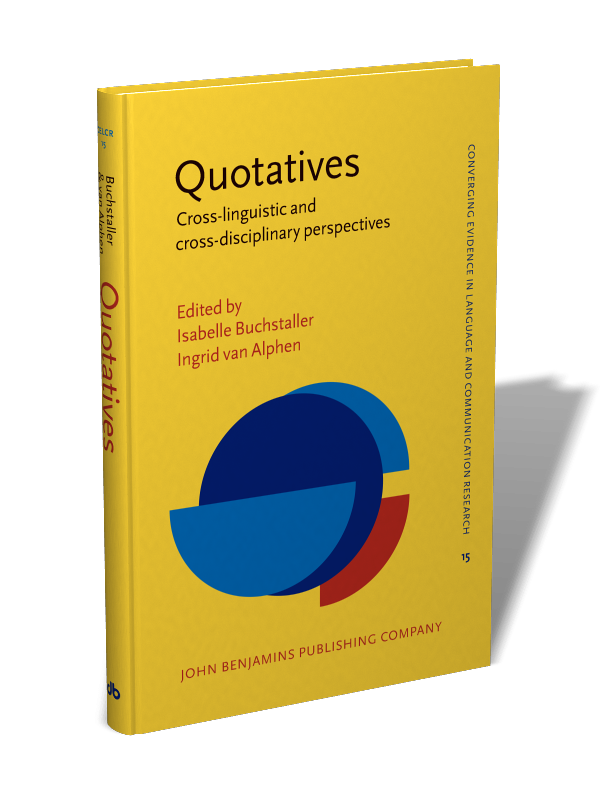
Quotatives
Cross-linguistic and cross-disciplinary perspectives
Editors


Research on quotation has yielded a rich and diverse knowledge-base. Scientific interest has been sparked particularly by the recent emergence of new quotative forms in typologically related and unrelated languages (i.e. English be like, Hebrew kazé, Japanese mitai-na).The present collection gives a platform to research conducted within different linguistic sub-disciplines and on the basis of a variety of Western and non-Western languages. The introduction presents an overview of forms and functions of old and new quotative constructions. The nine chapters investigate quotation from different perspectives, from conversation analysis over grammaticalization and language variation and change to typological and formal approaches. The collection advocates a comprehensive approach to the phenomenon ‘quotation’, seeking a more nuanced knowledge-base as regards the linguistic properties, social uses and pragmatic functions than monolingual or single disciplinary approaches deliver. The cross-disciplinary nature and the wealth of data make the findings broadly available and relevant.
[Converging Evidence in Language and Communication Research, 15] 2012. xxx, 296 pp.
Publishing status: Available
© John Benjamins Publishing Company




Table of Contents
-
Authors’ biographies | pp. vii–x
-
Preface: Introductory remarks on new and old quotativesIsabelle Buchstaller and Ingrid van Alphen | pp. xi–xxx
-
Part I. Discourse perspectives
-
Impersonal quotation and hypothetical discourseAndrea Golato | pp. 3–36
-
By three means: The pragmatic functions of three Norwegian quotativesIngrid Kristine Hasund, Toril Opsahl and Jan Svennevig | pp. 37–68
-
Part II. Typological perspectives
-
Minds divided: Speaker attitudes in quotativesStef Spronck | pp. 71–116
-
Thetic speaker-instantiating quotative indexes as a cross-linguistic typeTom Güldemann | pp. 117–142
-
Part III. Functional and formal perspectives
-
On the characteristics of Japanese reported discourse: A study with special reference to elliptic quotationDavid Oshima and Shin-ichiro Sano | pp. 145–172
-
Quotative go and be like: Grammar and grammaticalizationLieven Vandelanotte | pp. 173–202
-
Quotation in sign languages: A visible context shiftAnnika Herrmann and Markus Steinbach | pp. 203–228
-
Part IV. Language variation and change
-
Performed narrative: The pragmatic function of this is + speaker and other quotatives in London adolescent speechSue Fox | pp. 231–258
-
Dutch quotative van: Past and presentPeter-Arno Coppen and Ad Foolen | pp. 259–280
-
appendixGlossary of specialist terms for research in quotation | pp. 281–290
-
Author index | pp. 291–292
-
Index of terms | pp. 293–296
“A well-crafted collection of chapters surveying quotatives in a broader perspective than is available anywhere else – its papers offer substance to linguists of virtually any inclination. The studies benefit from careful editing that enhances the thematic coherence of the volume and adds value to the study of language typology, language change and sociolinguistics.”
Miriam Meyerhoff, University of Auckland
Cited by
Cited by 42 other publications
Arita, Yuki
2022. Japanese hypothetical enactment as a response to third-party complaint. Text & Talk 42:6 ► pp. 801 ff. 

Bogetić, Ksenija
2014. Be like and the quotative system of Jamaican English: Linguistic trajectories of globalization and localization. English Today 30:3 ► pp. 5 ff.
Bublitz, Wolfram
2018. Zitat und Zitation. In Handbuch Pragmatik, ► pp. 252 ff.
Buchstaller, Isabelle
2015. Exploring linguistic malleability across the life span: Age-specific patterns in quotative use. Language in Society 44:4 ► pp. 457 ff.
Caballero, Rosario
CABALLERO, ROSARIO & CARITA PARADIS
2018. Verbs in speech framing expressions: Comparing English and Spanish. Journal of Linguistics 54:1 ► pp. 45 ff.
CHESHIRE, JENNY & MARIA SECOVA
2018. The origins of new quotative expressions: the case of Paris French. Journal of French Language Studies 28:2 ► pp. 209 ff.
Corrigan, Karen P.
2015. “I always think of people here, you know, saying ‘like’ after every sentence”. In Pragmatic Markers in Irish English [Pragmatics & Beyond New Series, 258], ► pp. 37 ff.
Dostie, Gaétane
2022. Statut phraséologique de quelques séquences émergentes en français parlé préfaçant une scène recréée. Langages N° 225:1 ► pp. 65 ff.
D’Arcy, Alexandra
2015. Quotation and Advances in Understanding Syntactic Systems. Annual Review of Linguistics 1:1 ► pp. 43 ff.
García Castillero, Carlos
2017. Descriptive and diachronic aspects of the Old Irish quotative marker ol
. Journal of Historical Pragmatics 18:1 ► pp. 58 ff.
GARDNER, MATT HUNT, DEREK DENIS, MARISA BROOK & SALI A. TAGLIAMONTE
2021. Be like and the Constant Rate Effect: from the bottom to the top of the S-curve. English Language and Linguistics 25:2 ► pp. 281 ff.
Gentens, Caroline & Kasper Boye
2024. Introduction: the development of manner expressions into complementizers or quotatives. Linguistics 0:0
Guz, Wojciech
2024. Quotative uses of Polish similative demonstratives. Linguistics 0:0
Kibrik, Andrej A., Nikolay A. Korotaev & Vera I. Podlesskaya
2020. Chapter 1. Russian spoken discourse. In In Search of Basic Units of Spoken Language [Studies in Corpus Linguistics, 94], ► pp. 35 ff.
König, Ekkehard
2015. Manner deixis as source of grammatical markers in Indo-European languages. In Perspectives on Historical Syntax [Studies in Language Companion Series, 169], ► pp. 33 ff.
König, Ekkehard
2017. Chapter 5. The deictic identification of similarity. In Similative and Equative Constructions [Typological Studies in Language, 117], ► pp. 143 ff.
König, Ekkehard & Letizia Vezzosi
2022. Chapter 13. On the development of OE swā to ModE so and related changes in an atypical group of demonstratives. In English Historical Linguistics [Current Issues in Linguistic Theory, 358], ► pp. 310 ff.
Levey, Stephen, Karine Groulx & Joseph Roy
2013. A variationist perspective on discourse-pragmatic change in a contact setting. Language Variation and Change 25:2 ► pp. 225 ff.
Marmorstein, Michal
2021. Discourse markers as a lens to variation across speech and writing. Functions of Language 28:2 ► pp. 153 ff.
Mortelmans, Tanja
2024. Frequency differences in reportative exceptionality and how to account for them. Studies in Language
Oloff, Florence
2022. The Particle Jako (“Like”) in Spoken Czech: From Expressing Comparison to Mobilizing Affiliative Responses. Frontiers in Psychology 12
Palacios Martínez, Ignacio M
2013. Zero quoting in the speech of British and Spanish teenagers: A contrastive corpus-based study. Discourse Studies 15:4 ► pp. 439 ff.
Palacios Martínez, Ignacio M. & Paloma Núñez Pertejo
2022. “Go up to miss thingy”. “He’s probably like a whatsit or something”.. Pragmatics. Quarterly Publication of the International Pragmatics Association (IPrA) ► pp. 425 ff.
Palacios Martínez, Ignacio Miguel
2021. Recent changes in London English. An overview of the main lexical, grammar and discourse features of Multicultural London English (MLE). Complutense Journal of English Studies 29 ► pp. 1 ff.
Reber, Elisabeth
Robles, Jessica S.
2015. Quotatives. In The International Encyclopedia of Language and Social Interaction, ► pp. 1 ff.
SCHLEEF, ERIK & DANIELLE TURTON
2018. Sociophonetic variation of like in British dialects: effects of function, context and predictability. English Language and Linguistics 22:01 ► pp. 35 ff.
Schneider, Christa, Sarah Grossenbacher & David Britain
2019. Chapter 12. Quotative variation in Bernese Swiss German. In Language Variation - European Perspectives VII [Studies in Language Variation, 22], ► pp. 192 ff.
Secova, Maria
2015. Discours direct chez les jeunes : nouvelles structures, nouvelles fonctions. Langage et société n° 151:1 ► pp. 131 ff.
Secova, Maria
2018. Chapter 7. Direct speech, subjectivity and speaker positioning in London English and Paris French. In Positioning the Self and Others [Pragmatics & Beyond New Series, 292], ► pp. 155 ff.
Spronck, Stef
2016. Evidential fictive interaction (in Ungarinyin and Russian). In The Conversation Frame [Human Cognitive Processing, 55], ► pp. 255 ff.
Treis, Yvonne & Martine Vanhove
2017. Introduction. In Similative and Equative Constructions [Typological Studies in Language, 117], ► pp. 2 ff.
Vandelanotte, Lieven
2017.
Isabelle Buchstaller , Quotatives: New trends and sociolinguistic implications. Oxford: Wiley-Blackwell, 2014. Pp. xviii +306. ISBN 9780470657188.. English Language and Linguistics 21:1 ► pp. 184 ff.
Vandelanotte, Lieven
2023. Constructions of speech and thought representation. WIREs Cognitive Science 14:2
XUAN, Winfred Wenhui & Shukun Chen
2020. Taking stock of accumulated knowledge in projection studies from Systemic Functional Linguistics: a research synthesis. Functional Linguistics 7:1
Zeyuan, Chen
2015. Book review: Isabelle Buchstaller, Quotatives: New Trends and Sociolinguistic Implications. Discourse Studies 17:1 ► pp. 106 ff.
Синицына, Юлия Вячеславовна
2021. POLYSEMY PATTERNS OF THE SIMILATIVE SUFFIX -LA IN HILL MARI. Tomsk Journal of Linguistics and Anthropology :4(34) ► pp. 88 ff.
[no author supplied]
2013. You Can Quote Me On That: Defining Quotation. In Quotatives, ► pp. 34 ff.
[no author supplied]
2013. Reference Guide for Varieties of English. In A Dictionary of Varieties of English, ► pp. 363 ff.
[no author supplied]
[no author supplied]
This list is based on CrossRef data as of 16 april 2024. Please note that it may not be complete. Sources presented here have been supplied by the respective publishers. Any errors therein should be reported to them.
Subjects
Main BIC Subject
CFG: Semantics, Pragmatics, Discourse Analysis
Main BISAC Subject
LAN009000: LANGUAGE ARTS & DISCIPLINES / Linguistics / General