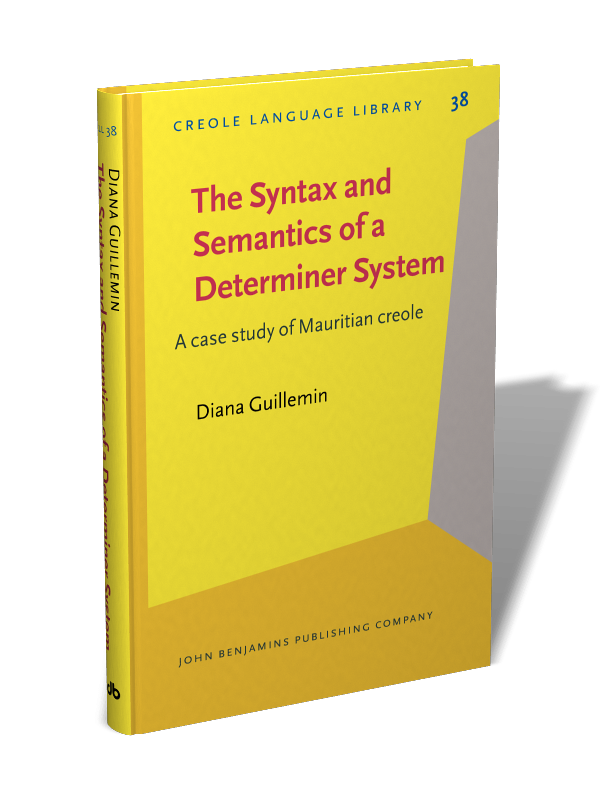
The Syntax and Semantics of a Determiner System

A case study of Mauritian creole

Diana Guillemin
Griffith University

Within the framework of Chomsky’s Minimalism and Formal Semantics, this work documents the development of the Mauritian Creole (MC) determiner system from the mid 18th century to the present. Guillemin proposes that the loss of the French quantificational determiners, which agglutinated to nouns, resulted in the occurrence of bare nouns in argument positions. This triggered a shift in noun denotation, from predicative in French to argumental in MC, and accounts for the very different determiner systems of the creole and its lexifier. MC nouns are lexically stored as Kind denoting terms, that share some of the distributional properties of English bare plurals. New MC determiners are analyzed as ‘type shifting operators’ that shift Kinds into predicates, and serve to establish the referential properties of noun phrases. The analysis provides evidence for the universality of semantic features like Definiteness and Specificity, and the mapping of their form and function.


[Creole Language Library, 38]  2011.  xviii, 310 pp.
Publishing status: Available
HardboundAvailable
ISBN 9789027252609 | EUR 105.00 | USD 158.00
 
e-BookSold by e-book platforms
ISBN 9789027284709 | EUR 105.00 | USD 158.00


Table of Contents

Acknowledgements
xvii–xviii
Chapter 1. Sources of Mauritian Creole
1–6
Chapter 2. Introduction
7–22
Chapter 3. Syntactic framework
23–46
Chapter 4. Semantics: Definitions and formalism
47–86
Chapter 5. Early changes: From French to creole
87–116
Chapter 6. The emergence of a new determiner system
117–162
Chapter 7. The modern MC determiner system
163–198
Chapter 8. Noun denotation and function of determiners
199–226
Chapter 9. The syntax of the MC noun phrase
227–280
Chapter 10. Conclusion
281–292
Abbreviations and Symbols
293–294
Texts (sources of examples)
295–306
Index
307

Quotes

“To the best of my knowledge, this is the only work in creolistics where the reader is presented with such a wide range of data that feeds into a very sophisticated analysis. […] On the description side, the data is presented in a very systematic manner using current tools in minimalism. While there is a body of literature on this issue in well-described languages, this domain of enquiry is virtually new in creolistics.”
Enoch Aboh, University of Amsterdam
“The data and the discussion of definiteness and specificity is an outstanding value of the book. G points to the Kwa and Bantu languages as ones that cut the cake the way MC does, but comparison with other languages that allow bare singulars to occur as arguments would also be most interesting. Some of those, such as Slavic languages, have no articles at all; others, like Hungarian and Hindi, have definite and/or indefinite articles. One hopes that the book under review will inspire a new wave of comparative studies, syntactic and semantic, in this area.”
Anna Szabolcsi, New York University, in Language
“This work ‘recommends itself for various aspects to the attention of both the scientific community concerned with the historical study of creole languages and that interested in the theory of form and interpretation of noun phrases. Major strength points are the almost unprecedented riches of detailed diachronic data on the development of a creole language and the original attempt to address such data through the most sophisticated tools recently made available by formal grammar, both on the syntactic and the semantic side. Such tools are introduced to the reader from scratch, along with a wide number of useful bibliographical references, which are doubtless useful also for many scholars experienced in the field.”
Giuseppe Longobardi, University of Trieste
“This work 'addresses issues of the syntax-semantics interface such as the licensing of specificity, definiteness and number and its implications as to the distribution of (bare) noun phrases in Mauritian Creole (MC). In order to do this, the author first presents a fantastic semantic analysis of bare noun phrases and determiner noun phrases in MC, building on Longobardi (1994), Chierchia (1998) and much related work. […] I have no doubt that the finding of this work will open a new research agenda in creolistics’.”
Enoch Aboh, Professor of Linguistics, University of Amsterdam

Subjects

Benjamins Subject classification

BIC Subject

CF/2ZXP: Linguistics/Esperanto

BISAC Subject

LAN009000: LANGUAGE ARTS & DISCIPLINES / Linguistics
U.S. Library of Congress Control Number:  2011026798
This page is part of John Benjamins Publishing Company website. Click 'embed' to view its contents in the fully-featured web application. Embed