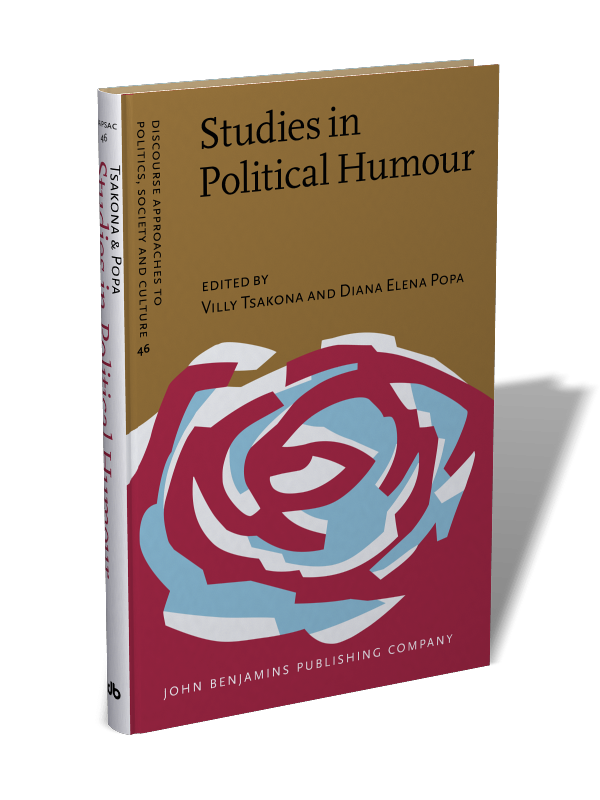
Studies in Political Humour
In between political critique and public entertainment
Editors


If politics is a serious matter and humour a funny one, this volume investigates how and why the boundaries between the two are blurred: politics can be represented in a humorous manner and humour can have a serious intent. Political humour conveys criticism against the political status quo and/or recycles and reinforces dominant views on politics. The data analysed comes from European states with different sociopolitical histories and traditions and the methodologies adopted originate in different fields (discourse analysis, folklore and cultural studies, media studies, sociolinguistics, sociology, theatre semiotics). The first part of the volume is dedicated to politicians’ humour as a means of public positioning, deliberation, and eventually attack against political adversaries, while the second one involves political satire as realised in different genres: animation, impersonation, and cartoons. Last but not least, the third part shows how political humour can be manipulated in public debates or become an integral part of postmodern art.
[Discourse Approaches to Politics, Society and Culture, 46] 2011. x, 290 pp.
Publishing status: Available
© John Benjamins Publishing Company




Table of Contents
-
Acknowledgements | p. vii
-
List of tables and figures | pp. ix–x
-
Chapter 1. Humour in politics and the politics of humour: An introductionVilly Tsakona and Diana Elena Popa | pp. 1–30
-
Part I. Humour by politicians
-
Chapter 2. Fun in the German parliament?Ralph Müller | pp. 33–59
-
Chapter 3. Informal talk in formal settings: Humorous narratives in Greek parliamentary debatesArgiris Archakis and Villy Tsakona | pp. 61–81
-
Chapter 4. “Stop caressing the ears of the hooded”: Political humour in times of conflictMarianthi Georgalidou | pp. 83–107
-
Chapter 5. Entertaining and enraging: The functions of verbal violence in broadcast political debatesMarta Dynel | pp. 109–133
-
Part II. Political humour in the media
-
Chapter 6. Political satire dies last: A study on democracy, opinion formation, and political satireDiana Elena Popa | pp. 137–165
-
Chapter 7. Being Berlusconi: Sabina Guzzanti’s impersonation of the Italian Prime Minister between stage and screenClare Watters | pp. 167–189
-
Chapter 8. Mocking Fascism: Popular culture and political satire as counter-hegemonyEfharis Mascha | pp. 191–213
-
Part III. Public debates and political humour
-
Chapter 9. Politics of taste in a post-Socialist state: A case studyLiisi Laineste | pp. 217–241
-
Chapter 10. Humour and… Stalin in a National Theatre of Greece postmodern production: Stalin: A Discussion about Greek TheatreVicky Manteli | pp. 243–270
-
Chapter 11. Postscript: A final (?) note on political humourDiana Elena Popa and Villy Tsakona | pp. 271–278
-
Contributors | pp. 279–282
-
Name index | pp. 283–286
-
Subject index | pp. 287–290
“A praiseworthy feature of the volume lies in its strong editorship. [...] Studies in Political Humour is a volume which scholars working on political discourse, humour theory, and the interface of the two will find valuable. It considers humour (broadly defined) from a wide range of perspectives and this may inspire readers to look to other disciplines when carrying out further work on such topics.”
James Murphy, University of Manchester, on Linguist List, 23.1425
“This interesting collection of essays by scholars from Romania, Poland, Estonia, Greece, Switzerland and England is a significant contribution to the study of the uses of humour within politics in several European countries, including Germany and Italy. [...] Studies in Political Humour is an excellent and wide-ranging volume that should enjoy a place on the bookshelves of both humour scholars and political scientists.”
Christie Davies, University of Reading, in Israeli Journal of Humor Research, 1(1), 2012
“As a survey of humour in a relatively geographically contained though culturally diverse area, this book functions as a solid starting point from which to launch into the world of political humour research.”
Jay M. Woodhams, Victoria University of Wellington, in Language in Society 42 (2013)
“Editors Villy Tsakona and Diana Elena Popa are to be congratulated for organizing this methodologically varied, empirically wide-ranging, and theoretically informed collection of European contributions to the study of political humor [...]. This collection is very valuable in that it demonstrates that political humor operates in a relationship of co-dependency. Humor reflects and
enables reflection upon political realities, but those same political dynamics also contest the status of humor and appropriate it for use in serious conflict.”
enables reflection upon political realities, but those same political dynamics also contest the status of humor and appropriate it for use in serious conflict.”
Sammy Basu, Willamette University, in Humor 27:3 (2014)
“
Studies in Political Humour is well rounded. The book guides both expert and general readers through a range of discussions about political humour. The applications, functions, and limitations of political humour and the difficulty of using it to communicate values and positions between parts of society become especially apparent in the concluding remarks of Tsakona and Popa. Extending the editors’ reflections would come in handy here as a starting point for further study in national environments. Those interested in the political dimension of humour and European politics will find the book a very helpful resource.”
Benjamin Nickl, in Pragmatics.Review Vol. 2:2 (2014)
“The book is a timely contribution as it addresses the current trends in political humour study. One of its strengths is its analysis of data in different genres collected from different languages and countries and the various methodologies adopted to analyze discourse.”
Songqing Li, Xi’an Jiaotong-Liverpool University, in Discourse Studies, Vol. 15:6 (2013), pag. 782-784
Cited by
Cited by 40 other publications
Adegoju, Adeyemi & Oluwabunmi Oyebode
2015. Humour as discursive practice in Nigeria’s 2015 presidential election online campaign discourse. Discourse Studies 17:6 ► pp. 643 ff. 

Alasmari, Afnan & Alaa Almohammadi
2023. A multimodal analysis of the representation of Saudi women in selected caricature images from Cartoon Movement: A global platform for editorial cartoons. Cogent Arts & Humanities 10:2
Balakrishnan, Vinod & Vishaka Venkat
2023. Performance of Humour in Political Cartoons. In The Language of Humour and Its Transmutation in Indian Political Cartoons, ► pp. 35 ff.
Balakrishnan, Vinod & Vishaka Venkat
2023. Understanding Humour. In The Language of Humour and Its Transmutation in Indian Political Cartoons, ► pp. 1 ff.
Beck, Daniel
2023. Humorous parodies of popular culture as strategy in Boris Johnson’s populist communication. The British Journal of Politics and International Relations ► pp. 136914812311741 ff.
Chovanec, Jan & Villy Tsakona
2018. Chapter 1. Investigating the dynamics of humor. In The Dynamics of Interactional Humor [Topics in Humor Research, 7], ► pp. 1 ff.
Constantinescu, Mihaela-Viorica
2020. Review of Tsakona & Chovanec (2018): The Dynamics of Interactional Humor. Creating and negotiating humor in everyday encounters. Language and Dialogue 10:2 ► pp. 290 ff.
CONSTANTINESCU, MIHAELA-VIORICA
2023. (Im)politeness from an Emic Perspective. Illustrations from Present Day Romanian Parliamentary Debates. Studii și cercetări lingvistice 2023:2 ► pp. 216 ff.
Corner, John
2016. Popular Culture. In The International Encyclopedia of Political Communication, ► pp. 1 ff.
Doona, Joanna
2021. News satire engagement as a transgressive space for genre work. International Journal of Cultural Studies 24:1 ► pp. 15 ff.
Dynel, Marta & Fabio IM Poppi
2018. In tragoedia risus: Analysis of dark humour in post-terrorist attack discourse. Discourse & Communication 12:4 ► pp. 382 ff.
Dörner, Andreas
2013. „So schmeckt die Zukunft “. In Politische Kommunikation in der repräsentativen Demokratie der Bundesrepublik Deutschland, ► pp. 165 ff.
Dörner, Andreas
2017. Komik, Humor und Lachen als Dimensionen der politischen Kommunikation. In Wahlkampf mit Humor und Komik, ► pp. 17 ff.
Dörner, Andreas
2017. Der Gegenstand: Talkformate mit Modulation ins Komische, ihre theatrale Logik und das beteiligte Ensemble. In Wahlkampf mit Humor und Komik, ► pp. 43 ff.
Dörner, Andreas & Ludgera Vogt
2017. Politiker im Satire- und Comedytalk: ein Blick auf den Forschungsstand. In Wahlkampf mit Humor und Komik, ► pp. 63 ff.
Etaati, Saeedeh Niktab
2019. Political Movement and Electionlore. Ethnologies 40:2 ► pp. 131 ff.
Ferrari, Elisabetta
2018. Fake accounts, real activism: Political faking and user-generated satire as activist intervention. New Media & Society 20:6 ► pp. 2208 ff.
Frantzi, Katerina T., Marianthi Georgalidou & Giorgos Giakoumakis
2019. Greek Parliamentary Discourse in the Years of the Economic Crisis. In Argumentation and Appraisal in Parliamentary Discourse [Advances in Linguistics and Communication Studies, ], ► pp. 1 ff.
Genov, Nikolai
2021. Nico Stehr and Dustin Voss, Geld. Eine Gesellschaftstheorie der Moderne. International Sociology 36:2 ► pp. 325 ff.
Georgalidou, Marianthi
2016. Addressing women in the Greek parliament. In Exploring Language Aggression against Women [Benjamins Current Topics, 86], ► pp. 127 ff.
Georgalidou, Marianthi
2017. Addressing women in the Greek parliament. Journal of Language Aggression and Conflict 5:1 ► pp. 30 ff.
Glăvan, Gabriela
2019. Power and Ridicule – Elena CeauȘescu in Communist Humour. Gender Studies 18:1 ► pp. 129 ff.
Haque, Shahzaman
2018. Langues et accents : pouvoir politique et lutte des castes. Langage et société N° 164:2 ► pp. 139 ff.
Inya, Onwu & Blessing Inya
2021. Interrogating the Phenomenon of Suffering and Smiling by Nigerians: A Mixed Methods Study. In The Palgrave Handbook of Humour Research, ► pp. 149 ff.
Jaubert, Anna & Damon Mayaffre
2013. Ethos préalable et ethos (re) construit La transformation de l'humour légendaire de François Hollande. Langage et société N° 146:4 ► pp. 71 ff.
Martin, Alexander P.
2023. It’s a Bit Inappropriate: UK Students’ Negative Perceptions of Using Humor in Teaching Politics. Journal of Political Science Education 19:2 ► pp. 231 ff.
Mehran, Weeda, Megan Byrne, Ella Gibbs-Pearce, Archie Macfarlane, Jacob Minihane & Amy Ranger
2024. Humour in jihadi rhetoric: comparative analysis of ISIS, Al-Qaeda, TTP, and the Taliban. Behavioral Sciences of Terrorism and Political Aggression 16:2 ► pp. 263 ff.
Moore, Rick
2017. Sardonic Atheists and Silly Evangelicals: the Relationship between Self-Concept and Humor Style. Qualitative Sociology 40:4 ► pp. 447 ff.
Nilsen, Don L. F. & Alleen Pace Nilsen
2018. The Language of Humor,
Petrović, Tanja
2018. Political Parody and the Politics of Ambivalence. Annual Review of Anthropology 47:1 ► pp. 201 ff.
Piata, Anna
2018. Chapter 11. On-line humorous representations of the 2015 Greek national elections. In The Dynamics of Interactional Humor [Topics in Humor Research, 7], ► pp. 257 ff.
Porzelt, Benedikt, Andreas Dörner, Ludgera Vogt & Matthias Bandtel
2017. Politische Akteure im Satire- und Comedy-Talk: Fallanalysen. In Wahlkampf mit Humor und Komik, ► pp. 149 ff.
Primbs, Oskar & Marcelle C. Dawson
2023. Taking Stand‐Up Seriously: Comedy as a Site for Imagining Decolonial Futures. Sociological Inquiry
SATIR, Mehmet Emin
2022. Siyasetin Mizahı: Amerikan Yardımlarının “Nuhun Gemisi” Dergisinde Ele Alınış Biçiminin İncelenişi. Türkiye İletişim Araştırmaları Dergisi :41 ► pp. 99 ff.
Scripnic, Gabriela & Diana Elena Popa
2015. From hostile humour to stereotyping in televised satire Les Guignols de l’Info
. Language and Dialogue 5:1 ► pp. 90 ff.
Sørensen, Majken Jul
2015. Radical Clowning: Challenging Militarism through Play and Otherness. HUMOR 28:1
Tesnohlidkova, Olivera
2021. Jody C Baumgartner and Amy B Becker (eds), Political Humor in a Changing Media Landscape. International Sociology 36:2 ► pp. 327 ff.
ÖZBAY, Emrah
2022. Bir Siyasi Hiciv Örneği Olarak Terry Pratchett’ın İlginç Zamanlar Romanı. Uluslararası Sosyal Bilimler Akademi Dergisi 4:9 ► pp. 418 ff.
[no author supplied]
2012. PUBLICATIONS RECEIVED. Language in Society 41:3 ► pp. 415 ff.
[no author supplied]
This list is based on CrossRef data as of 16 april 2024. Please note that it may not be complete. Sources presented here have been supplied by the respective publishers. Any errors therein should be reported to them.
Subjects
Communication Studies
Main BIC Subject
CFG: Semantics, Pragmatics, Discourse Analysis
Main BISAC Subject
LAN009000: LANGUAGE ARTS & DISCIPLINES / Linguistics / General