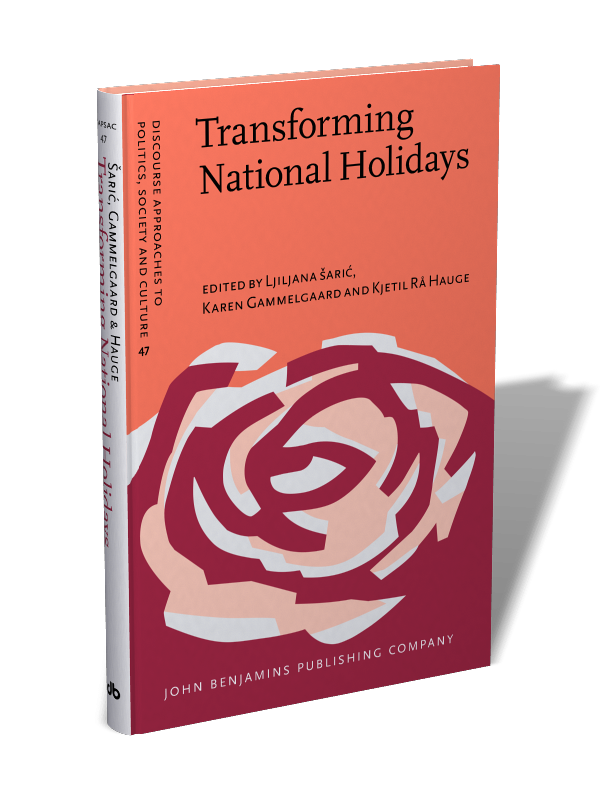
Transforming National Holidays
Identity discourse in the West and South Slavic countries, 1985-2010
Editors


How do people construct collective identity during profound societal transformations? This volume examines the discursive construction of identity related to important national holidays in nine countries of Central Europe and the Balkans: Bosnia-Herzegovina, Bulgaria, Croatia, the Czech Republic, Macedonia, Montenegro, Poland, Serbia, and Slovakia. The chapters focus on the decades during which these countries moved from communism towards democracy and a market economy. This transition saw revivals of national values and a new significance of regional and transnational ties, entangled with negotiations of national identity that have been particularly lively in discourse concerning national holidays.
The chapters apply discourse analysis in addition to approaches from history, sociology, political science, and anthropology. All of the analyses make use of empirical material in the Slavic languages, including newspaper articles, interviews and other media contributions, sermons, addresses, and speeches by members of the political elite.
The chapters apply discourse analysis in addition to approaches from history, sociology, political science, and anthropology. All of the analyses make use of empirical material in the Slavic languages, including newspaper articles, interviews and other media contributions, sermons, addresses, and speeches by members of the political elite.
[Discourse Approaches to Politics, Society and Culture, 47] 2012. xiii, 314 pp.
Publishing status: Available
© John Benjamins Publishing Company




Table of Contents
-
Contributors | pp. vii–xi
-
Acknowledgements | p. xiii
-
PrefaceKjetil Rå Hauge | pp. 1–4
-
Discursive construction of national holidays in West and South Slavic countries after the fall of communism: Introductory thoughtsKaren Gammelgaard and Ljiljana Šarić | pp. 5–31
-
Analyses
-
Chapter 1. Collective memory and media genres: Serbian Statehood Day 2002–2010Ljiljana Šarić | pp. 35–55
-
Chapter 2. The quest for a proper Bulgarian national holidayKjetil Rå Hauge | pp. 57–79
-
Chapter 3. The multiple symbolism of 3 May in Poland after the fall of communismElżbieta Hałas | pp. 81–100
-
Chapter 4. “Dan skuplji vijeka,” ‘A day more precious than a century’: Constructing Montenegrin identity by commemorating Independence DayTatjana Radanović Felberg | pp. 101–124
-
Chapter 5. Croatia in search of a national day: Front-page presentations of national-day celebrations, 1988–2005Ljiljana Šarić | pp. 125–148
-
Chapter 6. Contested pasts, contested red-letter days: Antifascist commemorations and ethnic identities in post-communist CroatiaVjeran Pavlaković | pp. 149–169
-
Chapter 7. Commemorating the Warsaw Uprising of 1 August 1944: International relational aspects of commemorative practicesTitus Ensink and Christoph Sauer | pp. 171–189
-
Chapter 8. Ilinden: Linking a Macedonian past, present and futureMarko Soldić | pp. 191–212
-
Chapter 9. Slovak national identity as articulated in the homilies of a religious holidayAlexander Bielicki | pp. 213–229
-
Chapter 10. The Czech and Czechoslovak 28 October: Stability and change in four presidential addresses 1988–2008Karen Gammelgaard | pp. 231–250
-
Chapter 11. Disputes over national holidays: Bosnia and Herzegovina 2000–2010Svein Mønnesland | pp. 251–270
-
Chapter 12. What Europe means for Poland: The front-page coverage of Independence Day in Gazeta Wyborcza 1989–2009Knut Andreas Grimstad | pp. 271–296
-
-
Appendix A. List of current laws on national holidays in West and South Slavic countries | pp. 311–312
-
Index | pp. 313–314
“The case-studies presented in the volume will undoubtedly be valuable to students and scholars interested in the interaction between politics and culture in Central and Southeast Europe. The major strengths of the work as a whole are that it indicates the instability and dynamics of collective identity discourse during the transformation processes in the region and that it convincingly introduces national holidays as a fruitful source to analyse collective self-understanding.”
Pieter Troch, Ghent University, in Slavonic and East European Review, Vol. 91.4 (October 2013), pages 942-944.
“The variety and the relevance of the contents are outstanding [...]. It offers a satisfying state of the art on memory studies on East and South East Europe, and, understandably, it also raises questions for future research.”
Gaetano Dato, University of Trieste, in Journal of Southeastern Europe, Vol. 38:1 (2014)
“It offers an excellent example of detailed understanding by means of discourse analysis of the transformation of national holidays and identities. Deep insights into these historical events and public debates are fully shown in the textual and semiotic analysis.”
Yu Hua, Shanghai International Studies University, in Discourse Studies Vol. 17:3 (2015)
Cited by
Cited by 4 other publications
Berrocal, Martina & Aleksandra Salamurović
2019. Chapter 1. Introduction. In Political Discourse in Central, Eastern and Balkan Europe [Discourse Approaches to Politics, Society and Culture, 84], ► pp. 1 ff. 

Gimadeev, Timur
2019. State-run celebration of Liberation Day in Czechoslovakia (based on audiovisual sources). Central-European Studies :1 ► pp. 251 ff.
Hofman, Ana
2021. “We are the Partisans of Our Time”: Antifascism and Post-Yugoslav Singing Memory Activism. Popular Music and Society 44:2 ► pp. 157 ff.
[no author supplied]
This list is based on CrossRef data as of 16 april 2024. Please note that it may not be complete. Sources presented here have been supplied by the respective publishers. Any errors therein should be reported to them.
Subjects
Main BIC Subject
CFG: Semantics, Pragmatics, Discourse Analysis
Main BISAC Subject
LAN009000: LANGUAGE ARTS & DISCIPLINES / Linguistics / General