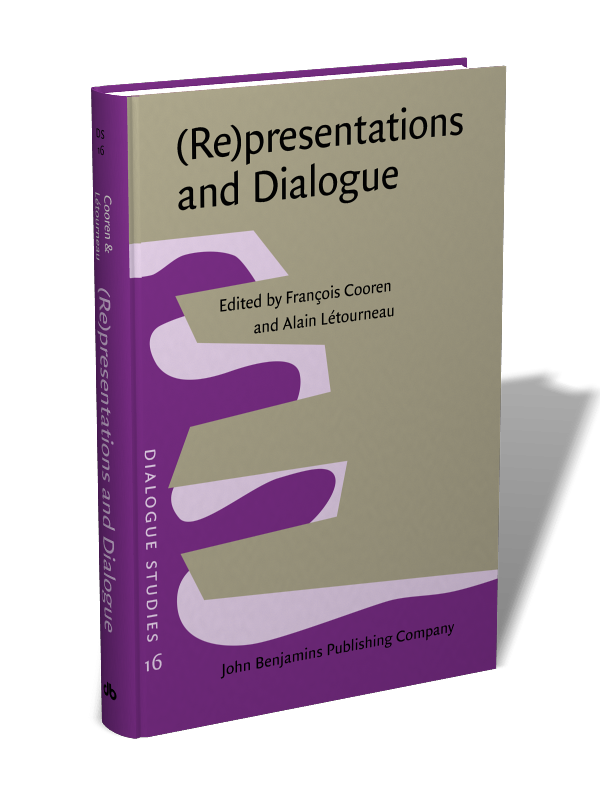
(Re)presentations and Dialogue
Editors


This edited volume proposes key contributions addressing the connections between two important themes: dialogue and representation. These connections were approached or interpreted in three possible ways: 1. Dialogue as representation, 2. Normative perspectives on dialogue/representation issues, and 3. Representations of dialogue. The first interpretation -- Dialogue as representation -- consists of exploring dialogue as an activity where many things, beings or voices can be made present, whether we think in terms of ideologies, cultures, situations, collectives, roles, etc. The second interpretation – Normative perspectives on dialogue/representation issues – leads scholars to explore questions of normativity, which are often associated with the notion of dialogue, when conceived as a morally stronger form of conversation. Finally, the third interpretation – Representations of dialogue – invites us to address methodological questions related to the representation of this type of conversation. Echoing Bakhtin, contributors were invited to explore the polyphonic, heteroglot, or dialogic character of any text, discourse or interaction.
[Dialogue Studies, 16] 2012. xv, 348 pp.
Publishing status: Available
© John Benjamins Publishing Company





Table of Contents
-
IntroductionFrançois Cooren and Alain Létourneau | pp. ix–xvi
-
Dialogue: Object and representationEdda Weigand | pp. 1–16
-
Towards an inclusive notion of dialog for ethical and moral purposesAlain Létourneau | pp. 17–36
-
Dogmatic dialogue: Essential qualities of judicial opinion-writingKaren Tracy | pp. 37–58
-
Representing gender in parliamentary dialogue: Are there any cross-cultural stereotypes?Cornelia Ilie | pp. 59–82
-
Dialogue as a truth-conveying discursive strategyEric Grillo | pp. 83–98
-
Democracy and web-based dialogueWolfgang Teubert | pp. 99–124
-
The metadiscourse of “voice”: Legitimizing participation in dialogueRobert T. Craig | pp. 125–142
-
Representation, re-presentation, presentation, and conversationKlaus Krippendorff | pp. 143–160
-
On the representation of a dialogue with God: Catherine of Siena and mystical communicationDavid Douyère | pp. 161–176
-
Where is dialogue in classroom discussion?Heidi L. Muller | pp. 177–194
-
Dialogue entries and exits: The discursive space of discussionDominique Ducard | pp. 195–214
-
Contribution-Representation-Subordination as conversational patterns: Manifestations of collective mind during routinized talk at workBertrand Fauré and Nicolas Arnaud | pp. 215–236
-
On the possibility of rhetoric as a dialogical guide for practical reason(ing): An old challenge in a new eraKatia A. Lima | pp. 237–256
-
The role of the moving image in the representation of a sensible dialogue between users and spaceAnne Faure | pp. 257–270
-
Dialogue as a possibility for knowledge in organizationsMarlene R. Marchiori, Miguel Luiz Contani and Patrice M. Buzzanell | pp. 271–288
-
Socrates as character, Socrates as narrator: Dialogue and representation in PlatoMaría J. Ortega Máñez | pp. 289–302
-
Evidential information represented in dialogueLori Czerwionka | pp. 303–324
-
Dialogues between two pupils during the process of writing a fictional story: Verbal erasures and their forms of representationEduardo E. Calil de Oliveira | pp. 325–342
-
Author Index | pp. 343–344
-
Subject Index | pp. 345–348
“The ideas presented in the volume will certainly inspire scholars who are working in multiple domains. I recommend the book to anyone who takes seriously the metatheoretical, theoretical and practical aspects of researching and understanding dialogue. This volume serves as an important conduit for promoting continued discussion about what dialogue is and what it can be in terms of conceptualization, method and practice.”
Jimmie Manning, Northern Illinois University, in Discourse Studies Vol. 17:3 (2015)
Subjects
Communication Studies
Main BIC Subject
CFG: Semantics, Pragmatics, Discourse Analysis
Main BISAC Subject
LAN009000: LANGUAGE ARTS & DISCIPLINES / Linguistics / General