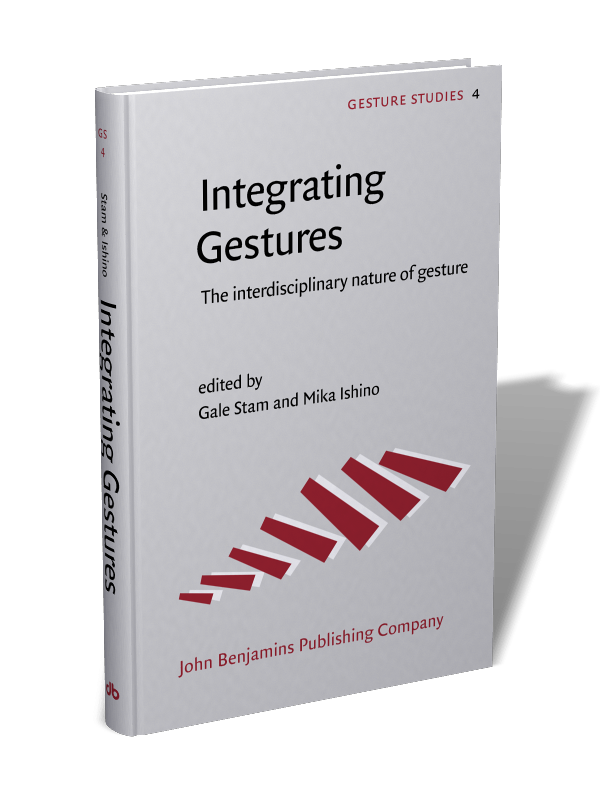
Integrating Gestures
The interdisciplinary nature of gesture


Gestures are ubiquitous and natural in our everyday life. They convey information about culture, discourse, thought, intentionality, emotion, intersubjectivity, cognition, and first and second language acquisition. Additionally, they are used by non-human primates to communicate with their peers and with humans. Consequently, the modern field of gesture studies has attracted researchers from a number of different disciplines such as anthropology, cognitive science, communication, neuroscience, psycholinguistics, primatology, psychology, robotics, sociology and semiotics. This volume presents an overview of the depth and breadth of current research in gesture. Its focus is on the interdisciplinary nature of gesture. The twenty-six chapters included in the volume are divided into six sections or themes: the nature and functions of gesture, first language development and gesture, second language effects on gesture, gesture in the classroom and in problem solving, gesture aspects of discourse and interaction, and gestural analysis of music and dance.
As of March 2017, this e-book is freely available, thanks to the support of libraries working with Knowledge Unlatched. It is licensed under a Creative Commons CC BY-NC-ND license.

For any use beyond this license, please contact the publisher at [email protected].




Table of Contents
-
Part I. Nature and functions of gestures
-
Chapter 1. IntroductionMika Ishino and Gale Stam | pp. 3–14
-
Chapter 2. Addressing the problems of intentionality and granularity in non-human primate gestureErica A. Cartmill and Richard W. Byrne | pp. 15–26
-
Chapter 3. Birth of a MorphDavid McNeill and Claudia Sowa | pp. 27–48
-
Chapter 4. Dyadic evidence for grounding with abstract deictic gesturesJanet Bavelas, Jennifer Gerwing, Meredith Allison and Chantelle Sutton | pp. 49–60
-
Chapter 5. If you don’t already know, I’m certainly not going to show you! Motivation to communicate affects gesture productionAutumn Hostetter, Martha W. Alibali and Sheree M. Schrager | pp. 61–74
-
Chapter 6. Measuring the formal diversity of hand gestures by their hamming distanceKatharina Hogrefe, Wolfram Ziegler and Georg Goldenberg | pp. 75–88
-
Chapter 7. ‘Parallel gesturing’ in adult-child conversationsMaria Graziano, Adam Kendon and Carla Cristilli | pp. 89–102
-
Part II. First language development and gesture
-
Chapter 8. Sentences and conversations before speech? Gestures of preverbal children reveal cognitive and social skills that do not wait for wordsClaire D. Vallotton | pp. 105–120
-
Chapter 9. Giving a nod to social cognition: Developmental constraints on the emergence of conventional gestures and infant signsMaria Fusaro and Claire D. Vallotton | pp. 121–136
-
Chapter 10. Sensitivity of maternal gesture to interlocutor and contextMaria Zammit and Graham Schafer | pp. 137–152
-
Chapter 11. The organization of children’s pointing stroke endpointsMats Andrén | pp. 153–162
-
Chapter 12. Is there an iconic gesture spurt at 26 months?Şeyda Özçalışkan and Susan Goldin-Meadow | pp. 163–174
-
Chapter 13. The development of spatial perspective in the description of large-scale environmentsKazuki Sekine | pp. 175–186
-
Chapter 14. Learning to use gesture in narratives: Developmental trends in formal and semantic gesture competenceOlga Capirci, Carla Cristilli, V. De Angelis and Maria Graziano | pp. 187–200
-
Chapter 15. The changing role of gesture form and function in a picture book interaction between a child with autism and his support teacherHannah Sowden, Michael R. Perkins and Judy Clegg | pp. 201–216
-
Part III. Second language effects on gesture
-
Chapter 16. A cross-linguistic study of verbal and gestural descriptions in French and Japanese monolingual and bilingual childrenMeghan Zvaigzne, Yuriko Oshima-Takane, Fred Genesee and Makiko Hirakawa | pp. 219–230
-
Chapter 17. Gesture and language shift on the Uruguayan-Brazilian borderKendra Newbury | pp. 231–242
-
Part IV. Gesture in the classroom and in problem-solving
-
Chapter 18. Seeing the graph vs. being the graph: Gesture, engagement and awareness in school mathematicsSusan Gerofsky | pp. 245–256
-
Chapter 19. How gesture use enables intersubjectivity in the classroomMitchell J. Nathan and Martha W. Alibali | pp. 257–266
-
Chapter 20. Microgenesis of gestures during mental rotation tasks recapitulates ontogenesisMingyuan Chu and Sotaro Kita | pp. 267–276
-
Part V. Gesture aspects of discourse and interaction
-
Chapter 21. Gesture and discourse: How we use our hands to introduce versus refer backStephani Foraker | pp. 279–292
-
Chapter 22. Speakers’ use of ‘action’ and ‘entity’ gestures with definite and indefinite referencesKatie Wilkin and Judith Holler | pp. 293–308
-
Chapter 23. “Voices” and bodies: Investigating nonverbal parameters of the participation frameworkClaire Maury-Rouan | pp. 309–320
-
Chapter 24. Gestures in overlap: The situated establishment of speakershipLorenza Mondada and Florence Oloff | pp. 321–338
-
Part VI. Gestural analysis of music and dance
-
Chapter 25. Music and leadership: The choir conductor’s multimodal communicationIsabella Poggi | pp. 341–354
-
Chapter 26. Handjabber: Exploring metaphoric gesture and non-verbal communication via an interactive art installationEllen Campana, Jessica Mumford, Cristóbal Martínez, Stjepan Rajko, Todd Ingalls, Lisa Tolentino and Harvey Thornburg | pp. 355–364
-
Name index | pp. 365–366
-
Subject index | pp. 367–372
integrative agenda for future research.”
Cited by
Cited by 12 other publications

This list is based on CrossRef data as of 12 april 2024. Please note that it may not be complete. Sources presented here have been supplied by the respective publishers. Any errors therein should be reported to them.