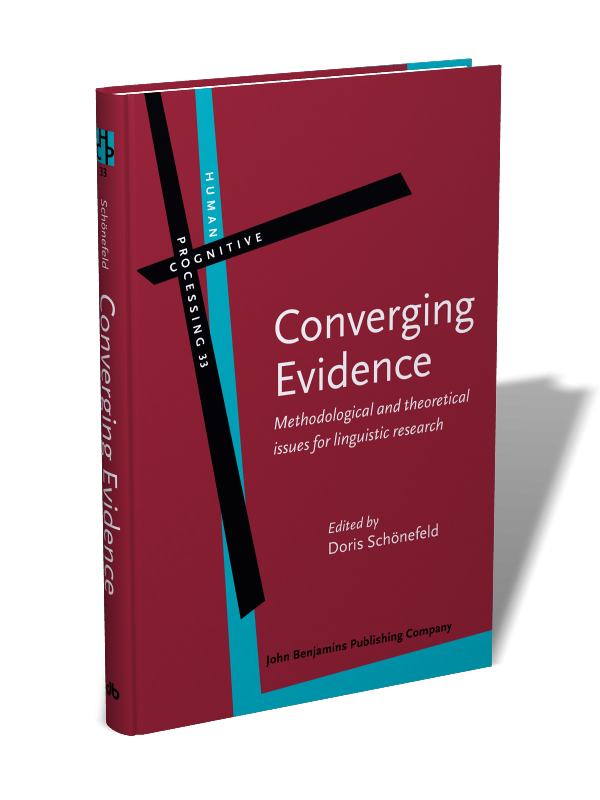
Converging Evidence
Methodological and theoretical issues for linguistic research
Editor

The volume argues for the use of multi-methodological strategies in linguistic research. In its lead chapter, in addition, the thorny issue of phenomenological pluralism is explored in detail. From a usage-based perspective, the individual chapters demonstrate methodological pluralism in the investigation of meaning, language acquisition, and discourse. The chapters report on studies in which the use of corpus data is combined with other methodological tools, e.g. experimentally elicited findings, showing how introspection and the analysis of performance data go hand in hand to provide empirical support for researchers’ hypotheses. Some of the authors inspire the discussion in usage-based linguistics, proposing innovative methods of analysis. Others adopt such methods and combine them in original ways. The cutting-edge studies presented in this volume should be of great interest to scholars and students of cognitive and corpus linguistics who want to familiarize themselves with recent methodological advances and their applications in the field.
[Human Cognitive Processing, 33] 2011. x, 352 pp.
Publishing status: Available
© John Benjamins Publishing Company




Table of Contents
-
Contributors | pp. vii–viii
-
Preface | pp. ix–x
-
Introduction: On evidence and the convergence of evidence in linguistic researchDoris Schönefeld | pp. 1–32
-
Issues in collecting converging evidence: Is metaphor always a matter of thought?Gerard J. Steen | pp. 33–54
-
Part 1. Multi-methodological approaches to constructional and idiomatic meaning
-
1.1. Cognition verb constructions
-
Perception and conception: The ‘see x to be y’ construction from a cognitive perspectiveThomas Egan | pp. 57–80
-
Explaining diverging evidence: The case of clause-initial I thinkGunther Kaltenböck | pp. 81–112
-
1.2. Constructional alternatives
-
I am about to die vs. I am going to die: A usage-based comparison between two future-indicating constructionsSilke Höche | pp. 115–142
-
Studying syntactic priming in corpora: Implications of different levels of granularityStefan Th. Gries | pp. 143–164
-
Islands of (im)productivity in corpus data and acceptability judgments: Contrasting two potentiality constructions in DutchAd Backus and Maria Mos | pp. 165–192
-
1.3. Idioms and creative language use
-
Compositional and embodied meanings of somatisms: A corpus-based approach to phraseologismsAlexander Ziem and Sven Staffeldt | pp. 195–220
-
Word-formation patterns in a cross-linguistic perspective: Testing predictions for novel object naming in Hungarian and GermanSusanne R. Borgwaldt and Réka Benczes | pp. 221–246
-
Part 2. Multi-methodological approaches to language acquisition
-
The interaction of function and input frequency in L1-acquisition: The case of was...für ‘what kind of...’ questions in GermanRasmus Steinkrauss | pp. 249–272
-
Relative clause acquisition and representation: Evidence from spontaneous speech, sentence repetition, and comprehensionSilke Brandt and Evan Kidd | pp. 273–292
-
Converging evidence in the typology of motion events: A corpus-based approach to interlanguageNina Reshöft | pp. 293–316
-
Part 3. Multi-methodological approaches to the study of discourse
-
Differences in the use of emotion metaphors in expert-lay communication: Converging evidence from two complementary studiesAnke Beger | pp. 319–348
-
Index | pp. 349–352
“The volume has a huge amount to say for researchers in cognitive and applied linguistics. The papers are unfailingly thoughtful and subtle.”
Alice Deignan, University of Leeds, in Review of Cognitive Linguistics, Vol. 11:1 (2013).
Cited by
Cited by 17 other publications
De Sutter, Gert & Marie-Aude Lefer
2020. On the need for a new research agenda for corpus-based translation studies: a multi-methodological, multifactorial and interdisciplinary approach. Perspectives 28:1 ► pp. 1 ff. 

Gilquin, Gaëtanelle
2022. One norm to rule them all? Corpus-derived norms in learner corpus research and foreign language teaching. Language Teaching 55:1 ► pp. 87 ff.
Gonzálvez-García, Francisco
2014. “That’s so a construction!”. In Theory and Practice in Functional-Cognitive Space [Studies in Functional and Structural Linguistics, 68], ► pp. 271 ff.
Hampe, Beate
2022. Editorial: Cognitive Linguistics as an interdisciplinary endeavour. Yearbook of the German Cognitive Linguistics Association 10:1 ► pp. 1 ff.
Hartmann, Stefan
2021. Diachronic Cognitive Linguistics. Yearbook of the German Cognitive Linguistics Association 9:1 ► pp. 1 ff.
Herrero-Ruiz, Javier
2020. On Some Pragmatic Effects of Event Metonymies. Metaphor and Symbol 35:4 ► pp. 266 ff.
HILPERT, MARTIN & DAVID CORREIA SAAVEDRA
2018. The unidirectionality of semantic changes in grammaticalization: an experimental approach to the asymmetric priming hypothesis. English Language and Linguistics 22:3 ► pp. 357 ff.
Horch, Stephanie
2019. Complementing corpus analysis with web-based experimentation in research on World Englishes. English World-Wide. A Journal of Varieties of English 40:1 ► pp. 25 ff.
Kortmann, Bernd
2021. Reflecting on the quantitative turn in linguistics. Linguistics 59:5 ► pp. 1207 ff.
Steen, Gerard J.
2023. Thinking by metaphor, fast and slow: Deliberate Metaphor Theory offers a new model for metaphor and its comprehension. Frontiers in Psychology 14
Tizón-Couto, David
2021. Holger Diessel, The grammar network: How linguistic structure is shaped by language use. Cambridge: Cambridge University Press, 2019. Pp. xvii + 289. ISBN 9781108671040.. English Language and Linguistics 25:3 ► pp. 663 ff.
Ungerer, Tobias & Stefan Hartmann
2023. Constructionist Approaches,
Wolfer, Sascha & Annette Klosa-Kückelhaus
2023. Tracking the acceptance of neologisms in German: Psycholinguistic factors and their correspondence with corpus-linguistic findings. Humanities and Social Sciences Communications 10:1
Wulff, Stefanie
2017. What learner corpus research can contribute to multilingualism research. International Journal of Bilingualism 21:6 ► pp. 734 ff.
[no author supplied]
2012. PUBLICATIONS RECEIVED. English Language and Linguistics 16:3 ► pp. 551 ff.
[no author supplied]
[no author supplied]
This list is based on CrossRef data as of 16 april 2024. Please note that it may not be complete. Sources presented here have been supplied by the respective publishers. Any errors therein should be reported to them.
Subjects
Main BIC Subject
CF: Linguistics
Main BISAC Subject
LAN009000: LANGUAGE ARTS & DISCIPLINES / Linguistics / General