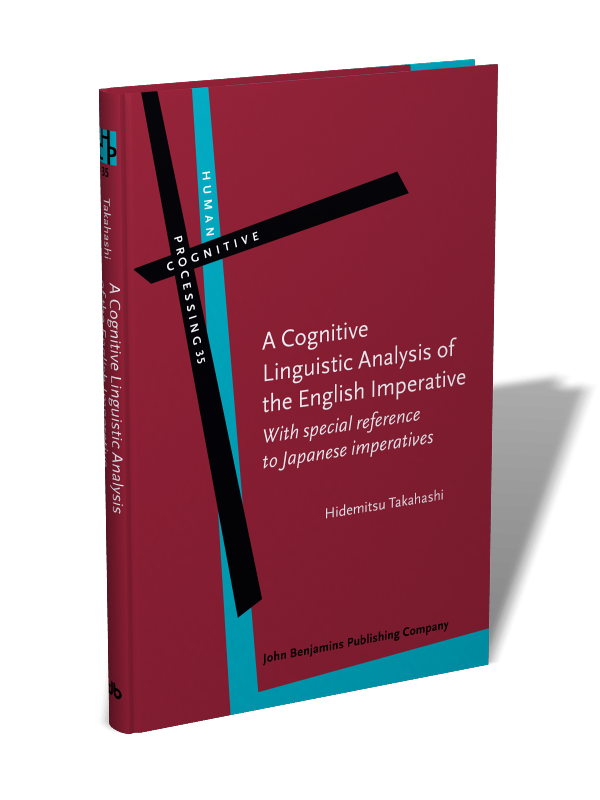
A Cognitive Linguistic Analysis of the English Imperative
With special reference to Japanese imperatives
Author

This volume offers the first comprehensive description of English imperatives made from a Cognitive Linguistic perspective. It proposes a new way of explaining the meaning and function of the imperative independently of illocutionary act classifications, which allows for quantifying the strength of imperative force in terms of parameters and numerical values. Furthermore, the book applies the theory of Construction Grammar to account for the felicity of imperatives in complex sentences. The model of description explains explicitly a wide range of phenomena, including frequency of use, prototypical vs. non-prototypical uses of the English imperative and the choice between longer vs. shorter directives including the imperative. A Cognitive Linguistic Analysis of the English Imperative: With Special Reference to Japanese Imperatives is intended for both researchers and students interested in the English imperative and Directive Speech Acts at large and for the linguists working within the Cognitive Linguistics and/or Construction Grammar approach.
[Human Cognitive Processing, 35] 2012. xvii, 242 pp.
Publishing status: Available
© John Benjamins Publishing Company




Table of Contents
-
List of figures | p. ix
-
List of tables | p. xi
-
Abbreviations | p. xiii
-
Acknowledgments | pp. xv–xvii
-
1. Introduction | pp. 1–20
-
2. Observing English imperatives in action | pp. 21–56
-
3. The meaning of the English imperative | pp. 57–92
-
4. Accounting for some of the findings in Chapter 2 and the choice between imperatives and indirect directives | pp. 93–119
-
5. Mixed imperative constructions: Passive, progressive, and perfective imperatives in English | pp. 121–135
-
6. Conditional imperatives in English | pp. 137–171
-
7. English imperatives in concessive clauses | pp. 173–196
-
8. Japanese imperatives | pp. 197–219
-
9. Conclusions and prospects | pp. 221–224
-
-
Data sources | p. 237
-
Name index | pp. 239–240
-
Subject index | pp. 241–242
“This book is most welcome for a number of reasons: as a detailed illustration of applying the descriptive and theoretical notions of cognitive linguistics; for its success in integrating multiple methods and multiple theoretical approaches; and as a comprehensive description of the English imperative. It achieves a broader and deeper understanding of this phenomenon, being especially informative due to comparison with Japanese.”
Ronald W. Langacker , University of California, San Diego
“The framework proposed in this work is a valuable addition to the field of Cognitive Linguistics. It provides insight into the elements by which imperative utterances can be classified, along with tools for comparing these utterances cross-linguistically. Ultimately, such a framework can serve as an important basis for further research in the area of imperative constructions.”
William W. Kruger, Lincoln, NE, USA, on Linguist List 23-1697 (2012)
“[...] this volume provides an interesting multi-faceted approach to functional, semantic and formal aspects of the imperative in English (and to a lesser extent in Japanese). By looking at the same object of study from different angles the reader arrives at a better understanding of the imperative both in terms of the attested behaviour and the motivations behind it.”
Bernard De Clerck, University College Ghent, in Functions of Language, Vol. 20:1 (2013).
Cited by
Cited by 19 other publications
Baicchi, Annalisa
2015. Conceptual metaphor in the complex dynamics of illocutionary meaning. Review of Cognitive Linguistics 13:1 ► pp. 106 ff. 

Chang, Miao-Hsia & Ún-giân Iûnn
2021. A corpus-based study of directives in Taiwanese Southern Min. Concentric. Studies in Linguistics 47:2 ► pp. 300 ff.
GÓRALCZYK, IWONA & JOANNA ŁOZIŃSKA
2021. Yoga instructions in Polish and Russian as directive speech acts: a cognitive linguistic perspective. Language and Cognition 13:4 ► pp. 613 ff.
Heine, Bernd
2016. On non-finiteness and canonical imperatives. In Finiteness and Nominalization [Typological Studies in Language, 113], ► pp. 243 ff.
Holvoet, Axel
2023. Towards an enhanced semantic map for imperatives. STUF - Language Typology and Universals 76:4 ► pp. 635 ff.
Lander, Yury & Irina Bagirokova
2022. West Circassian Imperative-Optative System: A Study in a Prototype-Based Organisation of a Grammatical Domain. Syntaxe & Sémantique N° 22:1 ► pp. 57 ff.
Li, Yisong & Changsong Wang
2022. A window into interpersonal relations inJane Eyrefrom the perspective of imperatives. Text & Talk 42:2 ► pp. 255 ff.
MINO, TAKASHI
2020. A CONSTRUCTIONAL ANALYSIS OF THE <i>THERE SPEAK</i> EXPRESSION WITH SPECIAL REFERENCE TO CONTEXT. ENGLISH LINGUISTICS 36:2 ► pp. 145 ff.
Pennock-Speck, Barry & Miguel Fuster-Márquez
2014. Imperatives in voice-overs in British TV commercials: ‘Get this, buy that, taste the other’. Discourse & Communication 8:4 ► pp. 411 ff.
Pérez Fernández, Sofía, Pedro Gras & Frank Brisard
2021. Semantic polyfunctionality and constructional networks. Constructions and Frames 13:1 ► pp. 82 ff.
Pérez-Hernández, Lorena
2019. From research to the textbook. Revista Española de Lingüística Aplicada/Spanish Journal of Applied Linguistics 32:1 ► pp. 248 ff.
Sansiñena, María Sol
2017. Eliciting evidence of functional differences. In Imperatives and Directive Strategies [Studies in Language Companion Series, 184],
Sansiñena, María Sol, Hendrik De Smet & Bert Cornillie
2015. Displaced directives: Subjunctive free-standing que-clauses vs. imperatives in Spanish. Folia Linguistica 49:1
Swearingen, Andrew
2017. Crossing the categorial divide. In Imperatives and Directive Strategies [Studies in Language Companion Series, 184],
Van Olmen, Daniël
2018. Reproachatives and imperatives. Linguistics 56:1 ► pp. 115 ff.
Van Olmen, Daniël & Simone Heinold
2017. Imperatives and directive strategies from a functional-typological perspective. In Imperatives and Directive Strategies [Studies in Language Companion Series, 184],
Vassilaki, Evgenia
2017. Chapter 4. Cognitive motivation in the linguistic realization of requests in Modern Greek. In Studies in Figurative Thought and Language [Human Cognitive Processing, 56], ► pp. 106 ff.
Xiang, Dajun & Chengyu Liu
2018. The Semantics of MOOD and the Syntax of the Let’s-construction in English: A Corpus-based Cardiff Grammar Approach. Australian Journal of Linguistics 38:4 ► pp. 549 ff.
[no author supplied]
2012. PUBLICATIONS RECEIVED. English Language and Linguistics 16:3 ► pp. 551 ff.
This list is based on CrossRef data as of 16 april 2024. Please note that it may not be complete. Sources presented here have been supplied by the respective publishers. Any errors therein should be reported to them.
Subjects
Main BIC Subject
CFK: Grammar, syntax
Main BISAC Subject
LAN009000: LANGUAGE ARTS & DISCIPLINES / Linguistics / General