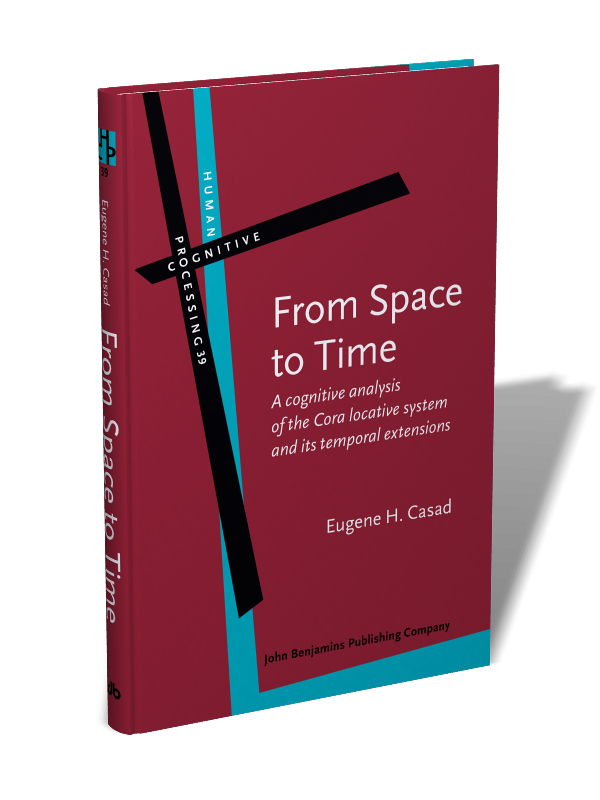
From Space to Time
A cognitive analysis of the Cora locative system and its temporal extensions
Author
Editors


Eugene Casad’s posthumous monograph is an in-depth study of the TIME IS SPACE metaphor in Cora – an Uto-Aztecan language spoken in the state of Nayarit, Mexico – within the framework of Ronald Langacker’s Cognitive Grammar. The author provides an introduction to Cora speakers and their history, and traces the evolution of Cora locative expressions, comparing them with cognate or corresponding expressions in other Uto-Aztecan languages, e.g. Huichol, to reconstruct the development of Cora temporal meanings. Based on a meticulous analysis of synchronic and diachronic data, Casad postulates distinct Cora models of time, grammatical aspect, and event structure, among which the topographically based model of time is especially prominent. This important book can be regarded as the opus magnum of the author. It should be of interest to scholars working in conceptual metaphor theory, grammaticalization, and the history and typology of Uto-Aztecan languages.
[Human Cognitive Processing, 39] 2012. xxvii, 263 pp.
Publishing status: Available
© John Benjamins Publishing Company




Table of Contents
-
List of figures | pp. xi–xii
-
List of tables | pp. xiii–xiv
-
List of maps | pp. xv–xvi
-
Abbreviations | pp. xvii–xviii
-
Author’s preface | pp. xix–xx
-
Editors’ prefaceKlaus-Uwe Panther and Linda L. Thornburg | pp. xxi–xxiv
-
PrologueBetty M. Casad | pp. xxv–xxviii
-
IntroductionRonald W. Langacker | pp. 1–4
-
Part 1. Background and orientation
-
Chapter 1. The Cora people and their language | pp. 7–24
-
Chapter 2. Theoretical prerequisites | pp. 25–54
-
Part 2. The emergence of the Cora locative system
-
Chapter 3. Inventory of Cora and Huichol locative prefixes | pp. 57–82
-
Chapter 4. Emergence of some Cora locative prefix sequences | pp. 83–124
-
Part 3. From space to time
-
Chapter 5. Cora temporals: Grounding and scope | pp. 127–144
-
Chapter 6. Space, events, and time in Cora | pp. 145–184
-
Chapter 7. Time and the sequencing of events | pp. 185–206
-
Chapter 8. Grammatical constructions and their temporal usages | pp. 207–238
-
Notes | pp. 239–250
-
“Since Cora is a language on the verge of extinction, this research monograph is undoubtedly the last chance of reading a thorough analysis of the emergence of its grammaticalized locative forms, coupled with a comprehensive account of the extensions from the locative domain to the domain of time. Having spent many years doing fieldwork among Cora speakers, E. Casad occupied the best possible position to undertake this endeavor and to complete it successfully. I know of nobody else who could have done it or would still be able to do it.”
Nicole Delbecque, Katholieke Universiteit Leuven
“This careful and detailed analysis of the semantic and conceptual relations between space and time draws on the author’s deep experience with the Cora language. Casad works systematically through the extensions of temporal language in Cora, giving a master class in the application of a classical Cognitive Grammar framework to the study of conceptual models and their development.”
N.J. Enfield, Max Planck Institute for Psycholinguistics, Nijmegen
“Overall, Eugene H. Casad has produced a comprehensive account of Cora’s unique locative system and its extensions to the temporal domain from a diachronic and synchronic point of view. Given the precarious status of the language, and Casad’s long-term commitment to the study and description of Cora, this book will become an invaluable source of reference for linguists interested in Uto-Atztecan languages, typology, and, most of all, cognitive linguistics.”
Dorothea Hoffmann, University of Chicago, in Anthropological Linguistics Vol. 55:3 (2014), pp. 301-304
Cited by
Cited by 5 other publications
Jódar Sánchez, José Antonio
2015. Review of Moore (2014): The Spatial Language of Time. Metaphor, Metonymy and Frames of Reference. Metaphor and the Social World 5:1 ► pp. 155 ff. 

Lewandowska-Tomaszczyk, Barbara
MOORE, KEVIN EZRA
2017. Elaborating time in space: the structure and function of space–motion metaphors of time. Language and Cognition 9:2 ► pp. 191 ff.
[no author supplied]
[no author supplied]
This list is based on CrossRef data as of 16 april 2024. Please note that it may not be complete. Sources presented here have been supplied by the respective publishers. Any errors therein should be reported to them.
Subjects
Main BIC Subject
CFK: Grammar, syntax
Main BISAC Subject
LAN009000: LANGUAGE ARTS & DISCIPLINES / Linguistics / General