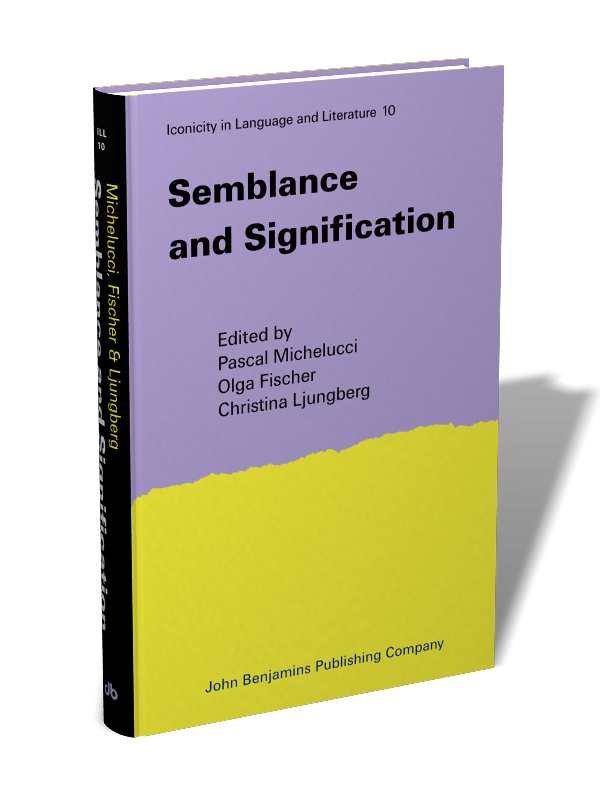
Semblance and Signification
Editors

The articles assembled in Semblance and Signification explore linguistic and literary structures from a range of theoretical perspectives with a view to understanding the extent, prevalence, productivity, and limitations of iconically grounded forms of semiosis. With the complementary examination of large theoretical issues, extensive corpus analysis in several modern languages such as Italian, Japanese Sign Language, and English, and applied close studies across a range of artistic media, this volume brings a fresh understanding of the cognitive underpinnings of iconicity. If primary and secondary modelling systems are rarely studied in tandem, it is clear from this volume that their fruitful juxtaposition yields striking insight into the cognitive concerns that pervade current semiotic research.
[Iconicity in Language and Literature, 10] 2011. xii, 427 pp.
Publishing status: Available
© John Benjamins Publishing Company




Table of Contents
-
Preface and acknowledgements | pp. ix–x
-
IntroductionPascal Michelucci | pp. xi–xii
-
Toward a phonosemantic definition of iconic wordsKimi Akita | pp. 1–18
-
Iconic thinking and the contact-induced transfer of linguistic material: The case of Japanese, signed Japanese, and Japan Sign LanguageWilliam J. Herlofsky | pp. 19–38
-
Ezra Pound among the Mawu: Ideophones and iconicity in SiwuMark Dingemanse | pp. 39–54
-
Cognitive iconic grounding of reduplication in languageOlga Fischer | pp. 55–82
-
Imagic iconicity in the Chinese languageZhuanglin Hu | pp. 83–100
-
Words in the mirror: Analysing the sensorimotor interface between phonetics and semantics in ItalianLuca Nobile | pp. 101–132
-
Un mélange genevois: Tacit notions of iconicity in Ferdinand De Saussure’s Writings in General LinguisticsJui-Pi Chien | pp. 133–148
-
How to put art and brain togetherMark Changizi | pp. 149–156
-
Image, diagram, and metaphor: Unmined resource and unresolved questionsVincent Colapietro | pp. 157–172
-
The farmers sowed seeds and hopes: Element order in metaphorical phrasesYeshayahu Shen and Elad Kotzer | pp. 173–190
-
Non-iconic chronology in English narrative textsVyacheslav Yevseyev | pp. 191–210
-
A burning world of war: How iconicity works in constructing the fictional world view in A Farewell to ArmsXinxin Zhao | pp. 211–230
-
Aesthetic qualities as structural resemblance: Divergence and perceptual forces in poetryReuven Tsur | pp. 231–250
-
Mental space mapping in classical Chinese poetry: A cognitive approachHan-liang Chang | pp. 251–268
-
Iconicity in conceptual blending: Material anchors in William Morris’s News from NowhereWilson David Glyn | pp. 269–288
-
Thematized iconicity and iconic devices in the modern novel: Some modes of interactionJohn J. White | pp. 289–312
-
Iconicity and intermediality in Charles Simic’s Dime-Store AlchemyGabriele Rippl | pp. 313–326
-
Words, like shells, are signs as well as thingsHeilna du Plooy | pp. 327–342
-
Unveiling creative subplots through the non-traditional application of diagrammatic iconicity: An analysis of Kingsley Amis’s The Green ManAndrew James | pp. 343–352
-
The iconic indexicality of photographyPiotr Sadowski | pp. 353–368
-
Unbinding the text: Intermedial iconicity in Peter Greenaway’s Prospero’s BooksChristina Ljungberg | pp. 369–388
-
Argumentative, iconic, and indexical structures in Schubert’s Die schöne MüllerinCostantino Maeder | pp. 389–404
-
John Irving’s A Widow for One Year and Tod Williams’ The Door in the Floor as ‘(mult-)i-conic’ works of artChristine Schwanecke | pp. 405–422
Cited by
Cited by 3 other publications
Hiraga, Masako K., William J. Herlofsky, Kazuko Shinohara & Kimi Akita
Ziomek, Paweł
2020. Corpus-based Analysis of Verbal and Nominal Reduplication in Colloquial Singapore English. Anglica. An International Journal of English Studies :29/2 ► pp. 55 ff. 

[no author supplied]
2017. Literatur. In Nicht-ikonische Chronologie, ► pp. 286 ff.
This list is based on CrossRef data as of 16 april 2024. Please note that it may not be complete. Sources presented here have been supplied by the respective publishers. Any errors therein should be reported to them.
Subjects
Literature & Literary Studies
Main BIC Subject
CFG: Semantics, Pragmatics, Discourse Analysis
Main BISAC Subject
LAN009000: LANGUAGE ARTS & DISCIPLINES / Linguistics / General