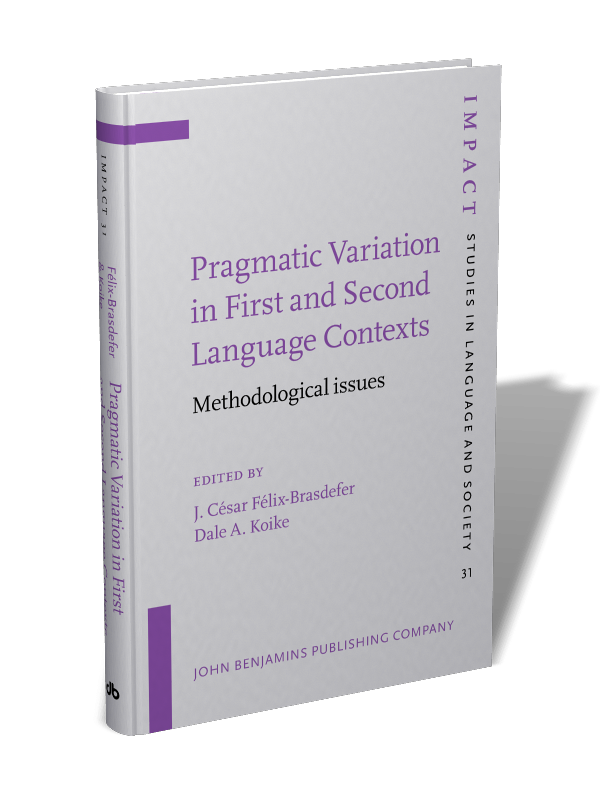
Pragmatic Variation in First and Second Language Contexts
Methodological issues
Editors


Departing from Schneider and Barron (2008), representing the emerging field of Variational Pragmatics, this volume examines pragmatic variation focusing on methods utilized to collect and analyze data in a variety of first (L1) and second (L2) language contexts. The objectives are to: (1) examine variation in such areas of pragmatics as speech acts, conventional expressions, metapragmatics, stance, frames, mitigation, communicative action, (im)politeness, and implicature; and (2) critically review central methodological concerns relevant for research in pragmatic variation, such as coding, ethical issues, qualitative and quantitative methods, and individual variation. Theoretical frameworks vary from variationist and interactional sociolinguistics, to variational pragmatics. This collection contains eleven chapters by leading scholars, including two state-of-the art chapters on key methodological issues of pragmatic variation study. Given the theoretical perspectives, methodological focus, and analyses, the book will be of interest to those who study pragmatics, discourse analysis, second language acquisition, sociolinguistics, corpus linguistics, and language variation.
[IMPACT: Studies in Language, Culture and Society, 31] 2012. x, 338 pp.
Publishing status: Available
© John Benjamins Publishing Company




Table of Contents
-
Acknowledgements | pp. vii–viii
-
Notes on contributors | pp. ix–x
-
Introduction: Pragmatic variation in first and second language contextsJ. César Félix-Brasdefer and Dale Koike | pp. 1–16
-
Chapter 1. Pragmatic variation by gender in market service encounters in MexicoJ. César Félix-Brasdefer | pp. 17–48
-
Chapter 2. Cross-cultural stances in online discussions: Pragmatic variation in French and American ways of expressing opinionsCarl S. Blyth | pp. 49–80
-
Chapter 3. Pragmatic variation in therapeutic discourse: An examination of mitigating devices employed by Dominican female clients and a Cuban American therapistNydia Flores-Ferrán | pp. 81–112
-
Chapter 4. Disagreement and sociolinguistic variables: English as a Lingua Franca of Practice in ChinaWei Zhu Hua and Diana Boxer | pp. 113–140
-
Chapter 5. Variation in the pragmatic use of conventional expressionsKathleen Bardovi-Harlig | pp. 141–174
-
Chapter 6. Variation in NS-learner interactions: Frames and expectations in pragmatic coconstructionDale Koike | pp. 175–208
-
Pragmatic variation in learner perception: The role of retrospective verbal report in L2 speech act researchHelen Woodfield | pp. 209–238
-
Chapter 8. Variationist sociolinguistics, L2 sociopragmatic competence, and corpus analysis of classroom-based synchronous computer-mediated discourseRémi A. van Compernolle and Lawrence Williams | pp. 239–270
-
Research methods for describing variation in intercultural pragmatics for cultures in contact and conflictAndrew D. Cohen | pp. 271–294
-
Chapter 10. Between pragmatics and sociolinguistics: Where does pragmatic variation fit in?Marina Terkourafi | pp. 295–318
-
Chapter 11. Conclusions: Methodological issues in pragmatic variationDale Koike and J. César Félix-Brasdefer | pp. 319–336
-
Index | pp. 337–338
“Recent years have seen an upsurge of interest in pragmatic variation in the first language setting. This volume very admiringly furthers the empirical basis and the theoretical and methodological discussion on this setting, while also taking up the investigation of pragmatic variation in the second language context. Taken together, the book offers many new and captivating insights, thoughts and ideas on pragmatic variation. It is a must-read for pragmatists, sociolinguists and second language researchers researching in the area.”
Anne Barron, Leuphana University Lüneburg
“Drawing on an impressive array of research methods, the 12 experts in this remarkable book push the fields of Pragmatics and Sociolinguistics in directions both qualitative and quantitative. How? In Pragmatics, the speaker is often depicted as fully rational yet living in an asocial world where the only tasks of communication are cognitive. Speakers deliberately select from sets of linguistic resources, obeying perceived discourse and listener-based constraints so as to best produce intended responses in the listener. If deliberate, no statistical variation should occur. Also, the listener as active socially-situated participant in negotiations of meaning is only vaguely present. Two issues emerge: the social listener as meaning maker and variation either of different forms to create similar meanings or of differing meanings mapped to similar forms. By pushing in these directions, the researchers here creatively push the envelope not only of Pragmatics but also of Variationist Sociolinguistics.”
Richard Cameron, University of Illinois at Chicago, USA
Cited by
Cited by 9 other publications
Barron, Anne
2023. Irish English and Variational Pragmatics. In The Oxford Handbook of Irish English, ► pp. 400 ff. 

Beeching, Kate & Helen Woodfield
2015. Introduction. In Researching Sociopragmatic Variability, ► pp. 1 ff.
Blyth, Carl & Dale A. Koike
2014. Interactional frames and grammatical constructions. In Perspectives on Linguistic Structure and Context [Pragmatics & Beyond New Series, 244], ► pp. 87 ff.
Derakhshan, Ali & Farzaneh Shakki
2023. Overview of the Theoretical Frameworks. In Instructed Second Language Pragmatics for The Speech Acts of Request, Apology, and Refusal: A Meta-Analysis [Second Language Learning and Teaching, ], ► pp. 1 ff.
Dixon, Tülay & Daniel H. Dixon
2024. A simple methodology for identifying speech act tendencies. Applied Pragmatics 6:1 ► pp. 60 ff.
Grein, Marion
2018. Progress in language teaching. In From Pragmatics to Dialogue [Dialogue Studies, 31], ► pp. 61 ff.
Kroll, Judith F., Paola E. Dussias, Kinsey Bice & Lauren Perrotti
2015. Bilingualism, Mind, and Brain. Annual Review of Linguistics 1:1 ► pp. 377 ff.
Sydorenko, Tetyana, Phoebe Daurio & Steven L. Thorne
2018. Refining pragmatically-appropriate oral communication via computer-simulated conversations. Computer Assisted Language Learning 31:1-2 ► pp. 157 ff.
[no author supplied]
2013. Publications Received. Language in Society 42:2 ► pp. 237 ff.
This list is based on CrossRef data as of 16 april 2024. Please note that it may not be complete. Sources presented here have been supplied by the respective publishers. Any errors therein should be reported to them.
Subjects
Main BIC Subject
CFG: Semantics, Pragmatics, Discourse Analysis
Main BISAC Subject
LAN009000: LANGUAGE ARTS & DISCIPLINES / Linguistics / General