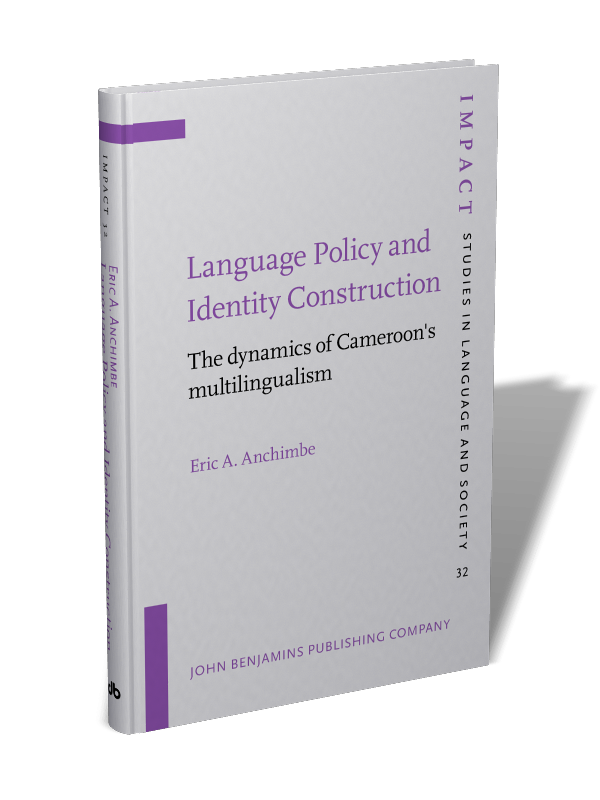
Language Policy and Identity Construction
The dynamics of Cameroon's multilingualism
Author

The (dis)empowerment of languages through language policy in multilingual postcolonial communities often shapes speakers’ identification with these languages, their attitude towards other languages in the community, and their choices in interpersonal and intergroup communication. Focusing on the dynamics of Cameroon’s multilingualism, this book contributes to current debates on the impact of politic language policy on daily language use in sociocultural and interpersonal interactions, multiple identity construction, indigenous language teaching and empowerment, the use of Cameroon Pidgin English in certain formal institutional domains initially dominated by the official languages, and linguistic patterns of social interaction for politeness, respect, and in-group bonding. Due to the multiple perspectives adopted, the book will be of interest to sociolinguists, applied linguists, pragmaticians, Afrikanists, and scholars of postcolonial linguistics.
[IMPACT: Studies in Language, Culture and Society, 32] 2013. xxvi, 250 pp.
Publishing status: Available
© John Benjamins Publishing Company




Table of Contents
-
Introduction: Language policy and identity construction in multilingual Cameroon | pp. 1–18
-
Chapter 1. Functional marginalisation and the future of indigenous languages: More official functions for indigenous languages | pp. 19–50
-
Chapter 2. Language policy towards indigenous languages: Many decrees and laws but less practice | pp. 51–66
-
Chapter 3. Constraints to indigenous language empowerment: On language relevance, views from below | pp. 67–76
-
Chapter 4. Crossing the survival line: Factors that protect indigenous languages from extinction | pp. 77–96
-
Chapter 5. Towards a regional multilingualism model: Empowering indigenous languages through policy and functional utility | pp. 97–112
-
Chapter 6. Slippery pathways in French-English bilingualism: Cameroon is bilingual but Cameroonians are not | pp. 113–128
-
Chapter 7. Anglophonism and francophonism: Tendencies in official language identity | pp. 129–148
-
Chapter 8. Hybrid linguistic identities and identity opportunism: Switching identity together with language | pp. 149–166
-
Chapter 9. Cameroon Pidgin English: Expanding functions and increasing users | pp. 167–188
-
Chapter 10. Come greet Uncle Eric: Politeness and respect through kinship terms | pp. 189–204
-
Chapter 11. Youthspeak: Lexical markers of youth group communication | pp. 205–218
-
On language policy, linguistic identity, and social interaction: General implications and further research | pp. 219–224
-
Appendices | pp. 225–228
-
References | pp. 229–246
-
Index | pp. 247–250
“It is nice, and refreshing, to get such a comprehensive look at the language situation in one specific African country, from a number of different perspectives and through different lenses. Sometimes, diverse aspects of the language situation cross over and shed light on each other in a way that is only made possible through having multiple objects of study. The author demonstrates the link between colonialism and the contemporary language situation in action, without being deterministic about it. There is a rather optimistic feeling that the language situation is really in the hands of Cameroonians rather than policy-makers or linguists.”
Ellen Hurst, Cape Town University
“
Language Policy and Identity Construction is a must for anyone interested in the sociolinguistics of Cameroon and beyond. Anchimbe’s work not only is the most up-to-date discussion of the complex linguistic situation in this multilingual country, but also offers fresh theoretical starting points for the post-colonial study of language.”
Hans-Georg Wolf, University of Potsdam
“This is a fascinating book. It is very richly documented, with up-to-date materials, on the sociolinguistic frameworks used in general, and on Cameroon in particular. The author is uniquely well informed about the field realities of the setting investigated.”
Augustin Simo Bobda, University of Yaounde I
Cited by
Cited by 22 other publications
Ajagbe, Samsondeen, Bridget Fonkeu & Uyi Edegbe
2022. West African Pidgin as a tool for socio-economic development. Language Problems and Language Planning 46:1 ► pp. 1 ff. 

Anchimbe, Eric A.
2014. Introduction—Indigenisation and Multilingualism: Extending the Debate on Language Evolution in Cameroon. In Structural and Sociolinguistic Perspectives on Indigenisation, ► pp. 1 ff.
Anchimbe, Eric A.
2014. Global Identities or Local Stigma Markers: How Equal Is the ‘E’ in Englishes in Cameroon?. In Englishes in Multilingual Contexts [Multilingual Education, 10], ► pp. 47 ff.
Anchimbe, Eric A.
2020. Chapter 13. Naming food in English in multilingual Cameroon. In Talking about Food [IMPACT: Studies in Language, Culture and Society, 47], ► pp. 257 ff.
Ashraf, Hina
2022. The ambivalent role of Urdu and English in multilingual Pakistan: a Bourdieusian study. Language Policy
BOKAMBA, EYAMBA G.
2015. African Englishes and creative writing. World Englishes 34:3 ► pp. 315 ff.
Bokamba, Eyamba G.
2018. Multilingualism and theories of second language acquisition in Africa. World Englishes 37:3 ► pp. 432 ff.
Bokamba, Eyamba G.
2019. African Englishes and Creative Writing. In The Handbook of World Englishes, ► pp. 173 ff.
Bokamba, Eyamba G.
2019. Nationalism and the emergence of Lingala as a supranational language in DR Congo. World Englishes 38:1-2 ► pp. 53 ff.
Haser, Verena, Anita Auer, Bert Botma, Beáta Gyuris, Kathryn Allan, Mackenzie Kerby, Lieselotte Anderwald, Alexander Kautzsch, Maja Miličević, Tihana Kraš & Marcus Callies
2015. IEnglish Language. The Year's Work in English Studies 94:1 ► pp. 1 ff.
Lucas, Rochelle Irene G., Ericson O. Alieto & Abee M. Eijansantos
2023. Assessing Language Attitudes Towards Translanguaging of Young Adult Learners in a Multilingual Setting. In Translanguaging for Empowerment and Equity, ► pp. 49 ff.
Mazzoli, Maria
2021. The ideological debate on Naijá and its use in education. English World-Wide. A Journal of Varieties of English 42:3 ► pp. 299 ff.
Ozón, Gabriel, Sarah FitzGerald & Melanie Green
2019. Chapter 1.6. Addressing a coverage gap in African Englishes. In Corpus Linguistics and African Englishes [Studies in Corpus Linguistics, 88], ► pp. 144 ff.
Pérez-Sabater, Carmen & Ginette Maguelouk-Moffo
Spolsky, Bernard
2018. Language policy in French colonies and after independence. Current Issues in Language Planning 19:3 ► pp. 231 ff.
Yakpo, Kofi
2016. Review of Migge & Léglise (2013): Exploring language in a multilingual context. Variation, interaction and ideology in language documentation. Journal of Pidgin and Creole Languages 31:2 ► pp. 467 ff.
Yakpo, Kofi
2020. Sociolinguistic characteristics of the English-lexifier contact languages of West Africa. In Advances in Contact Linguistics [Contact Language Library, 57], ► pp. 62 ff.
Zhang, Grace & Qian Gong
2014. The Retention of Year 11/12 Chinese in Australian Schools: A Relevance Theory Perspective. In Critical Perspectives on Language Education [Multilingual Education, 11], ► pp. 119 ff.
[no author supplied]
2013. PUBLICATIONS RECEIVED. Language in Society 42:4 ► pp. 479 ff.
[no author supplied]
[no author supplied]
[no author supplied]
This list is based on CrossRef data as of 16 april 2024. Please note that it may not be complete. Sources presented here have been supplied by the respective publishers. Any errors therein should be reported to them.
Subjects
Main BIC Subject
CFB: Sociolinguistics
Main BISAC Subject
LAN009000: LANGUAGE ARTS & DISCIPLINES / Linguistics / General