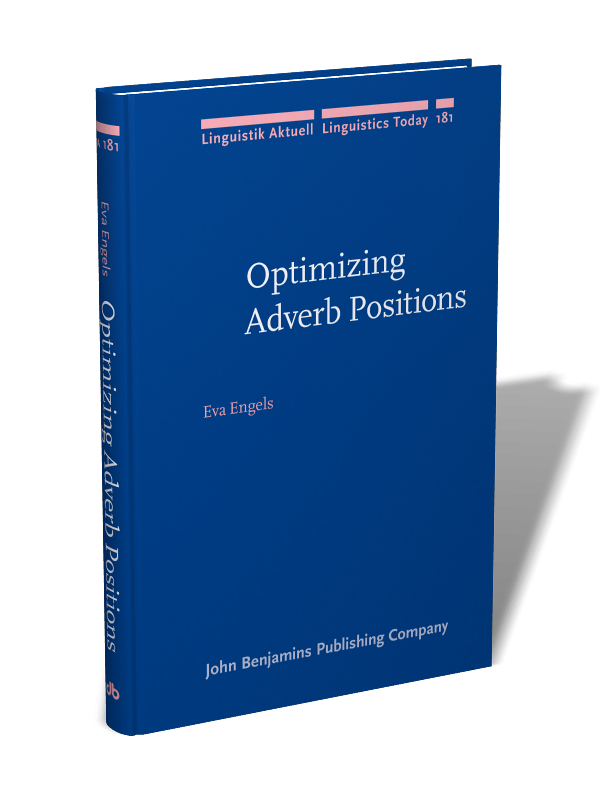
Optimizing Adverb Positions
Author

Adverb positions vary within a single language as well as across diverse languages. Based on the study of adverbs in English, French and German, this monograph shows that the distribution of adverbs is influenced by various factors at distinct levels of linguistic representation – comprising semantics, syntax, phonology and information structure –, which interact in determining adverb positions. The results of the investigation are formulated within the theoretical framework of Optimality Theory, which captures the complex interaction of these factors by hierarchically ranked constraints, deriving cross-linguistic variation of adverb positions by differences in the language-specific constraint hierarchies. The book is divided into two parts: While Part I examines adverb positions in general, Part II investigates under which circumstances an adverb may attach to a phonetically empty constituent in the languages under discussion. The book appeals to a linguistic audience interested in Germanic and Romance languages as well as in theoretical syntax in general.
[Linguistik Aktuell/Linguistics Today, 181] 2012. xiv, 347 pp.
Publishing status: Available
© John Benjamins Publishing Company




Table of Contents
-
| pp. ix–x
-
Introduction | pp. xi–xiv
-
Chapter 1. Basic assumptions on inputs and output candidates | pp. 1–32
-
Chapter 2. Verb movement and adverb placement | pp. 33–100
-
Chapter 3. Information structure and adverb placement | pp. 101–218
-
Chapter 4. Interim conclusion | pp. 219–222
-
Chapter 5. Gap constructions in English | pp. 223–268
-
Chapter 6. Other languages | pp. 269–324
-
Chapter 7. Conclusion | pp. 325–332
-
References | pp. 333–344
-
Index | pp. 345–348
Cited by
Cited by 6 other publications
Andréasson, Maia
2013. Object shift in Scandinavian languages: The impact of contrasted elements. Nordic Journal of Linguistics 36:2 ► pp. 187 ff. 

Engels, Eva & Sten Vikner
2013. Object Shift and remnant VP-topicalisation: Danish and Swedish verb particles and ‘let’-causatives. Nordic Journal of Linguistics 36:2 ► pp. 219 ff.
Ernst, Thomas
2020. The Syntax of Adverbials. Annual Review of Linguistics 6:1 ► pp. 89 ff.
Liao, Wei-wen Roger & Grant Hung-Ta Kao
2023. Extraction asymmetries in topic structures: a comparative analysis. Journal of East Asian Linguistics 32:1 ► pp. 63 ff.
[no author supplied]
2012. Livres reçus. Canadian Journal of Linguistics/Revue canadienne de linguistique 57:3 ► pp. 491 ff.
[no author supplied]
2013. Publications received in 2012. Nordic Journal of Linguistics 36:1 ► pp. 107 ff.
This list is based on CrossRef data as of 16 april 2024. Please note that it may not be complete. Sources presented here have been supplied by the respective publishers. Any errors therein should be reported to them.
Subjects
Main BIC Subject
CFK: Grammar, syntax
Main BISAC Subject
LAN009000: LANGUAGE ARTS & DISCIPLINES / Linguistics / General