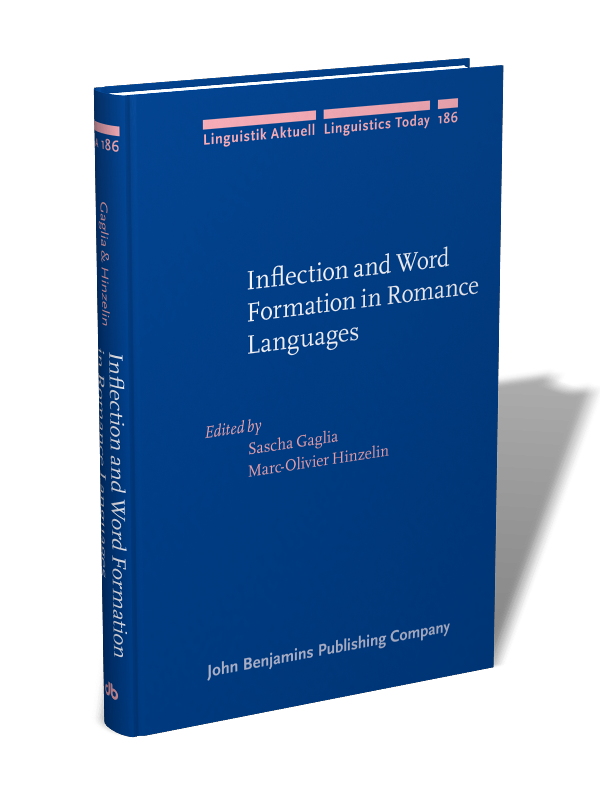
Inflection and Word Formation in Romance Languages
Editors


Morphology, and in particular word formation, has always played an important role in Romance linguistics since it was introduced in Diez’s comparative Romance grammar. Recent years have witnessed a surge of interest in inflectional morphology, and current research shows a strong interest in paradigmatic analyses. This volume brings together research exploring different areas of morphology from a variety of theoretical and methodological perspectives. On an empirical basis, the theoretical assumption of the ‘Autonomy of Morphology’ is discussed critically. ‘Data-driven’ approaches carefully examine concrete morphological phenomena in Romance languages and dialects. Topics include syncretism and allomorphy in verbs, pronouns, and articles as well as the use of specific derivational suffixes in word formation. Together, the articles in this volume provide insights into issues currently debated in Romance morphology, appealing to scholars of morphology, Romance linguistics, and advanced students alike.
[Linguistik Aktuell/Linguistics Today, 186] 2012. vii, 400 pp.
Publishing status: Available
© John Benjamins Publishing Company





Table of Contents
-
Acknowledgements | pp. vii–viii
-
Morphological theories, the Autonomy of Morphology, and Romance dataMarc-Olivier Hinzelin and Sascha Gaglia | pp. 1–26
-
A paradox? The morphological history of the Romance present subjunctiveMartin Maiden | pp. 27–54
-
Verb morphology gone astray: Syncretism patterns in Gallo-RomanceMarc-Olivier Hinzelin | pp. 55–82
-
The Friulian subject clitics: Realisation and paradigmatic structureSascha Gaglia | pp. 83–118
-
Romance clitic pronouns in lexical paradigmsChristoph Schwarze | pp. 119–140
-
Hiatus resolution between function and lexical words in French and Italian: Phonology or morphology?Luigia Garrapa | pp. 141–178
-
Occitan plurals: A case for a morpheme-based morphologyPatrick Sauzet | pp. 179–200
-
Partial or complete lack of plural agreement: The role of morphologyNatascha Pomino | pp. 201–230
-
Noun inflectional classes in MacerateseTania Paciaroni | pp. 231–270
-
Participles and nominal aspectEva-Maria Remberger | pp. 271–294
-
Modifying suffixes in Italian and the Autonomy of MorphologyHeike Necker | pp. 295–318
-
SE-verbs, SE-forms or SE-constructions? SE and its transitional stages between morphology and syntaxKatrin Mutz | pp. 319–346
-
The lexicalist hypothesis and the semantics of event nominalization suffixesMelanie Uth | pp. 347–368
-
Italian brand names – morphological categorisation and the Autonomy of MorphologyAntje Zilg | pp. 369–384
-
Author index | pp. 385–388
-
Index of subjects and languages | pp. 389–400
“The volume excels through the combination of a comprehensive theoretical perspective and detailed consideration of known facts and descriptive problems in Romance linguistics, presenting them in a new light. Accordingly, theory-driven and data-driven approaches are featured side by side, complementing each other perfectly. With their diverse theoretical backgrounds, which differ from each other above all with regard to the central issue of the Autonomy of Morphology, the contributions to the volume offer a highly interesting synopsis of descriptive approaches since the era of early Generative Grammar. The texts address synchronic as well as diachronic issues and are written in a way that makes them suitable as a highly useful introduction to the general field of enquiry also for the non-specialist.”
Ulrich Wandruszka, University of Klagenfurt
“Romance linguistics has a lot to offer to all linguists, and this book proves the point by showcasing the field at its best. It is a collection of studies impressive for empirical scope and depth of analysis in a variety of frameworks, and characterized by the rigour and attention to empirical detail that one can expect from a tradition of robust scholarship. Despite the rich diversity in theoretical approaches and empirical domains, these studies make up a remarkably coherent whole, which globally addresses the question of an irreducibly morphological dimension in linguistic analysis. Over and above the wealth of data and the specific contributions to topical theoretical issues, this stimulating collection is a major contribution to the fundamental debate on knowledge of morphology and on the nature of paradigmatic relations in a theory of language.”
Paolo Acquaviva, University College Dublin
Subjects
Main BIC Subject
CF/2AD: Linguistics/Romance, Italic & Rhaeto-Romanic languages
Main BISAC Subject
LAN009000: LANGUAGE ARTS & DISCIPLINES / Linguistics / General