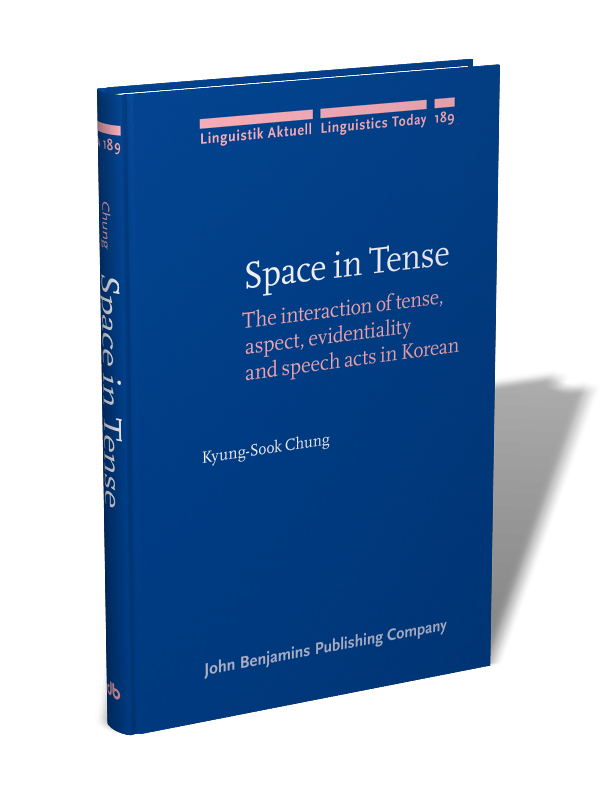
Space in Tense
The interaction of tense, aspect, evidentiality and speech acts in Korean
Author

This monograph explores the tense, aspect, mood, and evidentiality of Korean, which has a rich verbal inflectional system, and proposes novel treatments within the framework of compositional semantics. One of the major contributions is the demonstration that Korean has two types of deictic tense—simple deictic and spatial deictic tense. Spatial deictic tense refers to the notion of the speaker’s ‘perceptual field’ (or deictic range), as well as to temporality, functioning to set up a condition for a systematic evidential distinction. The research in this volume shows that the basic paradigm of evidentiality of Korean derives from the standard TMA system combined with the notion of space. This volume also shows that perfect and past tense utilize different primitives. The intended readership of this volume extends beyond Koreanists to scholars interested specifically in tense, mood, aspect, and evidentiality as well as in general theories of grammar and semantics-pragmatics.
[Linguistik Aktuell/Linguistics Today, 189] 2012. xvii, 292 pp.
Publishing status: Available
© John Benjamins Publishing Company




Table of Contents
-
Acknowledgments | pp. xi–xii
-
List of tables | pp. xiii–xiv
-
List of figures | pp. xv–xvi
-
Abbreviations | pp. xvii–xviii
-
Chapter 1. Introduction | pp. 1–20
-
Chapter 2. Deictic and non-deictic tenses in Korean | pp. 21–54
-
Chapter 3. Semantics and pragmatics of the perfect (anterior) | pp. 55–88
-
Chapter 4. Spatial deictic tense | pp. 89–124
-
Chapter 5. Evidentials in Korean | pp. 125–198
-
Chapter 6. Evidential vs. non-evidential sentences | pp. 199–226
-
Chapter 7. Conclusions and further issues | pp. 227–276
-
Bibliography | pp. 277–284
-
Author index | pp. 285–286
-
Language index | pp. 287–288
-
Subject index | pp. 289–292
“This book provides an original and coherent analysis of a major part of the Korean tense/aspect/evidentiality system. In spite of a large prior literature on these issues, many problems have remained unsolved. Kyung-Sook Chung’s book contributes novel empirical findings, as well as new analytical insights which have implications not just for Korean, but for natural language more generally.”
Lisa Matthewson, University of British Columbia
Cited by
Cited by 5 other publications
Ahn, Mikyung
Ahn, Mikyung & Foong Ha Yap
Chen, Sihwei, Jozina Vander Klok, Lisa Matthewson & Hotze Rullmann
2021. The ‘experiential’ as an existential past. Natural Language & Linguistic Theory 39:3 ► pp. 709 ff. 

Kim, Min-Joo
2016. The ‘imperfective’ in attributive clauses in Korean as a window into the evidential past and the metaphysical future. Studies in Language 40:2 ► pp. 340 ff.
Kwon, Kyongjoon
2018. A bias-driven modal development of evidentiality: the Korean inferential evidential –po. Journal of East Asian Linguistics 27:4 ► pp. 311 ff.
This list is based on CrossRef data as of 16 april 2024. Please note that it may not be complete. Sources presented here have been supplied by the respective publishers. Any errors therein should be reported to them.
Subjects
Main BIC Subject
CF/2GK: Linguistics/Korean
Main BISAC Subject
LAN009000: LANGUAGE ARTS & DISCIPLINES / Linguistics / General