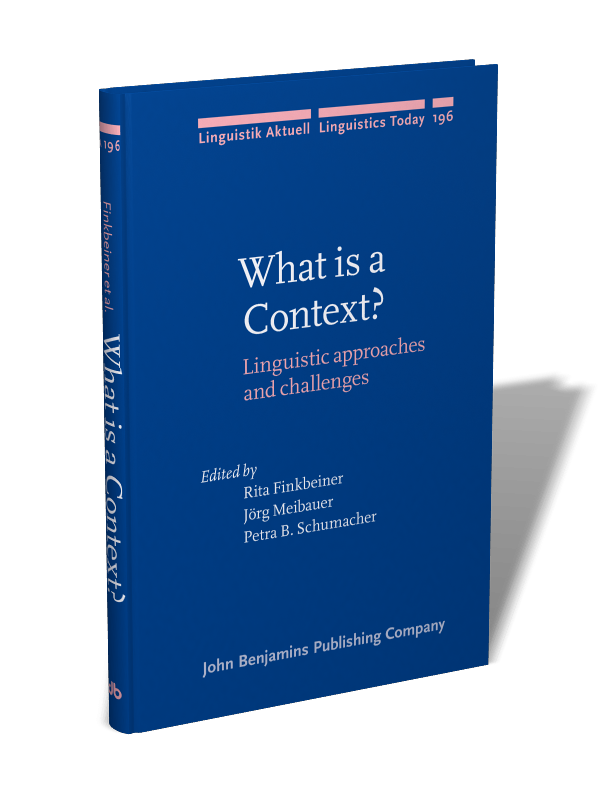
What is a Context?
Linguistic approaches and challenges
Editors


Context is a core notion of linguistic theory. However, while there are numerous attempts at explaining single aspects of the notion of context, these attempts are rather diverse and do not easily converge to a unified theory of context. The present multi-faceted collection of papers reconsiders the notion of context and its challenges for linguistics from different theoretical and empirical angles. Part I offers insights into a wide range of current approaches to context, including theoretical pragmatics, neurolinguistics, clinical pragmatics, interactional linguistics, and psycholinguistics. Part II presents new empirical findings on the role of context from case studies on idioms, unarticulated constituents, argument linking, and numerically-quantified expressions. Bringing together different theoretical frameworks, the volume provides thought-provoking discussions of how the notion of context can be understood, modeled, and implemented in linguistics. It is essential for researchers interested in theoretical and applied linguistics, the semantics/pragmatics interface, and experimental pragmatics.
[Linguistik Aktuell/Linguistics Today, 196] 2012. vii, 253 pp.
Publishing status: Available
© John Benjamins Publishing Company




Table of Contents
-
Preface | pp. vii–viii
-
IntroductionRita Finkbeiner, Jörg Meibauer and Petra B. Schumacher | pp. 1–6
-
Part I. Linguistic perspectives on context
-
What is a context? Theoretical and empirical evidenceJörg Meibauer | pp. 9–32
-
Context in neurolinguistics: Time-course data from electrophysiologyPetra B. Schumacher | pp. 33–54
-
Theorising context: The case of clinical pragmaticsLouise Cummings | pp. 55–80
-
Context: Gricean intentions vs. two-dimensional semanticsKatarzyna M. Jaszczolt | pp. 81–104
-
Contexts in interaction: Relating pragmatic wastebasketsAnita Fetzer | pp. 105–128
-
What’s non-linguistic visual context? A view from language comprehensionPia Knoeferle and Ernesto Guerra | pp. 129–150
-
Part II.Case studies on context
-
Emergent contexts: Observations on the context-creative power of idiomsRita Finkbeiner | pp. 153–174
-
The role of context in interpreting implicit meaning aspectsKristin Börjesson | pp. 175–198
-
Contextually enriched argument linkingUdo Klein | pp. 199–228
-
Modelling context within a constraint-based account of quantifier usageChris Cummins and Napoleon Katsos | pp. 229–250
-
Subject and name index | pp. 251–254
Cited by
Cited by 13 other publications
Dirks, Una
Finkbeiner, Rita
2014. Identical constituent compounds in German. Word Structure 7:2 ► pp. 182 ff. 

Glăveanu, Vlad Petre
2014. Theorising context in psychology: The case of creativity. Theory & Psychology 24:3 ► pp. 382 ff.
Haß, Ulrike
2018. Der verheißungsvolle Kontext und seine Leistungen bei der Erschließung von Wortbedeutungen. Zeitschrift für Angewandte Linguistik 2018:69 ► pp. 33 ff.
Hoffmeister, Toke
2023. Von toxischen Substanzen und toxischer Männlichkeit. Eine korpuspragmatische Studie zur Erschließung eines Gegenwartsphänomens. Zeitschrift für germanistische Linguistik 51:3 ► pp. 424 ff.
Meibauer, Jörg
Nagy C., Katalin
2014. Kontextus(ok) a grammatikalizációs jelentésváltozás irodalmában. Jelentés és Nyelvhasználat 1:1 ► pp. 11 ff.
Neyole, Eunice N., Frida A. Miruka & Deborah N. Amukowa
2023. Co-Text and Implicature in Bi. Msafwari’s Topical Discussions. African Journal of Empirical Research 4:2 ► pp. 885 ff.
Pemberton, Ian
2024. Principles. In Usage-Based Second Language Instruction, ► pp. 195 ff.
Renkema, Jan & Christoph Schubert
Traugott, Elizabeth
2023. Context in Historical Linguistics. In The Cambridge Handbook of Language in Context, ► pp. 49 ff.
Weigand, Edda
[no author supplied]
2013. PUBLICATIONS RECEIVED. Language in Society 42:3 ► pp. 359 ff.
This list is based on CrossRef data as of 16 april 2024. Please note that it may not be complete. Sources presented here have been supplied by the respective publishers. Any errors therein should be reported to them.
Subjects
Main BIC Subject
CFK: Grammar, syntax
Main BISAC Subject
LAN009000: LANGUAGE ARTS & DISCIPLINES / Linguistics / General