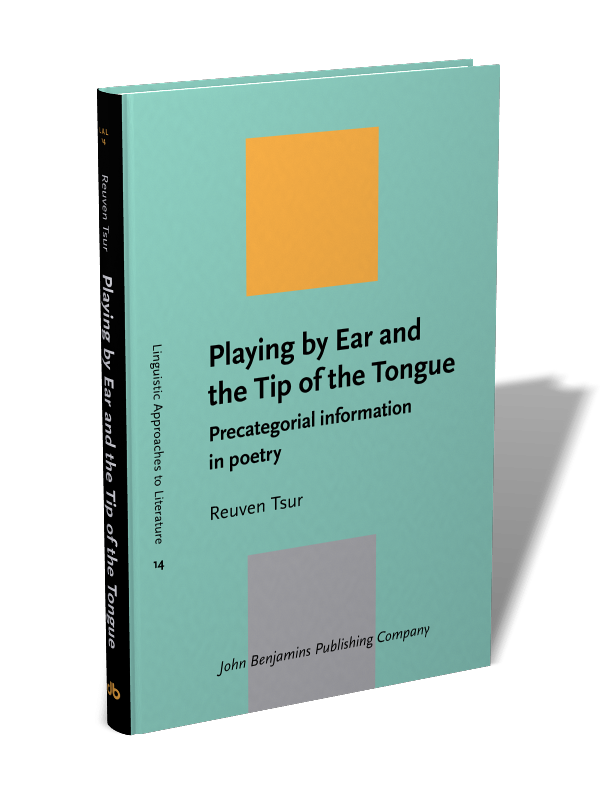
Playing by Ear and the Tip of the Tongue
Precategorial information in poetry
Author

In our everyday life we are flooded by a pandemonium of information which consciousness organizes into more easily manageable phonetic and semantic categories. In poetry reading, however, the total effect of a poem is not only obtained by some of these categories but also by precategorial information, for which there is a growing body of empirical evidence of its psychological reality. In the Tip of the Tongue phenomenon, a great amount of diffuse precategorial information is present but fails to “grow together” into a compact word, generating a feeling of some dense, undifferentiated mass. Poetic language typically exploits such precategorial information for its effects. By way of theoretical considerations and close readings, this book explores the semantic and phonetic strategies by which a text may increase or decrease the impact of such information. It investigates the conditions that boost or inhibit overtone fusion in rhyme and alliteration. By seeking empirical evidence for the claims he makes in different fields such as music, art, literature, linguistics, experiments in the speech laboratory, the author provides ample and sound examples (ambiguity intended) in an almost conversational tone, which makes us really anticipate reading each new chapter.
[Linguistic Approaches to Literature, 14] 2012. xi, 310 pp.
Publishing status: Available
© John Benjamins Publishing Company




Table of Contents
-
Preface | pp. xi–xii
-
Chapter 1. Introduction | pp. 1–18
-
Chapter 2. The poetic mode of speech perception revisited: What our ear tells our mind | pp. 19–36
-
Chapter 3. The tot phenomenon: A psycholinguistic model of poetry | pp. 37–50
-
Chapter 4. “Oceanic” dedifferentiation and poetic metaphor | pp. 51–64
-
Chapter 5. Deixis and abstractions: Adventures in space and time | pp. 65–94
-
Chapter 6. Three case studies – Keats, Spenser, Baudelaire | pp. 95–116
-
Chapter 7. Linguistic devices and ecstatic poetry: “The Windhover” – tongue-twisters and cognitive processes | pp. 117–130
-
Chapter 8. Defamiliarization revisited | pp. 131–138
-
Chapter 9. Aesthetic qualities as structural resemblance: Divergence and perceptual forces in poetry | pp. 139–158
-
Chapter 10. Metaphor and figure–ground relationship: Comparisons from poetry, music, and the visual arts | pp. 159–192
-
Chapter 11. Size–sound symbolism revisited | pp. 193–222
-
Chapter 12. Issues in literary synaesthesia: A brief glance | pp. 223–240
-
Chapter 13. The place of nonconceptual information in university education | pp. 241–258
-
Chapter 14. Points and counterpoints | pp. 259–292
-
References | pp. 293–300
Cited by
Cited by 25 other publications
Agapova, Ol'ga Vladislavovna
2019. SYNESTHESIA IN THE FRENCH FINE ART DISCOURSE. Philology. Theory & Practice 12:9 ► pp. 294 ff. 

Antović, Mihailo
2021. Multilevel grounded semantics across cognitive modalities: Music, vision, poetry. Language and Literature: International Journal of Stylistics 30:2 ► pp. 147 ff.
Bolognesi, Marianna M., Claudia Roberta Combei, Marta La Pietra & Francesca Masini
2024. What makes an awfully good oxymoron?. Language and Cognition 16:1 ► pp. 242 ff.
Gafni, Chen & Reuven Tsur
2015. “Softened” voice quality in poetry reading and listener response. Scientific Study of Literature 5:1 ► pp. 49 ff.
Gafni, Chen & Reuven Tsur
2019. Some experimental evidence for sound–emotion
interaction. Scientific Study of Literature 9:1 ► pp. 53 ff.
Kraxenberger, Maria & Winfried Menninghaus
2016. Mimological Reveries? Disconfirming the Hypothesis of Phono-Emotional Iconicity in Poetry. Frontiers in Psychology 7
McIntyre, Dan
2013. The year’s work in stylistics 2012. Language and Literature: International Journal of Stylistics 22:4 ► pp. 333 ff.
Myklebust, Nicholas
2017. Rhythmic Cognition in Late Medieval Lyrics: BL MS Harley 2253. In The Palgrave Handbook of Affect Studies and Textual Criticism, ► pp. 577 ff.
Strik Lievers, Francesca
Tsur, Reuven & Chen Gafni
2019. Methodological issues in the study of phonetic symbolism. Scientific Study of Literature 9:2 ► pp. 195 ff.
Turpin, Myfany & Nigel Fabb
2017. Brilliance as Cognitive Complexity in Aboriginal Australia. Oceania 87:2 ► pp. 209 ff.
Winter, Bodo
2019. Chapter 6. Synaesthetic metaphors are neither synaesthetic nor metaphorical. In Perception Metaphors [Converging Evidence in Language and Communication Research, 19], ► pp. 105 ff.
Winter, Bodo, Grace Eunhae Oh, Iris Hübscher, Kaori Idemaru, Lucien Brown, Pilar Prieto & Sven Grawunder
2021. Rethinking the frequency code: a meta-analytic review of the role of acoustic body size in communicative phenomena. Philosophical Transactions of the Royal Society B: Biological Sciences 376:1840
[no author supplied]
2018. From a World as Fluid as the Sea. In See It Feelingly, ► pp. 23 ff.
[no author supplied]
2018. Take for Grandin. In See It Feelingly, ► pp. 155 ff.
[no author supplied]
2018. Introduction. In See It Feelingly, ► pp. 1 ff.
[no author supplied]
2018. Finding Her Feet. In See It Feelingly, ► pp. 122 ff.
[no author supplied]
2018. Bibliography. In See It Feelingly, ► pp. 247 ff.
[no author supplied]
2018. Andys and Auties. In See It Feelingly, ► pp. 86 ff.
[no author supplied]
2018. Notes. In See It Feelingly, ► pp. 197 ff.
[no author supplied]
2018. The Heavens of the Brain. In See It Feelingly, ► pp. 57 ff.
[no author supplied]
2018. Epilogue. In See It Feelingly, ► pp. 191 ff.
[no author supplied]
2019. Chapter 18. Conclusion. In Sensory Linguistics [Converging Evidence in Language and Communication Research, 20], ► pp. 235 ff.
[no author supplied]
[no author supplied]
This list is based on CrossRef data as of 16 april 2024. Please note that it may not be complete. Sources presented here have been supplied by the respective publishers. Any errors therein should be reported to them.
Sound files
video
audio
audio
audio
audio
audio
video
Subjects
Literature & Literary Studies
Main BIC Subject
DC: Poetry
Main BISAC Subject
LAN009000: LANGUAGE ARTS & DISCIPLINES / Linguistics / General