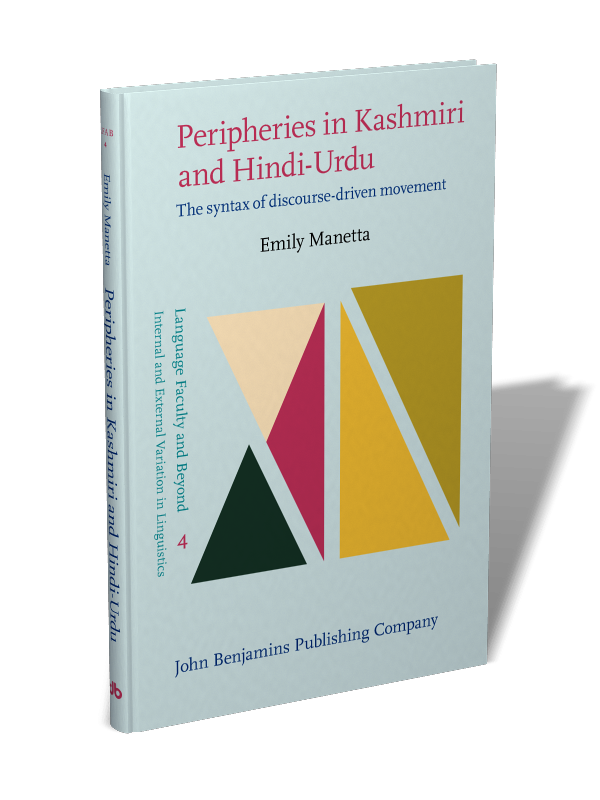
Peripheries in Kashmiri and Hindi-Urdu
The syntax of discourse-driven movement
Author

This research monograph is an investigation of wh-movement and wh-expletive constructions in the Indic languages Kashmiri and Hindi-Urdu. It advances a novel theory of the periphery, or the clausal positions that mediate A-bar movement. In particular, a detailed study of wh-expletives and wh-expletive constructions reveals an underlying similarity of design between the A and A-bar systems, and indicates that the two can be understood as driven by the same basic set of mechanisms. The monograph offers an account of wh-movement and the clausal periphery in the two languages, informed by the latest strands of research on the syntax and semantics of A-bar movement. This micro-comparative analytical method yields an important result: we can understand a set of systematic contrasts between the two languages in terms of the properties of specifically the phase-defining heads C and v. Empirically, this work explores the lesser-studied language Kashmiri, bringing to the fore linguistic data not yet discussed in formal syntactic literature. The significance of these data for the development of the wider theoretical framework is stressed throughout, making the book of substantial interest for general linguistic research.
[Language Faculty and Beyond, 4] 2011. ix, 160 pp.
Publishing status: Available
© John Benjamins Publishing Company




Table of Contents
-
Acknowledgements | pp. ix–x
-
Introduction: Peripheries in Kashmiri and Hindi-Urdu | pp. 1–12
-
Feature stacking: The Kashmiri periphery | pp. 13–46
-
Full and partial wh-movement in Kashmiri | pp. 47–86
-
Wh-expletives in Hindi-Urdu | pp. 87–126
-
Sluicing in Hindi-Urdu | pp. 127–142
-
Conclusions | pp. 143–150
-
References | pp. 151–158
-
Index | pp. 159–160
Cited by
Cited by 19 other publications
Alok, Deepak
2021. The Morphosyntax of Magahi Addressee Agreement. Syntax 24:3 ► pp. 263 ff. 

Bayer, Josef & Lisa Lai‐Shen Cheng
2017.
Wh‐
in‐Situ
. In The Wiley Blackwell Companion to Syntax, Second Edition, ► pp. 1 ff.
Bayer, Josef, Jana Häussler & Markus Bader
2016. A New Diagnostic for Cyclic Wh-Movement: Discourse Particles in German Questions. Linguistic Inquiry 47:4 ► pp. 591 ff.
Bennett, Ryan, Boris Harizanov & Robert Henderson
2018. Prosodic Smothering in Macedonian and Kaqchikel. Linguistic Inquiry 49:2 ► pp. 195 ff.
Chandra, Pritha & Richa Srishti
2014. The lexicon-syntax interface: Some issues. In The Lexicon–Syntax Interface [Linguistik Aktuell/Linguistics Today, 209], ► pp. 1 ff.
Giorgi, Alessandra & Sona Haroutyunian
2019. Indirect reports in Modern Eastern Armenian. In Indirect Reports and Pragmatics in the World Languages [Perspectives in Pragmatics, Philosophy & Psychology, 19], ► pp. 277 ff.
Gribanova, Vera & Emily Manetta
2016. Ellipsis inWh-in-Situ Languages: Deriving Apparent Sluicing in Hindi-Urdu and Uzbek. Linguistic Inquiry 47:4 ► pp. 631 ff.
Hsu, Brian
2021. Coalescence: A Unification of Bundling Operations in Syntax. Linguistic Inquiry 52:1 ► pp. 39 ff.
Manetta, Emily
2012. Reconsidering Rightward Scrambling: Postverbal Constituents in Hindi-Urdu. Linguistic Inquiry 43:1 ► pp. 43 ff.
Manetta, Emily
2014. Markedness and syncretism in Kashmiri differential argument encoding. In The Lexicon–Syntax Interface [Linguistik Aktuell/Linguistics Today, 209], ► pp. 245 ff.
Manetta, Emily
2019. Verb-phrase ellipsis and complex predicates in Hindi-Urdu. Natural Language & Linguistic Theory 37:3 ► pp. 915 ff.
Manetta, Emily Walker
2021. Verb-second and the verb-stranding verb phrase ellipsis debate. Glossa: a journal of general linguistics 6:1
Martinović, Martina
2022. Feature Geometry and Head Splitting in the Wolof Clausal Periphery. Linguistic Inquiry 54:1 ► pp. 79 ff.
Poole, Ethan
2023. Improper case. Natural Language & Linguistic Theory 41:1 ► pp. 347 ff.
Simpson, Andrew & Arunima Choudhury
2015. The Nonuniform Syntax of Postverbal Elements in SOV Languages: Hindi, Bangla, and the Rightward Scrambling Debate. Linguistic Inquiry 46:3 ► pp. 533 ff.
Simpson, Andrew & Binh Ngo
2018. Classifier syntax in Vietnamese. Journal of East Asian Linguistics 27:3 ► pp. 211 ff.
Singerman, Adam Roth
2021. The clausal organization of Tuparí, an indigenous Brazilian language. Acta Linguistica Academica 67:4 ► pp. 429 ff.
[no author supplied]
[no author supplied]
This list is based on CrossRef data as of 16 april 2024. Please note that it may not be complete. Sources presented here have been supplied by the respective publishers. Any errors therein should be reported to them.
Subjects
Main BIC Subject
CFK: Grammar, syntax
Main BISAC Subject
LAN009000: LANGUAGE ARTS & DISCIPLINES / Linguistics / General