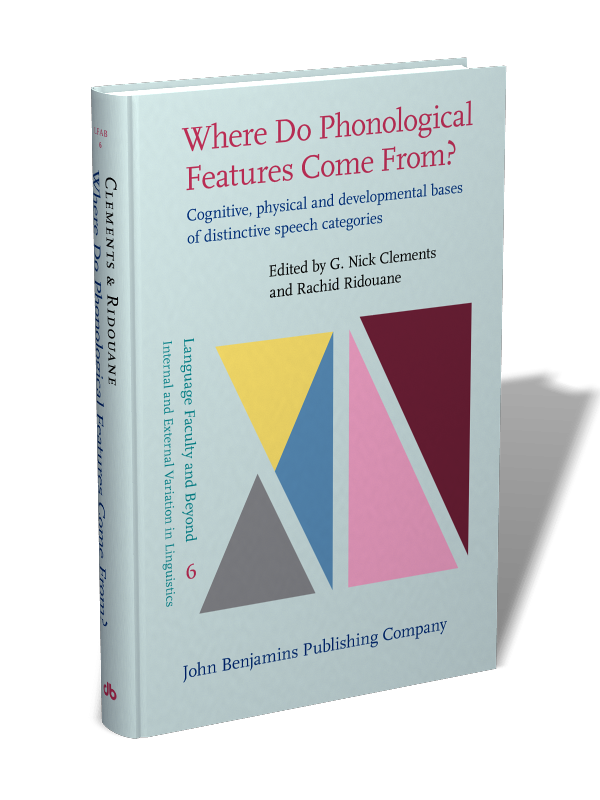
Where Do Phonological Features Come From?
Cognitive, physical and developmental bases of distinctive speech categories
Editors

This volume offers a timely reconsideration of the function, content, and origin of phonological features, in a set of papers that is theoretically diverse yet thematically strongly coherent. Most of the papers were originally presented at the International Conference "Where Do Features Come From?" held at the Sorbonne University, Paris, October 4-5, 2007. Several invited papers are included as well. The articles discuss issues concerning the mental status of distinctive features, their role in speech production and perception, the relation they bear to measurable physical properties in the articulatory and acoustic/auditory domains, and their role in language development. Multiple disciplinary perspectives are explored, including those of general linguistics, phonetic and speech sciences, and language acquisition. The larger goal was to address current issues in feature theory and to take a step towards synthesizing recent advances in order to present a current "state of the art" of the field.
[Language Faculty and Beyond, 6] 2011. xv, 347 pp.
Publishing status: Available
© John Benjamins




Table of Contents
-
Table of contents | pp. i–viii
-
ObituaryG. Nick Clements | pp. ix–xii
-
List of contributors | pp. xiii–xvi
-
Editors’ overviewRachid Ridouane and G. Nick Clements | pp. 1–12
-
Features, segments, and the sources of phonological primitivesAbigail C. Cohn | pp. 13–42
-
Feature economy in natural, random, and synthetic inventoriesJ. Scott Mackie and Jeff Mielke | pp. 43–64
-
Sound systems are shaped by their users: The recombination of phonetic substanceBjörn Lindblom, Randy Diehl, Sang-Hoon Park and Giampiero Salvi | pp. 65–98
-
What features underline the /s/ vs. /s’/ contrast in Korean? Phonetic and phonological evidenceHyunsoon Kim | pp. 99–130
-
Automaticity vs. feature-enhancement in the control of segmental F0Philip Hoole and Kiyoshi Honda | pp. 131–172
-
Categorization and features: Evidence from American English /ɹ/Diana Archangeli, Adam Baker and Jeff Mielke | pp. 173–196
-
Features as an emergent product of computing perceptual cues relative to expectationsBob McMurray, Jennifer Cole and Cheyenne Munson | pp. 197–236
-
Features are phonological transforms of natural boundariesWilly Serniclaes | pp. 237–258
-
Features in child phonology: Inherent, emergent, or artefacts of analysis?Lise Menn and Marilyn Vihman | pp. 259–302
-
Phonological features in infancyAlejandrina Cristià, Amanda Seidl and Alexander L. Francis | pp. 303–326
-
Acoustic cues to stop-coda voicing contrasts in the speech of 2-3-year-olds learning American EnglishStefanie Shattuck-Hufnagel, Katherine Demuth, Helen M. Hanson and Kenneth N. Stevens | pp. 327–342
-
Language index | pp. 343–344
-
Subject index | pp. 345–347
“There is no more important question facing linguistics today than the question of how linguistic knowledge is represented in the brain. There is no better entree to an understanding of that question than phonology/phonetics. There is no better collection of articles than these to point the way. This is a volume worthy of the memory of Nick Clements, visionary yet solidly grounded in the present.”
Samuel Jay Keyser, Peter de Florez Emeritus Professor of Linguistics, MIT
“[F]eature theory has always attempted to offer an explanation for the way sounds are extracted from the acoustic signal and how their composing units are organized and stored in the brains of language users, so as to enable inter-speaker oral communication. The present volume speaks to the core of this issue. It provides a solid set of groundbreaking papers [...].”
André Zampaulo,
The Ohio State University, Linguist List
Cited by
Cited by 11 other publications
Anderson, Stephen R.
2016. Synchronic Versus Diachronic Explanation and the Nature of the Language Faculty. Annual Review of Linguistics 2:1 ► pp. 11 ff. 

Anderson, Stephen R.
2021. Chapter 18. A short history of phonology in America. In All Things Morphology [Current Issues in Linguistic Theory, 353], ► pp. 327 ff.
Berry, Jeff & Maura Moyle
2011. Covariation among vowel height effects on acoustic measures. The Journal of the Acoustical Society of America 130:5 ► pp. EL365 ff.
Byun, Tara Mc Allister & Anne‐Michelle Tessier
2016. Motor Influences on Grammar in an Emergentist Model of Phonology. Language and Linguistics Compass 10:9 ► pp. 431 ff.
Kirby, James P. & D. Robert Ladd
2016. Effects of obstruent voicing on vowel F0: Evidence from “true voicing” languages. The Journal of the Acoustical Society of America 140:4 ► pp. 2400 ff.
Koenig, Laura L., Susanne Fuchs & Jorge C. Lucero
2011. Effects of consonant manner and vowel height on intraoral pressure and articulatory contact at voicing offset and onset for voiceless obstruents. The Journal of the Acoustical Society of America 129:5 ► pp. 3233 ff.
Martins, Pedro T. & Cedric Boeckx
2014. Attention mechanisms and the mosaic evolution of speech. Frontiers in Psychology 5
Rose, Yvan
2020. There is no phonology without abstract categories: A commentary on Ambridge (2020). First Language 40:5-6 ► pp. 626 ff.
Song, Jae Yung, Katherine Demuth & Stefanie Shattuck-Hufnagel
2012. The development of acoustic cues to coda contrasts in young children learning American English. The Journal of the Acoustical Society of America 131:4 ► pp. 3036 ff.
Zhang, Jie & Hanbo Yan
2018. Contextually dependent cue realization and cue weighting for a laryngeal contrast in Shanghai Wu. The Journal of the Acoustical Society of America 144:3 ► pp. 1293 ff.
[no author supplied]
2014. Introduction. In Phonological Development, ► pp. 1 ff.
This list is based on CrossRef data as of 16 april 2024. Please note that it may not be complete. Sources presented here have been supplied by the respective publishers. Any errors therein should be reported to them.
Subjects
Main BIC Subject
CFH: Phonetics, phonology
Main BISAC Subject
LAN011000: LANGUAGE ARTS & DISCIPLINES / Linguistics / Phonetics & Phonology