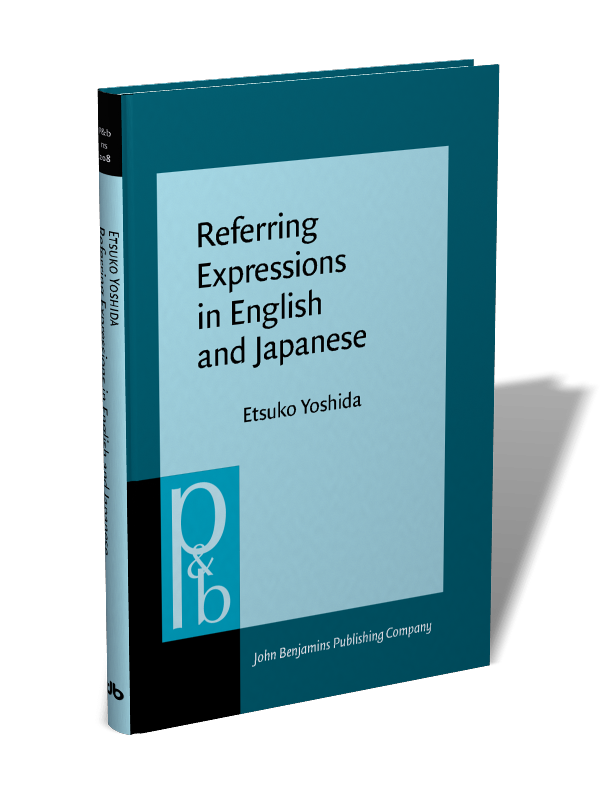
Referring Expressions in English and Japanese
Patterns of use in dialogue processing
Author

It is a major challenge for linguists to explore the relations between referential choice and the discourse structure in dialogues, because, unlike written modes of discourse, dialogue as an interactional mode of discourse needs careful treatment for linguistic analysis. This book investigates how discourse entities are linked with topic chaining and discourse coherence by showing that the choice and the distribution of referring expressions is correlated with center transition patterns in the centering framework. It provides original empirical research into the use of referring expressions in English and Japanese task-based dialogues, and applies and extends theoretical frameworks which attempt to account for local and global discourse coherence. Using a discourse-based integrated approach to anaphora resolution, Yoshida proposes a unified account on the patterns of use of referring expressions. The book will be of interest to discourse analysts, computational linguists, scholars of semantics and pragmatics, and cross-linguistics researchers.
[Pragmatics & Beyond New Series, 208] 2011. xviii, 206 pp.
Publishing status: Available
© John Benjamins Publishing Company




Table of Contents
-
Preface and acknowledgements | pp. ix–xi
-
Abbreviations used in glosses | p. xiii
-
List of tables | p. xv
-
List of figures | pp. xvii–xviii
-
1. Introduction | pp. 1–13
-
2. Approaches to referring expressions | pp. 15–34
-
3. Approaches to deictic expressions | pp. 35–52
-
4. Data collection | pp. 53–59
-
5. Centering and dialogue | pp. 61–94
-
6. Referring expressions in local coherence of discourse | pp. 95–115
-
7. Referring expressions in global coherence of discourse | pp. 117–157
-
8. Referring as a collaborative process in discourse | pp. 159–184
-
9. Conclusion | pp. 185–188
-
Appendix A | pp. 189–194
-
Appendix B | p. 195
-
-
Index | pp. 205–206
“Etsuko Yoshida’s book is a valuable and interesting contribution to the study of referring expressions. Not only is it based on naturally-occurring spoken Japanese but the use of the Map Task means that the Japanese dialogues can be directly compared with English dialogues produced by speakers carrying out the same task. There is a host of data for specialists in reference, dialogue and typology.”
Jim Miller, University of Edinburgh
“This book presents very interesting and original empirical data concerning anaphoricity and definiteness in English and Japanese discourse, and explores the implications of these for theoretical frameworks like Centering Theory. It will be of interest to researchers with an interest in the linguistic properties of English and Japanese, as well as those with a particular interest in discourse.”
Ronnie Cann, University of Edinburgh
Cited by
Cited by 2 other publications
Shimojo, Mitsuaki
2019. Topicalization in Japanese Cooking Discourse. Open Linguistics 5:1 ► pp. 511 ff. 

Shoji, Shinichi, Stanley Dubinsky & Amit Almor
2017. The Repeated Name Penalty, the Overt Pronoun Penalty, and Topic in Japanese. Journal of Psycholinguistic Research 46:1 ► pp. 89 ff.
This list is based on CrossRef data as of 16 april 2024. Please note that it may not be complete. Sources presented here have been supplied by the respective publishers. Any errors therein should be reported to them.
Subjects
Main BIC Subject
CFG: Semantics, Pragmatics, Discourse Analysis
Main BISAC Subject
LAN009000: LANGUAGE ARTS & DISCIPLINES / Linguistics / General