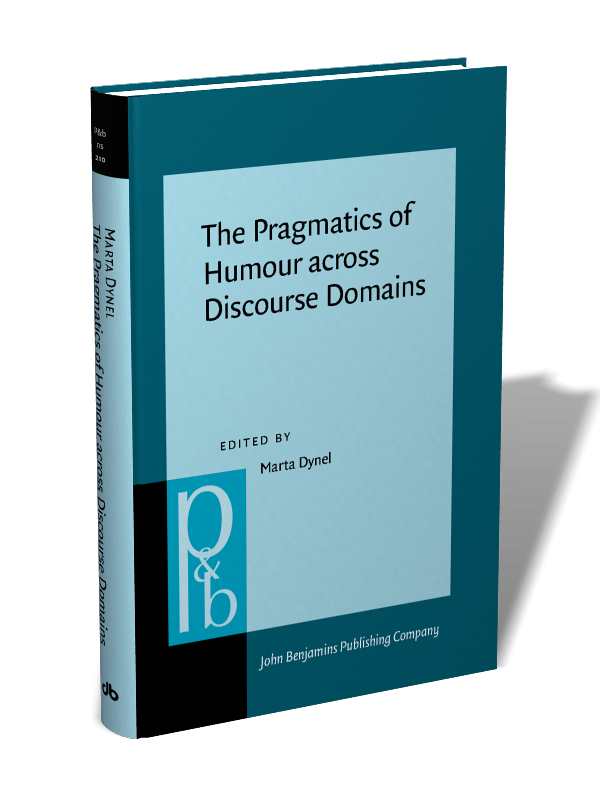
The Pragmatics of Humour across Discourse Domains
Editor


This edited volume brings together a range of contributions solely on the linguistics of humour. Rather than favour one approach, this collection of articles gives a state-of-the-art picture of current directions in pragmatic humour studies. The contributors assume multifarious theoretical perspectives and discuss a wide array of issues germane to different types of humour across discourse domains. Consequently, the whole gamut of humorous forms and mechanisms are elucidated, such as surrealist irony, incongruity in register humour, mechanisms of pun formation, as well as interpersonal functions of conversational humour. In addition, the papers address diversified manifestations of humour, such as puns in Shakespeare’s plays, gendered jokes on the Internet, sexuality in anti-proverbs, Woody Allen’s prose, humour in “Friends”, and parody by Monty Python’s Flying Circus. Most importantly, the chapters offer new research findings and advocate novel theoretical conceptualisations of humorous phenomena, drawing on the wealth of existing scholarship. Therefore, the volume is bound to serve as a well of knowledge and inspiration for both seasoned and beginning researchers with interests in the pragmatics of humour.
[Pragmatics & Beyond New Series, 210] 2011. vi, 382 pp.
Publishing status: Available
© John Benjamins Publishing Company




Table of Contents
-
Pragmatics and linguistic research into humourMarta Dynel | pp. 1–16
-
Part 1. Stylistic figures as forms of humour
-
1.1: Irony
-
Will anticipating irony facilitate it immediately?Rachel Giora | pp. 19–32
-
“That’s not ironic, that’s just stupid”: Towards an eclectic account of the discourse of ironyPaul Simpson | pp. 33–50
-
Irony via “surrealism”Eleni Kapogianni | pp. 51–68
-
1.2 Puns and other wordplay
-
The role of syllables and morphemes as mechanisms in humorous pun formationSarah Seewoester Cain | pp. 71–104
-
Context-sensitive aspects of Shakespeare’s use of puns in comedies: An enquiry into clowns’ and pages’ punning practicesMagdalena Adamczyk | pp. 105–124
-
Dimensions of incongruity in register humourChris Venour, Graeme D. Ritchie and Chris Mellish | pp. 125–144
-
Part 2. (Non)interactive forms of humour
-
2.1: Jokes
-
Displays of “new” gender arrangements in Russian jokesNadine Thielemann | pp. 147–172
-
Understanding ethnic humour in Romanian jokesCarmen Popescu | pp. 173–190
-
Sexuality in Anglo-American anti-proverbsAnna T. Litovkina | pp. 191–214
-
2.2 Conversational humour
-
Joker in the pack: Towards determining the status of humorous framing in conversationsMarta Dynel | pp. 217–242
-
Humour in quasi-conversations: Constructing fun in online sports journalismJan Chovanec | pp. 243–264
-
Humour and the integration of new staff in the workplace: An interactional studyPatricia Pullin | pp. 265–288
-
Part 3. Forms of humour in public discourse
-
Parody in the light of the incongruity-resolution model: The case of political sketches by Monty Pythons's Flying CircusMaciej Kaczorowski | pp. 291–309
-
“I’ll be there for you!” On participation-based sitcom humourMarta Dynel | pp. 311–334
-
“Losers, poltroons and nudniks” in Woody Allen’s Mere Anarchy: A linguistic approach to comic failureIsabel Ermida | pp. 335–352
-
Notes on humour and persuasion in advertising and legal discourseGiovannantonio Forabosco | pp. 353–364
-
Comic takeover or comic makeover? Notes on humour-translating, translation and (un)translatabilityDelia Chiaro | pp. 365–378
-
Name index | pp. 379–380
-
Subject index | pp. 381–382
“Overall, the volume offers both theoretical and empirical insights into humour research. All contributions show a very strong link between theory and empirical data. This is the reason why the book is likely to be of interest not only to linguists, but also to psychologists and cognitive scientists involved in humour research. The merge of pragmatic and cognitive paradigms looks very promising in terms of its explanatory potential.”
Ksenia Shilikhina, Voronezh State University, on Linguist List Vol. 23.547 (February 2012).
“The chapters [...] all offer valuable theoretical discussions, thorough empirical evidence, and interesting insights in the area of humour from the broadest reaches of the field of pragmatics. [...] This useful attempt to cover the field of humour and pragmatics in discourse certainly meets its target.”
Meredith Marra, Victoria University of Wellington, in Pragmatics and Society, Vol. 5:1 (2014)
Cited by
Cited by 19 other publications
Adam, Martin
2020. Persuasion in Religious Discourse: Employing Humour to Enhance Persuasive Effect in Sermons. In Persuasion in Specialised Discourses, ► pp. 197 ff. 

Batoréo, Hanna J.
2017. Chapter 5. On ironic puns in Portuguese authentic oral data. In Irony in Language Use and Communication [Figurative Thought and Language, 1], ► pp. 109 ff.
Bednarek, Monika
2018. Language and Television Series,
Chovanec, Jan
2018. Chapter 7. Laughter and non-humorous situations in TV documentaries. In The Dynamics of Interactional Humor [Topics in Humor Research, 7], ► pp. 155 ff.
Dynel, Marta & Valeria Sinkeviciute
2021. Conversational Humour. In The Cambridge Handbook of Sociopragmatics, ► pp. 408 ff.
Fortanet-Gómez, Inmaculada & Noelia Ruiz-Madrid
2016. Multimodal Humor in Plenary Lectures in English and in Spanish. Multimodal Communication 5:1 ► pp. 55 ff.
Gbadegesin, Victoria O
2019. Gender ideology and identity in humorous social media memes. Digital Scholarship in the Humanities
Inya, Onwu
2016. Pragmatics of Humour in a Nigerian University's Departmental Chat Rooms. In Analyzing Language and Humor in Online Communication [Advances in Linguistics and Communication Studies, ], ► pp. 190 ff.
Jobert, Manuel & Sandrine Sorlin
2018. Chapter 1. Introduction. In The Pragmatics of Irony and Banter [Linguistic Approaches to Literature, 30], ► pp. 3 ff.
Lugea, Jane & Brian Walker
2023. Humour. In Stylistics, ► pp. 227 ff.
Mullan, Kerry
2020. Pile of Dead Leaves Free to a Good Home: Humour and Belonging in a Facebook Community. In Studies in Ethnopragmatics, Cultural Semantics, and Intercultural Communication, ► pp. 135 ff.
Odebunmi, Akin & Simeon Ajiboye
2016. Negotiation of Wit in Facebook Humour. In Analyzing Language and Humor in Online Communication [Advances in Linguistics and Communication Studies, ], ► pp. 20 ff.
Salem, Essa, Marwan Jarrah & Imran Alrashdan
2020. Humor and the Creative Use of English Expressions in the Speech of University Students: A Case From Jordan. SAGE Open 10:1 ► pp. 215824402091455 ff.
Simpson, Paul
2023. Irony and Its Consequences in the Public Sphere. In The Cambridge Handbook of Irony and Thought, ► pp. 112 ff.
Uwen, God'sgift Ogban & Godwin Oko Ushie
2022. “Happy wives” and “sad husbands”. The European Journal of Humour Research 10:1 ► pp. 147 ff.
Zawiszová, Halina
2018. On ´doing friendship´ in and through talk: Exploring conversational interactions of Japanese young people,
[no author supplied]
2012. PUBLICATIONS RECEIVED. Language in Society 41:1 ► pp. 155 ff.
[no author supplied]
2021. Topics and Settings in Sociopragmatics. In The Cambridge Handbook of Sociopragmatics, ► pp. 247 ff.
[no author supplied]
2023. Irony’s Impact. In The Cambridge Handbook of Irony and Thought, ► pp. 79 ff.
This list is based on CrossRef data as of 16 april 2024. Please note that it may not be complete. Sources presented here have been supplied by the respective publishers. Any errors therein should be reported to them.
Subjects
Main BIC Subject
CFG: Semantics, Pragmatics, Discourse Analysis
Main BISAC Subject
LAN009000: LANGUAGE ARTS & DISCIPLINES / Linguistics / General