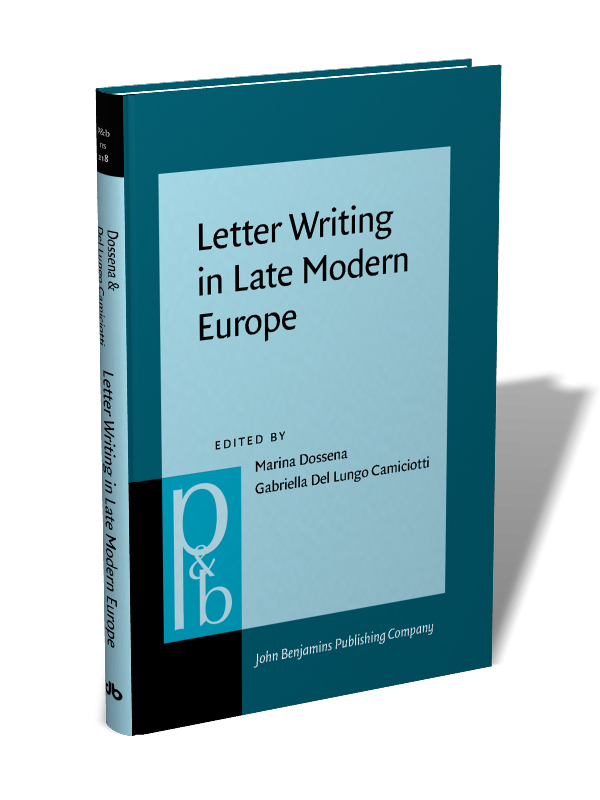
Letter Writing in Late Modern Europe
Editors


In recent years there has been a renewed interest in correspondence both as a literary genre and as cultural practice, and several studies have appeared, mainly spanning the centuries between Early and Late Modern times. However, it is between the eighteenth and nineteenth centuries that the roots of contemporary usage begin to evolve, thanks to the circulation of new educational materials and more widespread schooling practices.
In this volume, chapters representing diverse but complementary methodological approaches discuss linguistic and discursive practices of correspondence in Late Modern Europe, in order to offer material for the comparative, cross-linguistic analyses of patterns occurring in different social contexts.
The volume aims to provide a general and solid methodological structure for the study of largely untapped language material from a variety of comparable sources, and is expected to appeal to scholars and students interested in the linguistic history of epistolary writing practices, as well as to all those interested in the more recent history of European languages.
In this volume, chapters representing diverse but complementary methodological approaches discuss linguistic and discursive practices of correspondence in Late Modern Europe, in order to offer material for the comparative, cross-linguistic analyses of patterns occurring in different social contexts.
The volume aims to provide a general and solid methodological structure for the study of largely untapped language material from a variety of comparable sources, and is expected to appeal to scholars and students interested in the linguistic history of epistolary writing practices, as well as to all those interested in the more recent history of European languages.
[Pragmatics & Beyond New Series, 218] 2012. vii, 254 pp.
Publishing status: Available
© John Benjamins Publishing Company




Table of Contents
-
Acknowledgements | pp. vii–viii
-
IntroductionMarina Dossena and Gabriella Del Lungo Camiciotti | pp. 1–12
-
The study of correspondence: Theoretical and methodological issuesMarina Dossena | pp. 13–30
-
A historical digital archive of Portuguese lettersRita Marquilhas | pp. 31–44
-
Between linguistic creativity and formulaic restriction: Cross-linguistic perspectives on nineteenth-century lower class writers’ private lettersStephan Elspass | pp. 45–64
-
Performing identities and interaction through epistolary formulaeLea Laitinen and Taru Nordlund | pp. 65–88
-
Fanny to William: A Critical Discourse Analysis approach to the letters of Frances Leonora MacleayEleonora Chiavetta | pp. 89–104
-
An atypical commercial correspondence: Negotiating artefacts and statusGabriella Del Lungo Camiciotti | pp. 105–120
-
Reporting the news in English and Italian diplomatic correspondenceNicholas Brownlees | pp. 121–138
-
Letters as loot: Confiscated Letters filling major gaps in the History of DutchMarijke J. van der Wal, Gijsbert Rutten and Tanja Simons | pp. 139–162
-
The problem of reading dialect in semiliterate letters: The correspondence of the Holden family, 1812–16 and of Richard Taylor 1840–51Robert McColl Millar | pp. 163–178
-
“I will be expecting a letter from you before this reaches you”: A corpus-based study of shall/will variation in Irish English correspondenceKevin McCafferty and Carolina P. Amador-Moreno | pp. 179–204
-
Letters in mechanically-schooled language: Theories and ideologiesTony Fairman | pp. 205–228
-
Teaching grammar and composition through letter writing in seventeenth- and eighteenth-century EnglandLinda Mitchell | pp. 229–250
-
Index | pp. 251–254
“
Letter Writing in Late Modern Europe is a landmark publication that crosses cultural and language boundaries in 18th- and 19th-century Europe. At the intersection of historical pragmatics and sociolinguistics, the volume captures the diversity of epistolary communication in all walks of life, ranging from private letters to commercial and diplomatic correspondence. The windows that it opens on changing cultural practices and language history are truly fascinating.”
Terttu Nevalainen, University of Helsinki
“Dossena's long-standing expertise in the field has enabled her to present this striking volume which thoroughly explores the tension between early standardization, ideology and everyday best writing practices as they transpired in ego-documents from the 17th through the 19th century. This collection of articles contains cutting-edge research on Late Modern English letter writing, complemented with the very best work from spearheading teams from other language communities. Any scholar working on 'literacy from below', ego-documents or historical correspondence will have to include the present volume as a key reference.”
Prof. Dr. Wim Vandenbussche, Vrije Universiteit Brussel
“Altogether the volume covers a wide range of situations in which mostly ordinary, minimally or only moderately educated, writers had occasion to communicate by letter. The varied and extensive material examined has the potential to throw considerable light on how epistolary language was used at any one time and in different situations. It is a valuable addition to the study of letter writing in modern times.”
Frances Austin, Gillingham, Dorset, in English Studies, Vol. 94:4, pages 498-499.
“This volume gives a very good impression of the great range represented by the letter genre and of the diverse ways in which linguists can make use of it. The three aspects that stand out especially for me are (i) possible crosslinguistic comparisons, (ii) lower-class/less educated writers, and (iii) formulaic language use.”
Claudia Claridge, University of Duisburg-Essen, in International Journal of Corpus Linguistics, Vol. 19:3 (2014)
“This book is a welcome — and a well done — addition to the increasing family of both studies in late modern linguistics in general and in letter writing in particular. Dossena’s and Del Lungo Camiciotti’s deep knowledge and experience in the late modern era and its language practices has presented us with another high-quality publication, and also a very enjoyable read.”
Minna Nevala, University of Helsinki, in Journal of Historical Pragmatics, Vol 16:1 (2015)
“[A] solid addition to the field of historical sociolinguistics. The book [...] will provide historical sociolinguists with refined tools, methods, and approaches, as well as the cross-linguistic contextual background necassary for future studies.”
Aurelija Tamosiunaite, Vytautas Magnus University, Lithuania, in Journal of Historical Sociolinguistics 1(2), 2015
Cited by
Cited by 30 other publications
Ayres-Bennett, Wendy
2021. Sociolinguistique historique et suivi de l’évolution des langues : sources, types et genres de textes. Cahiers internationaux de sociolinguistique N° 18:1 ► pp. 19 ff. 

Calvo Cortés, Nuria
2020. Variations from letter-writing manuals. In Manners, Norms and Transgressions in the History of English [Pragmatics & Beyond New Series, 312], ► pp. 184 ff.
Calvo Cortés, Nuria
2024. Filled-in petition forms and hand-drafted petitions to the Foundling Hospital. In Unlocking the History of English [Current Issues in Linguistic Theory, 364], ► pp. 198 ff.
Dossena, Marina
2014. Chapter 9. “There is reason to believe however…”. In Trust and Discourse [Discourse Approaches to Politics, Society and Culture, 56], ► pp. 181 ff.
Dossena, Marina
2015. Introduction. In Transatlantic Perspectives on Late Modern English [Advances in Historical Sociolinguistics, 4], ► pp. 1 ff.
Dossena, Marina
2019. Chapter 6. “With kindest regards”. In Politeness in Nineteenth-Century Europe [Pragmatics & Beyond New Series, 299], ► pp. 197 ff.
Dossena, Marina
2019. Chapter 4. Singular, plural, or collective?. In Keeping in Touch [Advances in Historical Sociolinguistics, 10],
ERKOÇ, Seçil
2022. Paston Mektupları: Paston Kadınlarının Orta Çağ Hanesinde Artan Önemi. Gaziantep University Journal of Social Sciences 21:4 ► pp. 2154 ff.
Fragaki, Georgia & Dionysis Goutsos
2018. The importance of genre in the Greek diglossia of the 20th century. In Diachronic Corpora, Genre, and Language Change [Studies in Corpus Linguistics, 85], ► pp. 171 ff.
Hernández-Campoy, Juan M. & Tamara García-Vidal
2018. Style-shifting and accommodative competence in Late Middle English written correspondence: Putting Audience Design to the test of time. Folia Linguistica 52:s39-s2 ► pp. 383 ff.
Hernández-Campoy, Juan Manuel
2022. Mel Evans: Royal voices: Language and power in Tudor England. Journal of Historical Sociolinguistics 8:1 ► pp. 189 ff.
Hickey, Raymond
2019. Chapter 1. Mining emigrant correspondence for linguistic insights. In Keeping in Touch [Advances in Historical Sociolinguistics, 10],
Hickey, Raymond
2020. Review of Amador Moreno, Carolina P. 2019. Orality in Written Texts: Using Historical Corpora to Investigate Irish English (1700−1900). London: Routledge. ISBN: 978-1-138-80234-6. https://doi.org/10.4324/9781315754321. Research in Corpus Linguistics 8 ► pp. 201 ff.
House, Juliane & Dániel Z. Kádár
2021. Cross-Cultural Pragmatics,
House, Juliane, Dániel Z. Kádár, Fengguang Liu & Wenrui Shi
2023. Historical language use in Europe from a contrastive pragmatic perspective. Journal of Historical Pragmatics 24:1 ► pp. 143 ff.
Jones, Peter D. & Natalie Carter
2019. Writing for redress: redrawing the epistolary relationship under the New Poor Law. Continuity and Change 34:3 ► pp. 375 ff.
Kádár, Dániel Z., Gudrun Held & Annick Paternoster
McCafferty, Kevin
2014. “I DONT CARE ONE CENT WHAT [Ø] GOYING ON IN GREAT Britten”: BE-Deletion IN IRISH ENGLISH. American Speech 89:4 ► pp. 441 ff.
McCAFFERTY, KEVIN & CAROLINA P. AMADOR-MORENO
2014. ‘[The Irish] find much difficulty in these auxiliaries . . .puttingwillforshallwith the first person’: the decline of first-personshallin Ireland, 1760–1890. English Language and Linguistics 18:3 ► pp. 407 ff.
Nevala, Minna
2017.
Anita Auer , Daniel Schreier and Richard J. Watts (eds.), Letter writing and language change. Cambridge: Cambridge University Press, 2015. Pp. 352. ISBN 9781107018648.. English Language and Linguistics 21:3 ► pp. 574 ff.
Oudesluijs, Tino
2024. “No criticism or remarks & pray burn it as fast as you read it”. In Unlocking the History of English [Current Issues in Linguistic Theory, 364], ► pp. 180 ff.
Padilla-Moyano, Manuel
2015. A new view of Basque through eighteenth-century correspondence. In Language Variation - European Perspectives V [Studies in Language Variation, 17], ► pp. 169 ff.
Rutten, Gijsbert, Rik Vosters & Wim Vandenbussche
2014. The interplay of language norms and usage patterns. Comparing the history of Dutch, English, French and German. In Norms and Usage in Language History, 1600–1900 [Advances in Historical Sociolinguistics, 3], ► pp. 1 ff.
Schuster, Britt-Marie
2015. Kriegsausbruch, Kriegs Ausbruch, KriegsAusbruch. In Language Development [IMPACT: Studies in Language and Society, 37], ► pp. 189 ff.
Säily, Tanja, Arja Nurmi, Minna Palander-Collin & Anita Auer
2017. The future of historical sociolinguistics?. In Exploring Future Paths for Historical Sociolinguistics [Advances in Historical Sociolinguistics, 7], ► pp. 1 ff.
Tams, Nicola
2017. Gespensterbriefe. Freundschaft zwischen Nähe, Distanz und Abwesenheit am Gegenstand einiger Briefe Derridas. In Nahbeziehungen zwischen Freundschaft und Patronage, ► pp. 179 ff.
Voeste, Anja
2018. The self as a source. A peasant farmer’s letters from prison (1848–1852). Journal of Historical Sociolinguistics 4:1 ► pp. 97 ff.
Ávila-Ledesma, Nancy E.
2024. “I Thought you had Forgotten me”: A Corpus-Pragmatic Examination of the Mental Verb Think in Irish Emigrants’ Letters. Corpus Pragmatics 8:1 ► pp. 77 ff.
Ávila-Ledesma, Nancy E. & Carolina P. Amador-Moreno
2023.
‘The seas was like mountains’: intra-writer variation and social mobility in Irish emigrant letters. Journal of Historical Sociolinguistics 9:2 ► pp. 243 ff.
[no author supplied]
2012. PUBLICATIONS RECEIVED. Language in Society 41:5 ► pp. 697 ff.
This list is based on CrossRef data as of 16 april 2024. Please note that it may not be complete. Sources presented here have been supplied by the respective publishers. Any errors therein should be reported to them.
Subjects
Main BIC Subject
CFG: Semantics, Pragmatics, Discourse Analysis
Main BISAC Subject
LAN009000: LANGUAGE ARTS & DISCIPLINES / Linguistics / General