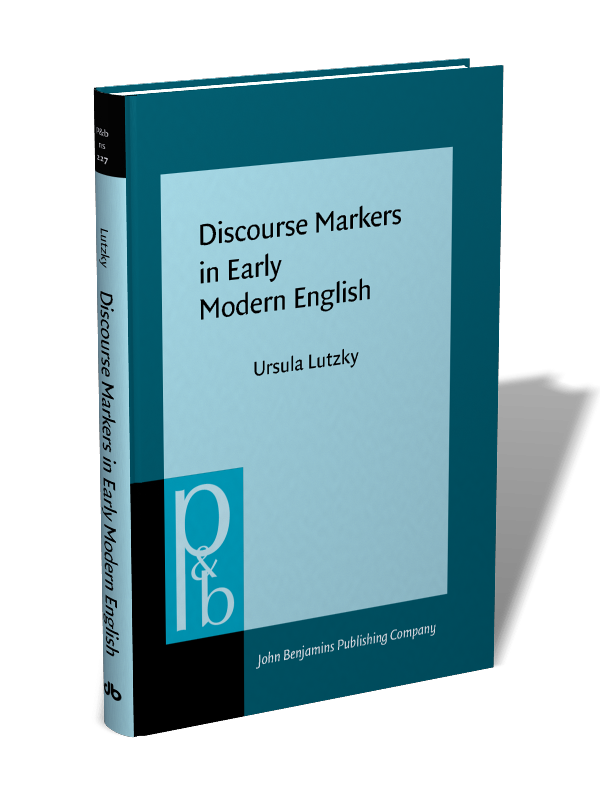
Discourse Markers in Early Modern English
Author


This volume provides new insights into the nature of the Early Modern English discourse markers marry, well and why through the analysis of three corpora (A Corpus of English Dialogues, 1560-1760, the Parsed Corpus of Early English Correspondence, and the Penn-Helsinki Parsed Corpus of Early Modern English). By combining both quantitative and qualitative approaches in the study of pragmatic markers, innovative findings are reached about their distribution throughout the period 1500-1760, their attestation in different speech-related text types as well as similarities and differences in their functions. Additionally, this work engages in a sociopragmatic study, based on the sociopragmatically annotated Drama Corpus of almost a quarter of a million words, to enhance our understanding about their use by characters of different social status and gender. This volume therefore constitutes an essential piece of the puzzle in our attempt to gain a full picture of discourse marker use.
This book won the 2014 ESSE book award in English Language and Linguistics
[Pragmatics & Beyond New Series, 227] 2012. ix, 293 pp.
Publishing status: Available
© John Benjamins Publishing Company




Table of Contents
-
Acknowledgements | p. ix
-
1. Introduction | pp. 1–8
-
2. Discourse markers | pp. 9–44
-
3. Methodology and data | pp. 45–68
-
4. The discourse markers marry, well and why | pp. 69–90
-
5. Quantitative analysis | pp. 91–110
-
6. Qualitative analysis | pp. 111–242
-
7. Sociopragmatic analysis | pp. 243–264
-
8. Conclusion | pp. 265–272
-
-
Index | pp. 291–293
“This in-depth, scholarly treatment of several Early Modern discourse markers is unsurpassed. By incorporating social factors within its corpus method, it pushes forward the boundaries of both historical corpus linguistics and sociopragmatics.”
Jonathan Culpeper, University of Lancaster
“Ursula Lutzky’s work perfectly fits into the still relatively new, but rapidly expanding, research fields of historical sociopragmatics and diachronic corpus linguistics, providing a systematic and innovative account of three English discourse markers. Quite aside from the valuable data collection and systematisation, the work offers exhaustive accounts of the methodologies adopted and of the increasingly large body of literature in this field. As a specialist in historical pragmatics, with an interest in the relatively elusive and classification-defying behaviour of discourse markers, I am looking forward to having this book available in the library!”
Gabriella Mazzon, University of Innsbruck
“Ursula Lutzky’s book on discourse markers in Early Modern English has an innovative approach as it uses a sociopragmatically annotated corpus as (part of) its data. The analysis works well and can serve as a model for other researchers.”
Irma Taavitsainen, University of Helsinki
“I would recommend this book to all scholars interested in socio-historical linguistics, historical pragmatics more generally, and, of course, especially to those interested in discourse markers.”
Hildegunn Støle, University of Stavanger, in Journal of Historical Pragmatics Vol. 16:1 (2015)
“Overall this volume is a valuable contribution to the study of discourse markers. The quantitative and qualitative analyses based on extensive corpus material provide innovative findings about the uses of the three discourse markers and their developments over time in the Early Modern English period. The study breaks new ground in historical discourse marker studies by including the importance of text type in the analysis. Moreover the sociopragmatic analysis points to a promising direction for future historical research on discourse markers. The study of discourse markers in new contexts can also contribute to larger pragmatic issues such as ‘what we mean by discourse markers’, their multifunctionality and functional spectrum.”
Karin Aijmer, University of Gothenburg, in English Text Construction, Vol. 8:2 (2015)
“The main strength of this book is its systematicity and thoroughness. As good as every decision and comment made by the author regarding the analysis, the results, the method and material, and the theoretical framework are acknowledged and firmly anchored in a substantial background of literature; the reader is made to feel that he or she is in good hands.”
Erika Berglind Söderqvist, Uppsala University, in Studia Neophilologica Vol. 89:2 (2017)
Cited by
Cited by 32 other publications
Aijmer, Karin
2014. Pragmatic markers. In Corpus Pragmatics, ► pp. 195 ff. 

Aijmer, Karin
2021. “That’s well good”: A Re-emergent Intensifier in Current British English. Journal of English Linguistics 49:1 ► pp. 18 ff.
Aijmer, Karin
2023. Corpus Pragmatics. In The Cambridge Handbook of Language in Context, ► pp. 289 ff.
Alonso Almeida, Francisco & Francisco J. Álvarez-Gil
2021. The discourse markers indeed, in fact, really and actually and their Spanish equivalents in economy. Revista de Lingüística y Lenguas Aplicadas 16 ► pp. 11 ff.
Alonso Almeida, Francisco & Francisco J. Álvarez-Gil
2021. The discourse markers indeed, in fact, really and actually and their Spanish equivalents in economy. Revista de Lingüística y Lenguas Aplicadas 16:1 ► pp. 11 ff.
Andersen, Gisle
2014. Relevance. In Corpus Pragmatics, ► pp. 143 ff.
Avila-Ledesma, Nancy E. & Carolina P. Amador-Moreno
2016. “The More Please [Places] I See the More I Think of Home”: On Gendered Discourse of Irishness and Migration Experiences. In Yearbook of Corpus Linguistics and Pragmatics 2016 [Yearbook of Corpus Linguistics and Pragmatics, ], ► pp. 85 ff.
Brinton, Laurel J.
2015. Historical Discourse Analysis. In The Handbook of Discourse Analysis, ► pp. 222 ff.
Claridge, Claudia
Demmen, Jane
2020. Issues and challenges in compiling a corpus of Early Modern English plays for comparison with those of William Shakespeare. ICAME Journal 44:1 ► pp. 37 ff.
Fedriani, Chiara & Andrea Sansó
2017. Introduction. Pragmatic Markers, Discourse Markers and Modal Particles. In Pragmatic Markers, Discourse Markers and Modal Particles [Studies in Language Companion Series, 186], ► pp. 1 ff.
González‐Díaz, Victorina
2018. Tracing The Development Of An Old Old Story: Intensificatory Repetition In English. Transactions of the Philological Society 116:1 ► pp. 30 ff.
Hummel, Martin
2014. The adjective-adverb interface in Romance and English. In Adjectives in Germanic and Romance [Linguistik Aktuell/Linguistics Today, 212], ► pp. 35 ff.
Khavronich, Alina Alekseevna
2020. To the question on methodology of stylistic stratification in analysis of the Early Modern English dramatic oeuvre (on the example of John Skelton’s play “Magnificence”). Litera :5 ► pp. 1 ff.
Koops, Christian & Arne Lohmann
2015. A quantitative approach to the grammaticalization of discourse markers. International Journal of Corpus Linguistics 20:2 ► pp. 232 ff.
Kytö, Merja
Kytö, Merja & Terry Walker
2020. L’interaction orale du passé : A Corpus of English Dialogues 1560–1760. Langages N° 217:1 ► pp. 55 ff.
Leitner, Magdalena & Andreas H. Jucker
2021. Historical Sociopragmatics. In The Cambridge Handbook of Sociopragmatics, ► pp. 687 ff.
Leuckert, Sven & Sofia Rüdiger
2021. Discourse markers and world Englishes. World Englishes
Lutzky, Ursula
Lutzky, Ursula
2021. The sociopragmatic nature of interjections in Early Modern English drama comedy. Journal of Historical Pragmatics 22:2 ► pp. 225 ff.
Marcus, Imogen
2018. Introduction. In The Linguistics of Spoken Communication in Early Modern English Writing, ► pp. 1 ff.
Marcus, Imogen
2018. Prose Structure. In The Linguistics of Spoken Communication in Early Modern English Writing, ► pp. 135 ff.
Mazzon, Gabriella
2017. Chapter 10. Paths of development of English DMs. In Pragmatic Markers, Discourse Markers and Modal Particles [Studies in Language Companion Series, 186], ► pp. 289 ff.
Rogos-Hebda, Justyna
2020. Visual pragmatics of abbreviations and otiose strokes in John Lydgate’sSiege of Thebes
. Journal of Historical Pragmatics 21:1 ► pp. 1 ff.
Smith, Chris A.
2018. Diachronic patterns of usage of no doubt in the English Historical Book Collection (EEBO, ECCO and EVANS). ExELL 6:1 ► pp. 1 ff.
Traugott, Elizabeth Closs
2016. On the rise of types of clause-final pragmatic markers in English. Journal of Historical Pragmatics 17:1 ► pp. 26 ff.
Włodarczyk, Matylda & Irma Taavitsainen
[no author supplied]
2013. PUBLICATIONS RECEIVED. English Language and Linguistics 17:3 ► pp. 601 ff.
[no author supplied]
2021. Approaches and Methods in Sociopragmatics. In The Cambridge Handbook of Sociopragmatics, ► pp. 567 ff.
[no author supplied]
2022. Future Directions. In Lexical Sociolinguistics, ► pp. 181 ff.
[no author supplied]
This list is based on CrossRef data as of 16 april 2024. Please note that it may not be complete. Sources presented here have been supplied by the respective publishers. Any errors therein should be reported to them.
Subjects
Main BIC Subject
CFG: Semantics, Pragmatics, Discourse Analysis
Main BISAC Subject
LAN009000: LANGUAGE ARTS & DISCIPLINES / Linguistics / General