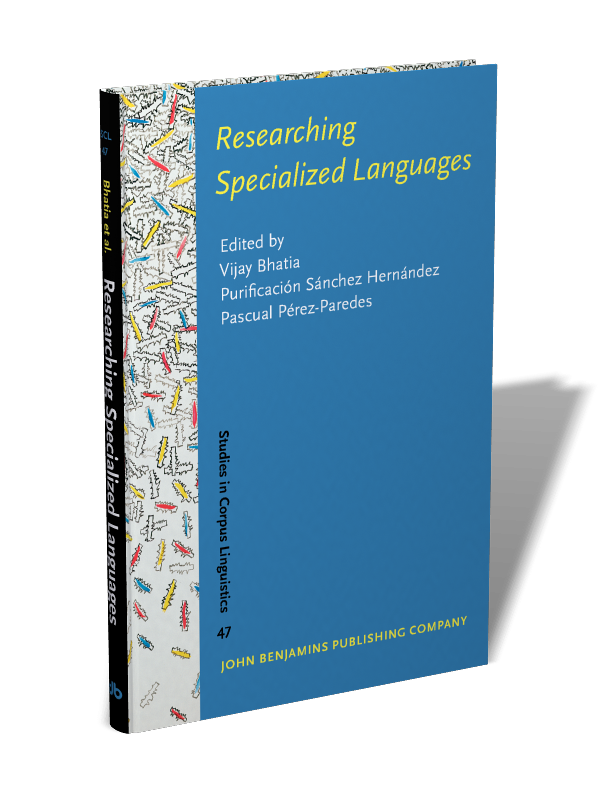
Researching Specialized Languages
Editors


The present collection of articles represents research efforts in the field of specialised languages, including the analysis of research articles in disciplines as diverse as Biomedicine and Computing, on the one hand, and overlapping disciplines such as in Social Sciences, on the other, all with high relevance to English for Academic Purposes, and English for specific Purposes. The volume offers empirical evidence obtained from corpus-based analyses of language, both from diachronic as well as synchronic perspectives, on topics such as the role of mother tongue in professional writing, the analysis of conference abstracts as a genre, or the analysis of visual data transfer. This collection addresses issues such as the implementation of lexicons for specialised language learning, and the development of ontologies to research language patterns. The volume thus provides a rich repertoire of research methodologies, in-depth analyses of specialised discourses, and the identification and discussion of relevant pedagogic issues.
Winner of the 4th Edition of the 'Enrique Alcaraz Research Award'
[Studies in Corpus Linguistics, 47] 2011. viii, 238 pp.
Publishing status: Available
© John Benjamins Publishing Company




Table of Contents
-
List of contributors | pp. vii–viii
-
Specialized languages: Corpora, meta-analyses and applicationsVijay Bhatia, Purificación Sánchez and Pascual Pérez-Paredes | pp. 1–8
-
Section one. Research based on corpora
-
The historical shift of scientific academic prose in English towards less explicit styles of expression: Writing without VerbsDouglas Biber and Bethany Gray | pp. 11–24
-
Heteroglossic (dis)engagement and the construal of the ideal readership: Dialogic spaces in academic textsCarmen Pérez-Llantada | pp. 25–46
-
Structure, content and functions of calls for conference abstractsSara Gesuato | pp. 47–70
-
Summarizing findings: An all-pervasive move in open access biomedical research articles involves rephrasing strategiesMercedes Jaime-Sisó | pp. 71–94
-
The use of adverbial hedges in EAP students’ oral performance: A cross-language analysisPascual Pérez-Paredes, Purificación Sánchez and Pilar Aguado-Jimenez | pp. 95–114
-
Integrating approaches to visual data commentary: An exploratory case studyCarmen Sancho Guinda | pp. 115–136
-
Section two. Research based on meta-analysis and applications in LSP
-
Some dichotomies in genre analysis for Languages for Specific PurposesJohn Flowerdew | pp. 139–154
-
English for legal purposes and domain-specific cultural awareness: The ‘continental paradox’, definition, causes and evolutionShaeda Isani | pp. 155–174
-
The Talking Cure: From Narrative to Academic ArgumentGillian Diane Lazar | pp. 175–190
-
UrgentiAS, a lexical database for medical students in clinical placements: Architecture, use and evaluationKris Buyse, Eva Saver, An Laffut and Herlinda Vekemans | pp. 191–210
-
Using natural language patterns for the development of ontologiesElena Montiel-Ponsoda and Guadalupe Aguado-de-Cea | pp. 211–230
-
Notes on contributors | pp. 231–236
-
Index | pp. 237–238
“The volume represents a most valuable contribution to the field of LSP and is highly recommendable to teachers and researchers whose interests lie in specialised languages, academic and professional writing, terminology and lexicography.”
Maria-Lluïsa Gea-Valor, Universitat Jaume I, Ibérica 27: 211-214, 2014
“This volume contains papers contributed by scholars from various countries and, consequently, with different sociocultural and sociolinguistic backgrounds, representing various academic schools and working within different spheres of LSP. This variety of approaches, aspects and ideas discussed by the researchers, alongside exhaustive theoretical considerations and practically valuable materials introduced in the publications cited in the volume, make this book ‘nutritious’ food for thought and give readers a powerful stimulus for further investigation into professional communication and specialized languages.”
Oksana Ksenzenko, Moscow State University, in World Englishes 33(2): 303-305, 2014
Cited by
Cited by 7 other publications
Dontcheva-Navratilova, Olga
2020. Persuasion: Definition, Approaches, Contexts. In Persuasion in Specialised Discourses, ► pp. 1 ff. 

Dontcheva-Navratilova, Olga
2020. Persuasion and Specialised Discourse in a Changing World. In Persuasion in Specialised Discourses, ► pp. 339 ff.
Herrmann, J. Berenike & Tony Berber Sardinha
2015. Metaphor in specialist discourse. In Metaphor in Specialist Discourse [Metaphor in Language, Cognition, and Communication, 4], ► pp. 3 ff.
Maniati, Mahmood, Alireza Jalilifar, Amir Mashhadi & Ali Hemmati
2020. Engagement under revision: How Iranian scholars negotiate the arguability of their texts. Complutense Journal of English Studies 28 ► pp. 147 ff.
Odebrecht, Carolin, Malte Belz, Amir Zeldes, Anke Lüdeling & Thomas Krause
2017. RIDGES Herbology: designing a diachronic multi-layer corpus. Language Resources and Evaluation 51:3 ► pp. 695 ff.
Pérez-Paredes, Pascual & María Sánchez-Tornel
2014. Adverb use and language proficiency in young learners’ writing. International Journal of Corpus Linguistics 19:2 ► pp. 178 ff.
Rycker, Antoon De, Kris Buyse & Lieve Vangehuchten
This list is based on CrossRef data as of 16 april 2024. Please note that it may not be complete. Sources presented here have been supplied by the respective publishers. Any errors therein should be reported to them.
Subjects
Main BIC Subject
CFM: Lexicography
Main BISAC Subject
LAN021000: LANGUAGE ARTS & DISCIPLINES / Spelling & Vocabulary