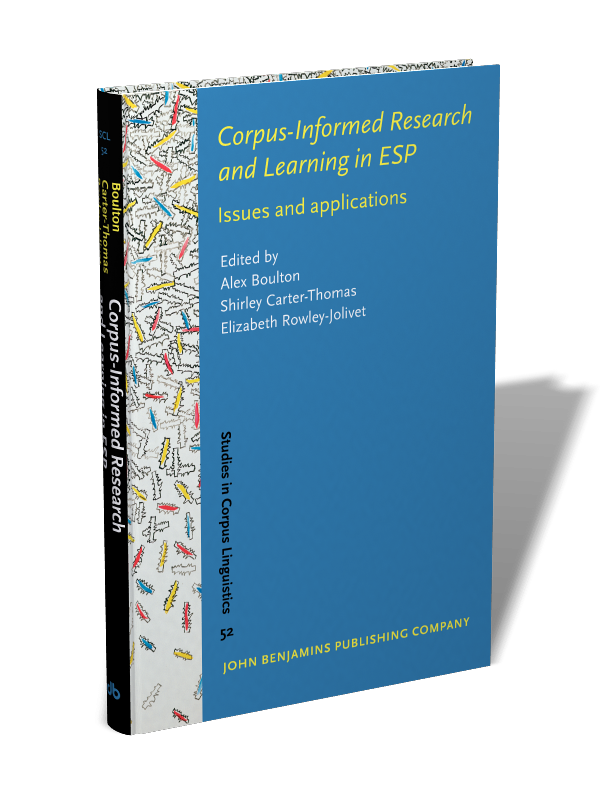
Corpus-Informed Research and Learning in ESP
Issues and applications
Editors


These specially-commissioned studies cover corpus-informed approaches to researching, teaching and learning English for Specific Purposes (ESP). The corpora used range from very large published corpora to small tailor-made collections of written and spoken text, as well as parallel and contrastive corpora, in both the hard and softer sciences. Designed to tackle the problems faced by a variety of first- and second-language ESP users (specialised translators, undergraduates, junior and experienced researchers, and language trainers), the breadth of approaches enables treatment of issues central to ESP and corpus research, from corpus compilation and analysis to new applications and data-driven learning. The first full-length book on applied corpus use in France, Corpus-Informed Research and Learning in ESP will be of interest not only to those working in the French context, but to a wide variety of language professionals – teachers, researchers or course designers – in many countries looking at ESP from different linguistic, cultural and educational perspectives.
[Studies in Corpus Linguistics, 52] 2012. ix, 306 pp.
Publishing status: Available
© John Benjamins Publishing Company




Table of Contents
-
PrefaceJohn M. Swales | pp. vii–x
-
Issues in corpus-informed research and learning in ESPAlex Boulton, Shirley Carter-Thomas and Elizabeth Rowley-Jolivet | pp. 1–14
-
Part I. ESP corpora for language research
-
From text to corpus: A contrastive analysis of first person pronouns in economics article introductions in English and FrenchShirley Carter-Thomas and Angela Chambers | pp. 15–44
-
Phraseological patterns in a large corpus of biomedical articlesAnthony Saber | pp. 45–82
-
A corpus-based study of adjectival vs nominal modification in medical EnglishFrançois Maniez | pp. 83–102
-
Semantic prosody and specialised translation, or how a lexico-grammatical theory of language can help with specialised translationNatalie Kübler and Alexandra Volanschi | pp. 103–134
-
Part II. ESP corpora for genre-based approaches
-
Oralising text slides in scientific conference presentations: A multimodal corpus analysisElizabeth Rowley-Jolivet | pp. 135–166
-
Corpora and academic writing: A contrastive analysis of research articles in biology and linguisticsCéline Poudat and Peter Follette | pp. 167–192
-
Measuring the construction of discoursal expertise through corpus-based genre analysisDacia Dressen-Hammouda | pp. 193–214
-
Part III. ESP corpora for language teaching and learning
-
Bringing data and dictionary together: Real science in real dictionariesGeoffrey Williams | pp. 215–238
-
Raising collective awareness of rhetorical strategies: Using an online writing tool to demonstrate discourse moves in the ESP classroomSue Birch-Bécaas and Ray Cooke | pp. 239–260
-
Corpus consultation for ESP: A review of empirical researchAlex Boulton | pp. 261–292
-
Notes on contributors | pp. 293–296
-
Author index | pp. 297–300
-
Subject index | pp. 301–306
“This volume is an excellent illustration of how the dichotomy between the register and the genre traditions outlined by Biber and Conrad (2009) can be resolved. While most of the papers in this collection present a combined research approach that takes into account qualitative as well as quantitative methods, there is a shared motivation to include corpus-driven, attested uses of language and innovative tools that, combined with quantitative methods such as keyword analysis or applications of standard deviation, can be instrumental in the description of specialized languages and their applications in language teaching. Thus, in this volume the reader will find references to both well-established software (Antconc) or cutting-edge applications such as the suite described by POUDAT and FOLLETE, and to corpora that can shed further light into some of the domains represented in the volume, in particular Economics, Medicine, Biology and Geology. The volume is prefaced by JOHN SWALES and the tables, figures and appendixes are extremely useful and easy to use.”
Pascual Pérez-Paredes, Universidad de Murcia, in Iberica 27: 221-224, 2014
Cited by
Cited by 16 other publications
Aleksandrzak, Magdalena
2021. Developing speaking skills at advanced level – the perspective of language department students and the implications for language teaching. In Angewandte Linguistik – Neue Herausforderungen und Konzepte, ► pp. 257 ff. 

Alsehibany, Raniya Abdullah & Safaa M. Abdelhalim
2023. Overcoming academic vocabulary errors through online corpus consultation: the case of Saudi English majors. Computer Assisted Language Learning ► pp. 1 ff.
Crosthwaite, Peter, Lillian L.C. Wong & Joyce Cheung
2019. Characterising postgraduate students’ corpus query and usage patterns for disciplinary data-driven learning. ReCALL 31:3 ► pp. 255 ff.
Hirata, Yoko & Yoshihiro Hirata
2018. Students’ Evaluation of SkELL: The ‘Sketch Engine for Language Learning’. In Blended Learning. Enhancing Learning Success [Lecture Notes in Computer Science, 10949], ► pp. 368 ff.
Hirata, Yoko & Yoshihiro Hirata
2019. Applying ‘Sketch Engine for Language Learning’ in the Japanese English classroom. Journal of Computing in Higher Education 31:2 ► pp. 233 ff.
Johnson, Jane Helen
2017. The SocWoC corpus: compiling and exploiting ESP material for undergraduate social workers. In New developments in ESP teaching and learning research, ► pp. 133 ff.
Leńko-Szymańska, Agnieszka
2014. Is this enough? A qualitative evaluation of the effectiveness of a teacher-training course on the use of corpora in language education. ReCALL 26:2 ► pp. 260 ff.
Leńko-Szymańska, Agnieszka & Alex Boulton
2015. Introduction. In Multiple Affordances of Language Corpora for Data-driven Learning [Studies in Corpus Linguistics, 69], ► pp. 1 ff.
Malá, Lucie
2021. Corpus-based teaching materials for specialised courses: the case of English for mathematicians. CASALC Review 11:1 ► pp. 59 ff.
Mizumoto, Atsushi, Sawako Hamatani & Yasuhiro Imao
2017. Applying the Bundle–Move Connection Approach to the Development of an Online Writing Support Tool for Research Articles. Language Learning 67:4 ► pp. 885 ff.
Noguera-Díaz, Yolanda & Pascual Pérez-Paredes
2020. Teaching acronyms to the military: A paper-based DDL approach. Research in Corpus Linguistics 8:2 ► pp. 1 ff.
Ohashi, Yukiko, Noriaki Katagiri, Katsutoshi Oka & Michiko Hanada
2020. ESP corpus design: compilation of the Veterinary Nursing Medical Chart Corpus and the Veterinary Nursing Wordlist. Corpora 15:2 ► pp. 125 ff.
Pérez-Paredes, Pascual & Purificación Sánchez-Hernández
2018. Uptake of corpus tools in the Spanish Higher Education context: a mixed-methods study. Research in Corpus Linguistics ► pp. 51 ff.
Strietholt, Sophia, Julie Larson‐Guenette & Gemini Fox
2024. Using music reviews in the intermediate L2 German classroom: An exploratory lesson in genre‐based writing. Die Unterrichtspraxis/Teaching German
Tuzlukova, Victoria & Saleh S. Al-Busaidi
2015. Exploring English Academic Texts on Language Education and Pedagogy: Structural, Stylistic and Lexical Features. Theory and Practice in Language Studies 5:2 ► pp. 255 ff.
[no author supplied]
This list is based on CrossRef data as of 16 april 2024. Please note that it may not be complete. Sources presented here have been supplied by the respective publishers. Any errors therein should be reported to them.
Subjects
Main BIC Subject
CFDC: Language acquisition
Main BISAC Subject
LAN020000: LANGUAGE ARTS & DISCIPLINES / Study & Teaching