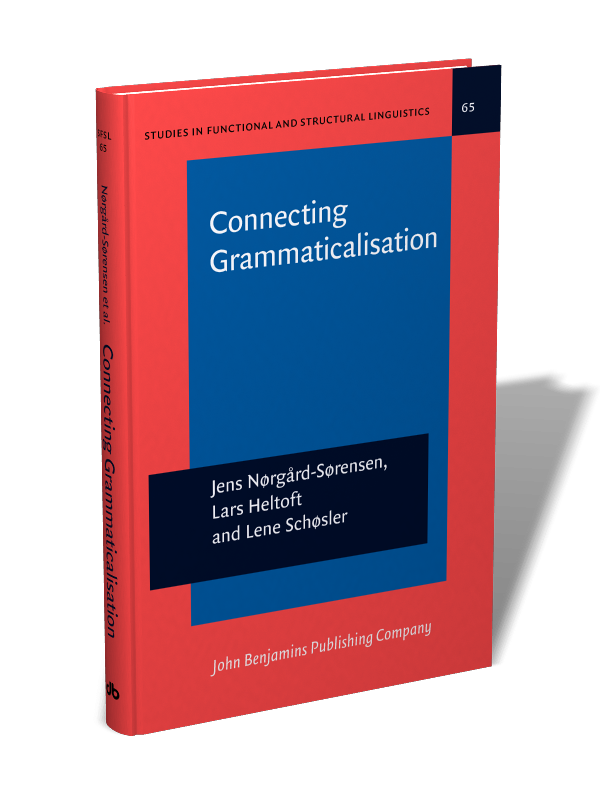
This monograph presents a view on grammaticalisation radically different from standard views centering around the cline of grammaticality. Grammar is seen as a complex sign system, and, as a consequence, grammatical change always comprises semantic change. What unites morphology, topology (word order), constructional syntax and other grammatical subsystems is their paradigmatic organisation. The traditional concept of an inflexional paradigm is generalised as the structuring principle of grammar. Grammatical change involves paradigmatic restructuring, and in the process of grammatical change morphological, topological and constructional paradigms often connect to form complex paradigms. The book introduces the concept of connecting grammaticalisation to describe the formation, restructuring and dismantling of such complex paradigms. Drawing primarily on data from Germanic, Romance and Slavic languages, the book offers both a broad general discussion of theoretical issues (part one) and three case studies (part two).
As of March 2017, this e-book is freely available, thanks to the support of libraries working with Knowledge Unlatched.
“[T]he framework is genuinely new and provides a range of insights into the analysis of grammatical paradigms and their interrelationship. And it also provides a new perspective on how to approach linguistic reconstruction, especially with reference to paradigmatic restructuring and to the interaction between the different parts of language structure, most of all of morphology, syntax, and of constructions. The volume reviewed here therefore constitutes a valuable addition to the range of methodological tools to be consulted by students of grammatical change.”
Bernd Heine, Universität zu Köln, in Studies in Language, 36:1 (2012)
Cited by
Cited by 43 other publications
Christensen, Tanya Karoli & Torben Juel Jensen
2022. Introduction: Analysing and Explaining Syntactic Variation. In Explanations in Sociosyntactic Variation, ► pp. 1 ff.
Company Company, Concepción
2018. Analogía inducida por contexto: la extensión de la preposición "A" en la historia del español. Revista de Historia de la Lengua Española :13 ► pp. 31 ff.
D. M. Smith, Andrew, Graeme Trousdale & Richard Waltereit
2021. Proposition d’une classification des marqueurs discursifs comme membres d’un paradigme. Langue française N° 209:1 ► pp. 119 ff.
Jeppesen Kragh, Kirsten
2022. Voilà , membre du paradigme des marqueurs discursifs. Langages N° 227:3 ► pp. 99 ff.
Jeppesen Kragh, Kirsten & Lene Schøsler
2021. Analyse constructionnelle et paradigmatique illustrée par le verbe voir. Langue française N° 209:1 ► pp. 83 ff.
KRAGH, KIRSTEN JEPPESEN & LENE SCHØSLER
2015. Regrammation and paradigmatization: Diachronic analysis of a number of progressive periphrases in French. Journal of French Language Studies 25:2 ► pp. 265 ff.
2013. Evolution and Regrammation in the Mood System: Perspectives from Old, Middle, Renaissance and Modern French. In Research on Old French: The State of the Art [Studies in Natural Language and Linguistic Theory, 88], ► pp. 123 ff.
Nørgård-Sørensen, Jens
2010. What languages must convey: the construction-based syntax of Old Russian. Acta Linguistica Hafniensia 42:1 ► pp. 46 ff.
2022. Au-delà de la perception visuelle : étude de quelques marqueurs formés sur voir . Présentation. Langages N° 227:3 ► pp. 7 ff.
Schøsler, Lene
2013. The Development of the Declension System. In Research on Old French: The State of the Art [Studies in Natural Language and Linguistic Theory, 88], ► pp. 167 ff.
SCHØSLER, LENE
2015. Grammaticalisation des valeurs d’aspect et de phase? A propos des constructions à verbes supports. Journal of French Language Studies 25:2 ► pp. 239 ff.
Lene Schøsler
2021. L’analyse constructionnelle des structures à réduction du sujet. Langue française N° 209:1 ► pp. 101 ff.
Stolk, Joanne Vera
2017. Dative Alternation and Dative Case Syncretism in Greek: The Use of Dative, Accusative and Prepositional Phrases in Documentary Papyri. Transactions of the Philological Society 115:2 ► pp. 212 ff.
2012. Publications received in 2011. Nordic Journal of Linguistics 35:1 ► pp. 97 ff.
This list is based on CrossRef data as of 12 april 2024. Please note that it may not be complete. Sources presented here have been supplied by the respective publishers.
Any errors therein should be reported to them.