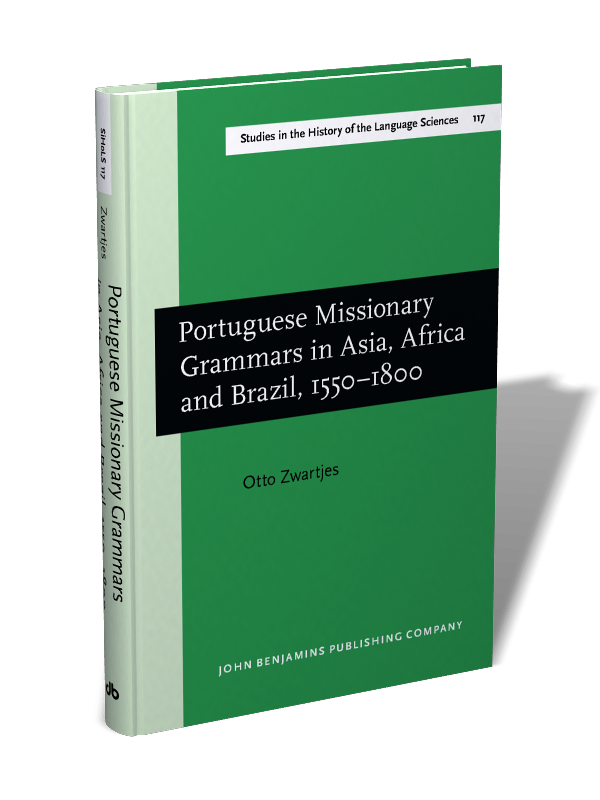
Portuguese Missionary Grammars in Asia, Africa and Brazil, 1550-1800
Author


From the 16th century onwards, Europeans encountered languages in the Americas, Africa, and Asia which were radically different from any of the languages of the Old World. Missionaries were in the forefront of this encounter: in order to speak to potential converts, they needed to learn local languages. A great wealth of missionary grammars survives from the 16th century onwards. Some of these are precious records of the languages they document, and all of them witness their authors’ attempts to develop the methods of grammatical description with which they were familiar, to accommodate dramatically new linguistic features.This book is the first monograph covering the whole Portuguese grammatical tradition outside Portugal. Its aim is to provide an integrated description, analysis and evaluation of the missionary grammars which were written in Portuguese. Between them, these grammars covered a huge range of languages: in Asia, Tamil, four Indo-Aryan languages and Japanese; in Brazil, Kipeá and Tupinambá; in Africa and the African diaspora, Kimbundu and Sena (from the modern Angola and Mozambique respectively).Each text is placed in its historical context, and its linguistic context is analyzed, with particular attention to orthography, the parts of speech system, morphology and syntax. Whenever possible, pedagogical features of the grammars are discussed, together with their treatment of language variation and pragmatics, and the evidence they provide for the missionaries’ attitude towards the languages they studied.
[Studies in the History of the Language Sciences, 117] 2011. xiv, 359 pp.
Publishing status: Available
© John Benjamins Publishing Company




Table of Contents
-
Preface & acknowledgements | pp. xiii–xiv
-
Chapter 1. Introduction | pp. 1–22
-
Chapter 2. The Indian subcontinent | pp. 23–92
-
Chapter 3. Missionary linguistics in Japan | pp. 93–142
-
Chapter 4. Missionary linguistics in Brazil | pp. 143–204
-
Chapter 5. African languages | pp. 205–242
-
Chapter 6. Arabic and Hebrew | pp. 243–260
-
Chapter 7. Conclusion | pp. 261–270
-
Appendix. Lexicography | pp. 271–302
-
-
Index of biographical names | pp. 347–352
-
Index of subjects and terms | pp. 353–359
“[T]he first complete study and most extensive research to date of Portuguese missionary linguistics, covering three continents, South America (Brazil), Africa and Asia, through the entire pre-modern period (16th-18th centuries). It provides an integrated framework, analysis and evaluation of the first grammars written in Portuguese by missionaries.”
Gonçalo Fernandes, Universidade de Trás-os-Montes e Alto Douro, Portugal, in Historiographia Linguistica, Vol 39:2/3 (2012)
“[...] una investigación rigurosa en las fuentes, coherente en su estructura externa e interna y que, sin lugar a dudas, cumple los objetivos propuestos al principio, pues contribuye a que los aspectos concretos sobre la lingüística misionera portuguesa sean mejor conocidos, integrándolos en su contexto y evaluando sus logros y errores.”
Ana Segovia Gordillo, in BSEHL 8 (2012)
“[...] an insightful and eye-opening study of an area of linguistics which will be somewhat ironically new to many readers.”
David D. Robertson, University of Victoria, on eLanguage, September 2012
“Este trabajo constituye un valioso aporte al campo de la lingüística misionera, tanto con sus contribuciones a la metodología de análisis como al redescubrir antiguos documentos que arrojan luz sobre algunos aspectos lingüísticos y culturales en los complejos vínculos entre Occidente con el antiguo mundo oriental y el nuevo mundo americano.”
María Emilia Orden, Universidad Nacional de La Pampa, in Revista argentina de historiografia lingüística, IV, 2, 169-172, 2012
“[W]ithout doubt the most comprehensive study to date of a large body of missionary linguistic work. As such it will be of interest to any scholar seeking a better understanding of the content and organization of missionary grammars. [...] For researchers in the field of linguistic historiography, Zwartjes’ detailed study of the terminology used by missionary linguists is of great interest. [...] The fact that terms used by missionaries are often opaque to researchers studying the languages described in these grammars has been a major hindrance to their acceptance as sources of legitimate information. It is to be hoped that this book will be followed by others that not only take a broad view of the field but also examine in detail the vocabulary and conventions used in missionary linguistic work.”
Catherine Fountain, Appalachian State University, USA, in Language & History 56, 125-127 (2013)
“This volume addresses a long-standing need. [...] This book provides a fascinating window on the development of early grammatical description of non-European languages by missionaries writing in Portuguese. It demonstrates the significant contribution of Portuguese missionaries to the description of these languages, and to the study of Asian languages.”
Alan N. Baxter, Universidade Federal da Bahia, Brazil, in Journal of Pidgin and Creole Language, Vol. 31:2 (2016)
Cited by
Cited by 40 other publications
Assunçao, Carlos, Gonçalo Fernandes, Susana Fontes, Sónia Coelho & Maria Luísa Soares
2022. Discoveries, missions and interlinguistic meetings of the Portuguese language in the East. Moenia 

Wendy Ayres-Bennett & John Bellamy
2021. The Cambridge Handbook of Language Standardization,
Bae, Eun Mi
2022. El tratamiento de las «partículas» en las artes japonesas de misioneros portugueses y españoles: el vínculo entre diversas tradiciones historiográficas. Moenia
Cancino Cabello1, Nataly
2018. La categoría ‘nombre’ en laGrammatica o Arte(1560) de Domingo de Santo Tomás y en elArte(1571) de Alonso de Molina. Historiographia Linguistica 45:1-2 ► pp. 1 ff.
Coffey, Simon
2020. Introduction. In The History of Grammar in Foreign Language Teaching,
Cravens, Marlena Petra
2020. "Eu mato": The Linguistic and Religious Rewriting of the Tupí under Portuguese Missionary Rule (1555-1630). Tusaaji: A Translation Review 7:1
Cravens, Marlena Petra
2020. "Eu mato": The Linguistic and Religious Rewriting of the Tupí under Portuguese Missionary Rule (1555-1630). Tusaaji: A Translation Review 7:1 ► pp. 1 ff.
Fernandes, Gonçalo, Carlos Assunçao, Orquídea Ribeiro, Ezra Nhampoca & Sónia Coelho
2022. A first survey of the history of Angolan lexicography. Moenia
Fernandes, Gonçalo & Carlos Assunção
2017. First codification of Vietnamese by 17th-century missionaries: the description of tones and the influence of Portuguese on Vietnamese orthography. Histoire Epistémologie Langage 39:1 ► pp. 155 ff.
Franchina, Miriam
2023. Beyond the (Holy) Shroud: A glimpse into Afro-Catholicism during the Haitian Revolution. Atlantic Studies ► pp. 1 ff.
Gianninoto, Mariarosaria
2014. The Development of Chinese Grammars and the Classification of the Parts of Speech. Language & History 57:2 ► pp. 137 ff.
Gianninoto, Mariarosaria
2019. LeTraitéchinois des particules et des principaux termes de grammaire : un exemple de traduction et d’adaptation de la terminologie linguistique chinoise. Histoire Epistémologie Langage 41:1 ► pp. 97 ff.
Graziani, Michela
2023. Il Portogallo nel XVIII secolo. In Il Settecento portoghese e lusofono [Studi e saggi, 250], ► pp. 13 ff.
Gutiérrez Maté, Miguel
Kaltner, Leonardo Ferreira
2022. O lugar da Gramática de Anchieta na história do pensamento linguístico no Brasil. Cadernos de Linguística 2:1 ► pp. e610 ff.
Kaltner, Leonardo Ferreira & Melyssa Cardozo
2021. Considerações sobre a Gramática de Anchieta. Cadernos de Linguística 2:2 ► pp. e360 ff.
Kaltner, Leonardo Ferreira & Melyssa Cardozo Silva dos Santos
2022. Gramáticas antigas. Cadernos de Linguística 3:2 ► pp. e660 ff.
Kaltner, Leonardo Ferreira & Melyssa Cardozo Silva dos Santos
2022. FENÔMENOS FONÉTICOS E COMPOSIÇÃO DE VERBOS E NOMES. Cadernos de Linguística 3:1 ► pp. e634 ff.
Kishimoto, Emi
2021. Some remarks on Alexandre de Rhodes’s linguistic works on Vietnamese. In Missionary Linguistics VI [Studies in the History of the Language Sciences, 130], ► pp. 189 ff.
Matsumoto, Mallory E.
2022. Letters of Conversion: Meta‐Alphabetic Discourse and Linguistic Participation in Colonial Highland Guatemala. Journal of Linguistic Anthropology 32:1 ► pp. 28 ff.
McLelland, Nicola
2021. Grammars, Dictionaries and Other Metalinguistic Texts in the Context of Language Standardization. In The Cambridge Handbook of Language Standardization, ► pp. 263 ff.
Muru, Cristina
2014. Shaping Minds and Cultures: The impact of missionary translations in Southern India. In Missionary Linguistics V / Lingüística Misionera V [Studies in the History of the Language Sciences, 122], ► pp. 203 ff.
Muru, Cristina
2021. Mood and modality in 17th century missionary grammars of Tamil. In Missionary Linguistics VI [Studies in the History of the Language Sciences, 130], ► pp. 233 ff.
Nakaema, Olivia Yumi
2021. Politeness in João Rodrigues’s grammars of Japanese. In Missionary Linguistics VI [Studies in the History of the Language Sciences, 130], ► pp. 155 ff.
Nash, Joshua
2015. On the Possibility of Pidgin English Toponyms in Pacific Missions. Historiographia Linguistica 42:1 ► pp. 139 ff.
Olry, Régis
2023. Hikikomori (引きこもり): Ancient term, modern concept. Journal of the History of the Neurosciences 32:4 ► pp. 499 ff.
Santos, Melyssa Cardozo Silva dos
2021. Schola Aquitanica (1583): Latin grammar and Renaissance tradition. Revista da ABRALIN ► pp. 452 ff.
Severo, Cristine & Sinfree Makoni
2023. Língua e raça no Brasil colonial. International Journal of the Sociology of Language 2023:282 ► pp. 15 ff.
Swiggers, Pierre, Werner Thomas & Toon Van Hal
2021. On the ‘affinities of Oriental languages’. In Missionary Linguistics VI [Studies in the History of the Language Sciences, 130], ► pp. 265 ff.
Taylor-Leech, Kerry & Carol Benson
2017. Language planning and development aid: the (in)visibility of language in development aid discourse. Current Issues in Language Planning 18:4 ► pp. 339 ff.
Triviño, Ascensión Hernández
Van Hal, Toon
Van Rooy, Raf
2021. How Greek is the Graeco-Latin model?. In Missionary Linguistics VI [Studies in the History of the Language Sciences, 130], ► pp. 217 ff.
H. Ekkehard Wolff
2019. A History of African Linguistics,
H. Ekkehard Wolff
2019. The Cambridge Handbook of African Linguistics,
Zwartjes, Otto
2012. The Historiography of Missionary Linguistics. Historiographia Linguistica 39:2-3 ► pp. 185 ff.
Zwartjes, Otto
2014. More on “Arabic Linguistic Terminology in Pedro de Alcalá”. Historiographia Linguistica 41:2-3 ► pp. 247 ff.
Zwartjes, Otto
2014. The Missionaries’ Contribution to Translation Studies in the Spanish Colonial Period: Themise en pageof translated texts and its functions in foreign language teaching. In Missionary Linguistics V / Lingüística Misionera V [Studies in the History of the Language Sciences, 122], ► pp. 1 ff.
Zwartjes, Otto & Paolo De Troia
2021. André Palmeiro’s Epistola (Macau 8/V 1632) cum paradigmate Orationis Dominicae Pater Noster in lingua Sinica, Japonica, Annamitica. In Missionary Linguistics VI [Studies in the History of the Language Sciences, 130], ► pp. 1 ff.
[no author supplied]
2014. Foreword & Acknowledgements. In Missionary Linguistics V / Lingüística Misionera V [Studies in the History of the Language Sciences, 122], ► pp. vii ff.
This list is based on CrossRef data as of 16 april 2024. Please note that it may not be complete. Sources presented here have been supplied by the respective publishers. Any errors therein should be reported to them.
Subjects
Main BIC Subject
CF: Linguistics
Main BISAC Subject
LAN009000: LANGUAGE ARTS & DISCIPLINES / Linguistics / General