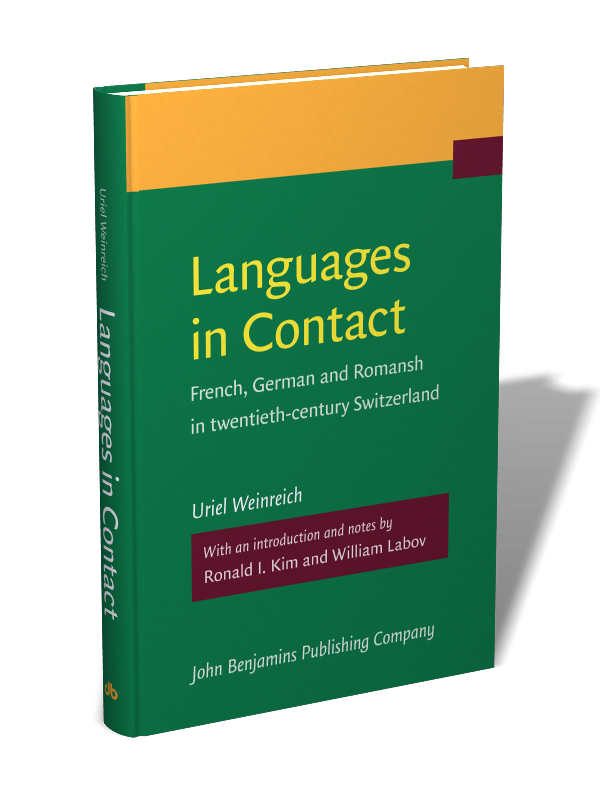
Languages in Contact
French, German and Romansh in twentieth-century Switzerland
Author
Introduction and notes by


The appearance of Uriel Weinreich's Languages in Contact: Findings and Problems (1953) marked a milestone in the study of multilingualism and language contact. Yet until now, few linguists have been aware that its main themes were first laid out in Weinreich’s Columbia University doctoral dissertation of 1951, Research Problems in Bilingualism with Special Reference to Switzerland. Based on the author's fieldwork, it contains a detailed report on language contact in Switzerland in the first half of the 20th century, especially along the French-German linguistic border and between German and Romansh in the canton of Grisons (Graubünden). The present edition reproduces Weinreich's original text in full, with only minor alterations and corrections, as well as the author's fieldwork photographs and many of his hand-drawn diagrams. A new foreword reviews Weinreich's life and legacy, as well as developments in contact linguistics and the Swiss linguistic situation over the past 60 years. With selected comments on noteworthy points and references to more recent literature, this volume will be of interest not only to those working on the languages of Switzerland, or specialists in language contact, but all scholars today whose work builds on the broad and lasting foundations laid over half a century ago by Uriel Weinreich.
[Not in series, 166] 2011. xxxiv, 401 pp.
Publishing status: Available
© John Benjamins Publishing Company




Table of Contents
-
List of tables | pp. xv–xvi
-
List of figures | pp. xvii–xviii
-
Introduction | pp. xix–xxx
-
Foreword to the original | pp. xxxi–xxxiv
-
Chapter 1. The bilingual individual | pp. 1–18
-
Chapter 2. Patterns of bilingual communities | pp. 19–36
-
Chapter 3. Linguistic problems of bilingualism | pp. 37–64
-
Chapter 4. Switzerland as a quadrilingual country | pp. 65–80
-
Chapter 5. Intralingual relations: Contact between standard language and dialect | pp. 81–120
-
Chapter 6. French-German bilingualism: General characteristics | pp. 121–142
-
Chapter 7. Case study: A static bilingual situation in the canton of Fribourg | pp. 143–176
-
Chapter 8. The linguistic effects of bilingualism in Fribourg | pp. 177–190
-
Chapter 9. German-Romansh bilingualism: General characteristics | pp. 191–214
-
Chapter 10. Case study: A dynamic bilingual situation in Central Grisons | pp. 215–268
-
Chapter 11. Reversing language shift: The Romansh language movement in Central Grisons | pp. 269–300
-
Chapter 12. The linguistic effects of bilingualism in Central Grisons | pp. 301–324
-
Chapter 13. German-Italian bilingualism | pp. 325–326
-
Chapter 14. Conclusions | pp. 327–336
-
Appendix A: Excerpts from interviews with bilingual children | pp. 337–354
-
Poll of Chur students concerning their language background | pp. 355–368
-
Bibliography | pp. 369–394
“The importance of this volume lays first in the fact that, until now, few linguists have been aware that the main themes of LiC were first proposed in embryonic form here and even fewer had access to it. Besides its undeniable utility, the book is pleasant reading also thank to the inclusion of photos, hand-drawn diagrams and other material personally prepared by the author.”
Ilaria Fiorentini, University of Pavia/Free University of Bozen, on Linguist List 22. 4961, 2012
“Overall, this is a groundbreaking book that offers important insights into bilingualism and language contact. Although the dissertation was written in the 1950s, it is still highly relevant. It raises important questions in the field of bilingualism and language contact, such as questions regarding the direction and nature of cross-linguistic influence and the borrowability of linguistic elements. These questions are still a topic of debate. In addition, the book addresses methodological issues and is an inspiring example of well-conducted fieldwork. Finally, it shows the importance of comparative research to better understand the outcome of bilingualism at different levels.”
Antje Muntendam, Radboud University Nijmegen, in Journal of Sociolinguistics 17-2 (2013) pag. 257-260.
Cited by
Cited by 28 other publications
Alvanoudi, Angeliki
2019. Introduction. In Modern Greek in Diaspora, ► pp. 1 ff. 

Andreo-Raynaud, Grégoire
2020. Étude des représentations sociales de la culture occitane chez les élèves de Calandretas. Lengas :87
Baptista, Marlyse
Berthele, Raphael
2015. Convergence in the domains of static spatial relations and events of putting and taking. Evidence from bilingual speakers of Romansh and German. International Journal of Bilingual Education and Bilingualism 18:5 ► pp. 624 ff.
BERTHELE, RAPHAEL & LADINA STOCKER
2017. The effect of language mode on motion event descriptions in German–French bilinguals. Language and Cognition 9:4 ► pp. 648 ff.
Boutin, Akissi Béatrice
2021. Réanalyses avec et sans convergence : l’imbrication des facteurs sociaux, communicationnels et structurels dans le contexte plurilingue ivoirien . TIPA. Travaux interdisciplinaires sur la parole et le langage :37
Bukharov, V. M. & O. V. Baykova
2021. Interaction and Interference of Languages in Bilingual Germans of the Vyatka Region of Russia. NSU Vestnik. Series: Linguistics and Intercultural Communication 19:2 ► pp. 5 ff.
Dal Negro, Silvia & Marco Angster
2017. Francoprovençal in contact with Walser German. International Journal of the Sociology of Language 2018:249 ► pp. 135 ff.
Eide, Kristin Melum & Arnstein Hjelde
2023. Linguistic Repertoires: Modeling Variation in Input and Production: A Case Study on American Speakers of Heritage Norwegian. Languages 8:1 ► pp. 49 ff.
Gardani, Francesco
2020. Borrowing matter and pattern in morphology. An overview. Morphology 30:4 ► pp. 263 ff.
Grünert, Matthias
2019. Le romanche : situation sociohistorique et sociolinguistique. Cahiers internationaux de sociolinguistique N° 14:2 ► pp. 149 ff.
Honkasalo, Sami
2024. Kazakhstani Gansu Dungan as a Contact Language: An Analysis of Russian Influence. Languages 9:2 ► pp. 59 ff.
Joseph, John E.
Kriegel, Sibylle
2021. Mieux comprendre l’émergence de nouvelles langues. TIPA. Travaux interdisciplinaires sur la parole et le langage :37
Kriegel, Sibylle & Sophie Herment
2021. La convergence – terme fédérateur à travers les disciplines de la linguistique ?. TIPA. Travaux interdisciplinaires sur la parole et le langage :37
Li, David C. S.
2017. Language Contact: Sociolinguistic Context and Linguistic Outcomes. In Multilingual Hong Kong: Languages, Literacies and Identities [Multilingual Education, 19], ► pp. 21 ff.
Maraffino, Rossella
2021. Progressive periphrases in language contact. STUF - Language Typology and Universals 74:1 ► pp. 109 ff.
Matthey, Marinette & Daniel Véronique
2004. Trois approches de l’acquisition des langues étrangères : enjeux et perspectives. Acquisition et interaction en langue étrangère :21 ► pp. 203 ff.
Ning, Ruochen
2022. Chinese graduate students in Catalonia: learning Catalan within the social networks in a bilingual society. Journal of Multilingual and Multicultural Development 43:10 ► pp. 935 ff.
Qazalbash, Farwa, Humaira Irfan & Zehra Batool
2023. Hybridisation and Lexical Variation: An In-depth Analysis of The Ministry of Utmost Happiness. Linguistics and Literature Review 9:2
Rössel, Jörg & Julia H. Schroedter
2014. Der Erwerb linguistischen Kapitals: Transnationales und Schweiz-spezifisches linguistisches Kapital im Vergleich. In Globalisierung, Bildung und grenzüberschreitende Mobilität, ► pp. 153 ff.
Sadi, Nabil
2018. Le code switching en Algérie : les langues autour du français radiophonique. Multilinguales :10
Siebenhütter, Stefanie
2021. Language practices and attitudes among young minority language speakers in Thailand. Journal of Multilingual and Multicultural Development 42:7 ► pp. 595 ff.
Sokolova, Svitlana
2022. Bilingualism in Ukraine and the Problems of National Identity
. Balcania et Slavia :1
Sánchez Fajardo, José A.
2018. The pragmalinguistic dimensions of cultural borrowing. International Journal of Language and Culture 5:1 ► pp. 112 ff.
Véronique, Georges Daniel
2021. Convergence, congruence et créolisation. TIPA. Travaux interdisciplinaires sur la parole et le langage :37
Zsombok, Gyula
2022. Official new terms in the age of social media: the story ofhashtagon French Twitter. Journal of French Language Studies 32:2 ► pp. 145 ff.
[no author supplied]
This list is based on CrossRef data as of 19 april 2024. Please note that it may not be complete. Sources presented here have been supplied by the respective publishers. Any errors therein should be reported to them.
Subjects
Main BIC Subject
CFB: Sociolinguistics
Main BISAC Subject
LAN009000: LANGUAGE ARTS & DISCIPLINES / Linguistics / General