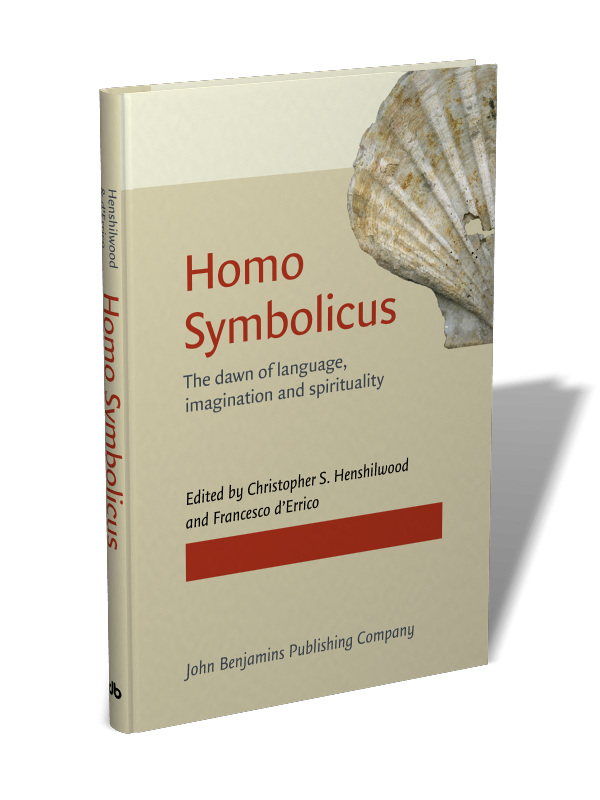
Homo Symbolicus
The dawn of language, imagination and spirituality
Editors

The emergence of symbolic culture, classically identified with the European cave paintings of the Ice Age, is now seen, in the light of recent groundbreaking discoveries, as a complex nonlinear process taking root in a remote past and in different regions of the planet. In this book the archaeologists responsible for some of these new discoveries, flanked by ethologists interested in primate cognition and cultural transmission, evolutionary psychologists modelling the emergence of metarepresentations, as well as biologists, philosophers, neuro-scientists and an astronomer combine their research findings. Their results call into question our very conception of human nature and animal behaviour, and they create epistemological bridges between disciplines that build the foundations for a novel vision of our lineage's cultural trajectory and the processes that have led to the emergence of human societies as we know them.
[Not in series, 168] 2011. xi, 237 pp.
Publishing status: Available
© John Benjamins Publishing Company




Table of Contents
-
Editors’ introduction | pp. vii–x
-
Acknowledgements | pp. xi–xii
-
Chapter 1. Pan symbolicus: A cultural primatologist’s viewpointWilliam C. McGrew | pp. 1–12
-
Chapter 2. The evolution and the rise of human language: Carry the babyE. Sue Savage-Rumbaugh and William M. Fields | pp. 13–48
-
Chapter 3. The origin of symbolically mediated behaviour: From antagonistic scenarios to a unified research strategyFrancesco d'Errico and Christopher S. Henshilwood | pp. 49–74
-
Chapter 4. Middle Stone Age engravings and their significance to the debate on the emergence of symbolic material cultureChristopher S. Henshilwood and Francesco d'Errico | pp. 75–96
-
Chapter 5. Complex cognition required for compound adhesive manufacture in the Middle Stone Age implies symbolic capacityLyn Wadley | pp. 97–110
-
Chapter 6. The emergence of language, art and symbolic thinking: A Neandertal test of competing hypothesesJoão Zilhão | pp. 111–132
-
Chapter 7. The human major transition in relation to symbolic behaviour, including language, imagination, and spiritualityDavid Sloan Wilson | pp. 133–140
-
Chapter 8. The living as symbols, the dead as symbols: problematising the scale and pace of hominin symbolic evolutionPaul Pettitt | pp. 141–162
-
Chapter 9. Biology and mechanisms related to the dawn of languageGeorge F.R. Ellis | pp. 163–184
-
Chapter 10. The other middle-range theories: Mapping behaviour and the evolution of the mindBenoît Dubreuil | pp. 185–204
-
Chapter 11. Metarepresentation, Homo religiosus, and Homo symbolicusJustin L. Barrett | pp. 205–224
-
Index | pp. 225–238
“Generally, this edited volume is a good introduction to issues about the evolution of the modern mind. [...] The editors and contributors to this volume should be congratulated for their success in introducing novel concepts and approaches to the study of what makes modern humans unique—our brains and their cognitive baggage. But they also make it clear that modern Homo sapiens may not have been as unique as some of us paleoanthropologists would prefer.”
Pamela R. Willoughby, University of Alberta, in PaleoAnthropology 2012, pag. 231-232.
“The volume as a whole offers a useful interdisciplinary source for students of human evolution, reflecting well the current state of knowledge. It is written in an authoritative but accessible manner, is well edited and features excellent figures. I agree with the editors' assertion that progress critically depends on archaeological evidence brought into play in concert with palaeoenvironmental science.”
Huw S. Groucutt, University of Oxford, in Antiquity 86 (2012)
“[T]he variety of perspectives in this volume is a strength. This particular combination of ideas on the evolution of human cognition is not available anywhere else, and is a useful starting point for research into this complex topic. It is a detailed account of the list of archaeological items considered to be symbolic, with the other chapters providing stimulating and thought-provoking perspectives on the early primatological roots of language and/or symbolism, its relationship to religion and complex cognition, and its philosophical and biological context.”
Sarah Wurz, University of Witwatersrand, South Africa and University of Bergen, Norway, in the South African Archaeological Bulletin 67 (196), pag. 279-284, 2012
Cited by
Cited by 31 other publications
Barnard, Alan
2019. Bushmen, 

Berruti, Gabriele Luigi Francesco, Dario Sigari, Cristiana Zanasi, Stefano Bertola, Allison Ceresa & Marta Arzarello
2022. A myth debunked. The Porosphaera globularis beads and their relation to the onset of symbolic thinking in prehistory. Archaeological and Anthropological Sciences 14:8
Da Silva, Amós Coêlho
2023. Os jogos como um ‘agón’. Cuadernos de Educación y Desarrollo 15:11 ► pp. 13046 ff.
Dubey, K.M., A.K. Chaubey, A.S. Gaur & M.V. Joglekar
2023. Evolution of Ramasetu region as a link between India and Sri Lanka during the late Pleistocene and Holocene. Quaternary Research 111 ► pp. 166 ff.
Dubreuil, Benoît & Christopher Stuart Henshilwood
2013. Archeology and the language-ready brain. Language and Cognition 5:2-3 ► pp. 251 ff.
Froese, Tom, Alexander Woodward & Takashi Ikegami
2013. Turing instabilities in biology, culture, and consciousness? On the enactive origins of symbolic material culture. Adaptive Behavior 21:3 ► pp. 199 ff.
Gellel, Adrian-Mario
2018. Towards a symbol literacy approach in the education of children. International Journal of Children's Spirituality 23:2 ► pp. 109 ff.
Hodgson, Derek & Paul Pettitt
2018. The Origins of Iconic Depictions: A Falsifiable Model Derived from the Visual Science of Palaeolithic Cave Art and World Rock Art. Cambridge Archaeological Journal 28:4 ► pp. 591 ff.
Hoffmann, D. L., C. D. Standish, M. García-Diez, P. B. Pettitt, J. A. Milton, J. Zilhão, J. J. Alcolea-González, P. Cantalejo-Duarte, H. Collado, R. de Balbín, M. Lorblanchet, J. Ramos-Muñoz, G.-Ch. Weniger & A. W. G. Pike
2018. U-Th dating of carbonate crusts reveals Neandertal origin of Iberian cave art. Science 359:6378 ► pp. 912 ff.
Hoffmann, Dirk L., Diego E. Angelucci, Valentín Villaverde, Josefina Zapata & João Zilhão
2018. Symbolic use of marine shells and mineral pigments by Iberian Neandertals 115,000 years ago. Science Advances 4:2
Laurence J. Kirmayer, Carol M. Worthman, Shinobu Kitayama, Robert Lemelson & Constance Cummings
2020. Culture, Mind, and Brain,
Klimek, Peter, Robert Kreuzbauer & Stefan Thurner
2019. Fashion and art cycles are driven by counter-dominance signals of elite competition: quantitative evidence from music styles. Journal of The Royal Society Interface 16:151 ► pp. 20180731 ff.
Li, Zhanyang, Luc Doyon, Hui Fang, Ronan Ledevin, Alain Queffelec, Emeline Raguin, Francesco d’Errico & Karen Hardy
2020. A Paleolithic bird figurine from the Lingjing site, Henan, China. PLOS ONE 15:6 ► pp. e0233370 ff.
Malafouris, Lambros
2021. Mark Making and Human Becoming. Journal of Archaeological Method and Theory 28:1 ► pp. 95 ff.
Morelli, Ugo
2019. Eppur si crea. Conflitto estetico e creatività. EDUCAZIONE SENTIMENTALE :30 ► pp. 64 ff.
Nadal, Marcos & Anjan Chatterjee
2019. Neuroaesthetics and art's diversity and universality. WIREs Cognitive Science 10:3
Nadal, Marcos & Martin Skov
2018. The pleasure of art as a matter of fact. Proceedings of the Royal Society B: Biological Sciences 285:1875 ► pp. 20172252 ff.
Porr, Martin
2019. Rock art as art. Time and Mind 12:2 ► pp. 153 ff.
Porraz, Guillaume, John E. Parkington, Patrick Schmidt, Gérald Bereiziat, Jean-Philippe Brugal, Laure Dayet, Marina Igreja, Christopher E. Miller, Viola C. Schmid, Chantal Tribolo, Aurore Val, Christine Verna & Pierre-Jean Texier
2021. Experimentation preceding innovation in a MIS5 Pre-Still Bay layer from Diepkloof Rock Shelter (South Africa): emerging technologies and symbols. Peer Community Journal 1
Salagnon, Mathilde, Sandrine Cremona, Marc Joliot, Francesco d’Errico, Emmanuel Mellet & Enza Elena Spinapolice
2022. Neural correlates of perceiving and interpreting engraved prehistoric patterns as human production: Effect of archaeological expertise. PLOS ONE 17:8 ► pp. e0271732 ff.
Schulze, Wolfgang
2020. Explorationen zur Genre-Grammatik von Volksnarrationen. Zeitschrift für germanistische Linguistik 48:3 ► pp. 590 ff.
Sterelny, Kim
2014. A Paleolithic Reciprocation Crisis: Symbols, Signals, and Norms. Biological Theory 9:1 ► pp. 65 ff.
Sterelny, Kim
2016. Cooperation, Culture, and Conflict. The British Journal for the Philosophy of Science 67:1 ► pp. 31 ff.
Stout, Dietrich
2020. Culture, Mind, and Brain in Human Evolution. In Culture, Mind, and Brain, ► pp. 55 ff.
Swedberg, Richard
2017. Theorizing in Sociological Research: A New Perspective, a New Departure?. Annual Review of Sociology 43:1 ► pp. 189 ff.
Talamo, Sahra, Wioletta Nowaczewska, Andrea Picin, Antonino Vazzana, Marcin Binkowski, Marjolein D. Bosch, Silvia Cercatillo, Marcin Diakowski, Helen Fewlass, Adrian Marciszak, Dragana Paleček, Michael P. Richards, Christina M. Ryder, Virginie Sinet-Mathiot, Geoff M. Smith, Paweł Socha, Matt Sponheimer, Krzysztof Stefaniak, Frido Welker, Hanna Winter, Andrzej Wiśniewski, Marcin Żarski, Stefano Benazzi, Adam Nadachowski & Jean-Jacques Hublin
2021. A 41,500 year-old decorated ivory pendant from Stajnia Cave (Poland). Scientific Reports 11:1
Tejero, José-Miguel, Guy Bar-Oz, Ofer Bar-Yosef, Tengiz Meshveliani, Nino Jakeli, Zinovi Matskevich, Ron Pinhasi, Anna Belfer-Cohen & Marco Peresani
2021. New insights into the Upper Palaeolithic of the Caucasus through the study of personal ornaments. Teeth and bones pendants from Satsurblia and Dzudzuana caves (Imereti, Georgia). PLOS ONE 16:11 ► pp. e0258974 ff.
Tejero, José-Miguel, Anna Belfer-Cohen, Ofer Bar-Yosef, Vitaly Gutkin & Rivka Rabinovich
2018. Symbolic emblems of the Levantine Aurignacians as a regional entity identifier (Hayonim Cave, Lower Galilee, Israel). Proceedings of the National Academy of Sciences 115:20 ► pp. 5145 ff.
Texier, Pierre-Jean, Guillaume Porraz, John Parkington, Jean-Philippe Rigaud, Cedric Poggenpoel & Chantal Tribolo
2013. The context, form and significance of the MSA engraved ostrich eggshell collection from Diepkloof Rock Shelter, Western Cape, South Africa. Journal of Archaeological Science 40:9 ► pp. 3412 ff.
Tiège, Alexis De, Jan Verpooten & Johan Braeckman
2021. From Animal Signals to Art: Manipulative Animal Signaling and the Evolutionary Foundations of Aesthetic Behavior and Art Production. The Quarterly Review of Biology 96:1 ► pp. 1 ff.
[no author supplied]
2020. The Co-emergence of Culture, Mind, and Brain. In Culture, Mind, and Brain, ► pp. 53 ff.
This list is based on CrossRef data as of 19 april 2024. Please note that it may not be complete. Sources presented here have been supplied by the respective publishers. Any errors therein should be reported to them.
Subjects
Sociology
Main BIC Subject
JHM: Anthropology
Main BISAC Subject
SOC002010: SOCIAL SCIENCE / Anthropology / Cultural & Social