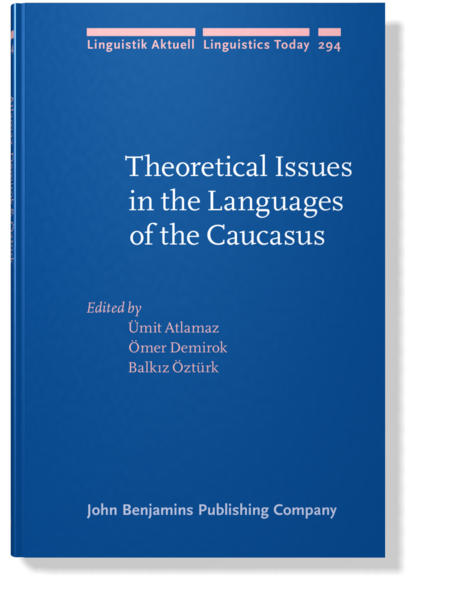
In:Theoretical Issues in the Languages of the Caucasus
Edited by Ümit Atlamaz, Ömer Demirok and Balkız Öztürk
[Linguistik Aktuell/Linguistics Today 294] 2026
► pp. v–vi
This content is being prepared for publication; it may be subject to changes.
Table of contents
Introduction
Ümit Atlamaz
Ömer Demirok
Balkız Öztürk
Part 1.Verbal domain
Case and argument structureChapter 1.The diverse argument structures of Georgian subject-experiencer predicates
Léa Nash
Martha McGinnis
Chapter 2.Där c’ik’iw teqa retiχ ‘I want to understand everything’: Tsez verbs of perception and cognition
Masha Polinsky
Chapter 3.Revisiting case in Laz
Ümit Atlamaz
Muhammet Bal
Ömer Demirok
Chapter 4.Preference for transparency and locality in Heritage Laz
Ömer Eren
Part 2.Inflectional domain
Chapter 5.On development of the negative phrase in Ossetic
David Erschler
Chapter 6.Evidentiality in Karachay-Balkar: Implications for the phrase structure
Aslı Gürer
Chapter 7.Participles, auxiliaries and the insertion approaches to verbal periphrasis
Pavel Rudnev
Chapter 8.Hyperagreement in Alashkert Armenian
Mariam Asatryan
Part 3.Clausal architecture and beyond
Chapter 9.Within language variation in V-final projections: Objects and goals in Tush (Tsova-Tush, Batsbi)
Diana Kakashvili
Stavros Skopeteas
Chapter 10.The Georgian predicate cleft: A prolegomenon
Daniel Harbour
Tamar Kalkhitashvili
Chapter 11.West Circassian lessons on phase theory
Ksenia Ershova
Chapter 12.West Circassian scalar ‘only’ in a typology
of focus marking
of focus marking
Yury Lander
Irina Bagirokova
Anna Lander
