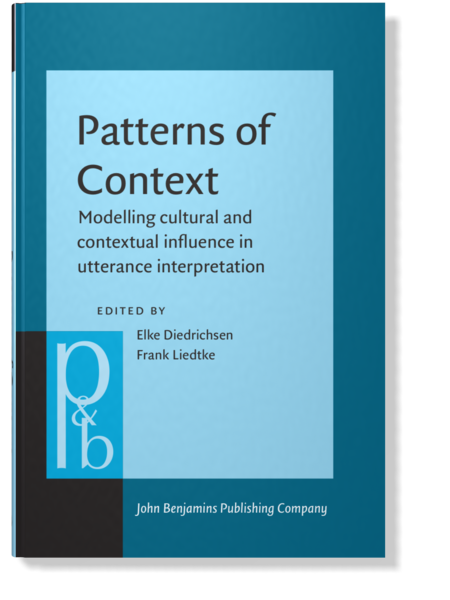
In:Patterns of Context: Modelling cultural and contextual influence in utterance interpretation
Edited by Elke Diedrichsen and Frank Liedtke
[Pragmatics & Beyond New Series 356] 2026
► pp. 1–17
Introduction
This content is being prepared for publication; it may be subject to changes.
Article outline
- 1.The contextualist programme
- 2.What is said and what is inferred from it
- 3.Interactional linguistics and contextualisation
- 4.Common ground
- 5.Standardised communicative situations
- 6.Frames and scripts
- 7.Activity types and text types
- 8.Online communication
- 9.About this book
- 10.The organisation of the volume
- Part I: Context, interaction, and emergence
- Part II: Schemas, templates, and models
- Part III: Inference and enrichment
- Part IV: Multimodality and viewpoint
- 11.The significance of this volume: Introducing new aspects of context
- Author queries
Notes References

References (63)
Arundale, Robert B. 2008. “Against (Gricean)
Intentions at the Heart of Human Interaction.” Intercultural
Pragmatics 5 (2): 229–258.
Austin, David John Joseph. 2015. Lying: A Gricean
Account. Master’s Thesis, University of Hertfordshire.
Austin, John L. [1962]1976. How to do Things with
Words, ed. by James O. Urmson and Marina Sbisà. Oxford: Oxford University Press.
boyd, danah. 2011. “Social
Network Sites as Networked Publics: Affordances, Dynamics, and
Implications.” In A Networked Self. Identity, Community, and
Culture on Social Network Sites, ed. by Zizi A. Papacharissi, 39–58. New York and London: Routledge.
Briggs, Charles L., and Richard Bauman. 1992. “Genre,
Intertextuality, and Social Power.” In Journal of Linguistic
Anthropology, 2(2): 131–172.
Bucher, Hans-Jürgen. 2020. “Zwischen
Deliberation und Emotionalisierung: Interaktionsstrukturen in sozialen
Medien.” In Deutsch in sozialen Medien: interaktiv —
multimodal — vielfältig, ed. by Konstanze Marx, Henning Lobin, and Axel Schmidt, 123–145. Berlin/Boston: De Gruyter (Jahrbuch des Instituts für Deutsche Sprache, 2019).
. 2024. “Handeln
unter den Bedingungen digitaler Kommunikation: Ein integrierter aneignungstheoretischer
Ansatz.” In Handbuch Sprache und digitale
Kommunikation, ed. by Jannis Androutsopoulos, and Friedemann Vogel, 9–29. Berlin, Boston: De Gruyter.
Bücker, Jörg. 2018. “Gesprächsforschung
und Interaktionale Linguistik.” In Handbuch
Pragmatik, ed. by Frank Liedtke and Astrid Tuchen, 41–52. Stuttgart: Metzler.
Bühler, Karl [1934]
2011. Theory of Language. The Representational Function of
Language. Amsterdam: Benjamins.
Chilton, Paul. 2024. Brexitspeak.
Demagoguery and the Decline of
Democracy. Cambridge: Cambridge University Press.
Clark, Herbert H. 2010a. “Context and Common
Ground.” In Concise Encyclopedia of Philosophy of Language
and Linguistics, ed. by Alex Barter and Robert Stainton, 85–87. Amsterdam: Elsevier.
Faulkner, Paul. 2013. “Lying
and Deceit.” In International Encyclopedia of
Ethics, ed. by Hugh LaFollette, 3101–3109. Hoboken, New Jersey: Wiley-Blackwell.
Fetzer, Anita. 2004. Recontextualizing
Context: Grammaticality Meets
Appropriateness. Amsterdam: John Benjamins.
. 2021. “Computer-Mediated
Discourse in Context. Pluralism of Communicative Action and Discourse Common
Ground.” In Approaches to Internet Pragmatics. Theory and
Practice, ed. by Chaoqun Xie, Francisco Yus, and Hartmut Haberland, 47–74. Amsterdam, Philadelphia: Benjamins.
. 2023. “Context:
Theoretical Analysis and its Implications for Political Discourse
Analysis” In Handbook of Political
Discourse, ed. by Piotr Cap, 164–179. Cheltenham: Edward Elgar Publishing Limited.
. This
volume. “Conversational Contributions in Discourse: Contextualisation, Entextualisation
and Recontextualisation.”
Fillmore, Charles J. 1982. “Frame
Semantics.” In Linguistics in the Morning
Calm, ed. by the Linguistic Society of
Korea, 111–137. Seoul: Hanshin Publishing Company.
Goddard, Cliff, and Anna Wierzbicka 2004. “Cultural
Scripts: What are They and What are They Good for?” Intercultural
Pragmatics 1–2, 153–166.
Goffman, Irving. 1974. Frame
Analysis. An Essay on the Organization of Experience. New York: Harper and Row.
Grice, Paul [1975]
1991. “Logic and
Conversation.” In H. Paul Grice. Studies in the Way of
Words, 22–40. Cambridge MA.: Harvard University Press
Günthner, Susanne, und Hubert Knoblauch. 2000. “Textlinguistik
und Sozialwissenschaften.” In Text- und Gesprächslinguistik.
Ein internationales Handbuch zeitgenössischer Forschung, ed. by Klaus Brinker, Gerd Antos, Wolfgang Heinemann, Sven F. Sager, 811–819. Berlin/New York: De Gruyter.
1996. “The Linguistic and
Cultural Relativity of Inference.” In Rethinking Linguistic
Relativity, ed. by John J. Gumperz and Stephen C. Levinson, 374–406. Cambridge: Cambridge University Press.
2003. “Response
Essay.” In Language and Interaction, Discussions with John J.
Gumperz, ed. by Susan Eerdmans, Carlo L. Prevignano, and Paul Thibault, 105–126. Amsterdam: John Benjamins.
Heinemann, Wolfgang. 2000. “Textsorten.
Zur Diskussion um Basisklassen des Kommunizierens. Rückschau und
Ausblick.” In Textsorten: Reflexionen und
Analysen, ed. by Kirsten Adamzik, 9–29. Tübingen: Stauffenburg.
Horn, Laurence. 1984. „Towards
a New Taxonomy for Pragmatic Inference: Q-based and R-based
Implicatures.” In Meaning, Form, and Use in
Context, ed. by Deborah Schiffrin, 11–42. Washington: Georgetown University Press.
Kelsey, Darren. 2015. Media,
Myth and Terrorism: A Discourse-Mythological Analysis of the ‘Blitz spirit’ in British Newspaper Responses to the July
7th Bombings. Basingstoke: Palgrave Macmillan.
Kesckes, Istvan. 2000. “A
Cognitive-Pragmatic Approach to Situation- Bound utterances.” Journal of
Pragmatics 32, 605–625.
. 2022. “The
Theoretical Framework of Intercultural Pragmatics.” In The
Cambridge Handbook of Intercultural Pragmatics, ed. by Istvan Kecskes, 83–104. Cambridge: Cambridge University Press.
Kecskes, Istvan, and Fenghui Zhang. 2009. “Activating,
Seeking and Creating Common Ground: A Socio-Cognitive Approach.” Pragmatics and
Cognition 17(2), 331–355.
2006. “On the Human
‘Interaction Engine’.” In Roots of Human Sociality. Culture,
Cognition, and Human Interaction, ed. by Stephen C. Levinson, and Nick Enfield, 39–69. Oxford/New York: Berg.
Locher, Miriam A., and Brook Bolander. 2017. “Face
Work and Identity.” In Pragmatics of Social
Media, ed. by Christian R. Hoffmann, and Wolfram Bublitz, 407–434. Berlin, Boston: De Gruyter.
Maci, Stefania M., Massimiliano Demata, Mark McGlashan, and Philip Seargeant. 2024. The
Routledge Handbook of Discourse and Disinformation. London and New York: Routledge.
Marwick, Alice, and danah boyd. 2011. “I
Tweet Honestly, I Tweet Passionately: Twitter Users, Context Collapse, and the Imagined
Audience.” New Media
Society 13, 96–113.
Merten, Marie-Luis. 2022. “Ritualisierte
Anschlusskommunikation auf Instagram. Formelhafte Komplimente und ihre Erwiderung als verdichtete
Online-Interaktion.” Deutsche
Sprache 50.4: 309–334.
Norris, Pippa, and Ronald Inglehart. 2019. Cultural
Backlash: Trump, Brexit, and Authoritarian
Populism. Cambridge: Cambridge University Press.
Perry, John. 1998. “Indexicals,
Contexts, and Unarticulated Constituents.” In Computing
Natural Language, ed. by Atocha Aliseda, Rob J. van Glabbeek, and Dag Westerståhl, 1–11. Stanford: CSLI Publications.
Pike, Kenneth. 1971. Language
in Relation to a Unified Theory of the Structure of Human Behavior. The Hague and Paris: Mouton.
Schank, Roger C. and Robert P. Abelson. 1975. “Scripts,
Plans, and Knowledge.” In Advance Papers of the 4th
International Joint Conference on Artificial Intelligence,
Vol.1, 151–157. Tbilisi/Georgia. The University of California: Artificial Intelligence Laboratory.
Schütz, Alfred. 1973. Collected
Papers 1: the Problem of Social Reality, ed. by Maurice Natanson. The Hague: Nijhoff.
Searle, John R. 1969. Speech Acts. An Essay in the
Philosophy of Language. Cambridge: Cambridge University Press.
1979. “Literal
Meaning.” In John R. Searle. Expression and Meaning.
Studies in the Theory of Speech
Acts, 117–136. Cambridge: Cambridge University Press.
Sharifian, Farzad. 2017. Cultural
Linguistics: Cultural Conceptualisations and
Language. Amsterdam: John Benjamins.
Sperber, Dan and Deirdre Wilson. 22004
[1986]. Relevance. Cognition and
Communication. Oxford: Blackwell.
Stein, Stephan and Sören Stumpf. 2019. Muster
in Sprache und Kommunikation. Berlin: Erich Schmidt Verlag.
Taylor, Charlotte. 2024. “Disinformation
and Immigration Discourses.” In The Routledge Handbook of
Discourse and Disinformation, ed. by Stefania M. Maci, Massimiliano Demata, Mark McGlashan, and Philip Seargeant, 171–186. London and New York: Routledge.
Thibault, Paul J. 2004. Agency and Consciousness in
Discourse: Self-Other Dynamics as a Complex System. London/New York: Continuum.
Urban, Greg, and Michael Silverstein. 1996. „The
Natural History of Discourse.” In Natural Histories of
Discourse, ed. by Greg Urban and Michael Silverstein, 1–20.
Xie, Chaoqun and Francisco Yus. 2018. “Introducing
Internet Pragmatics.” Internet
pragmatics 1:1 (2018), 1–12.